Starship Flight 7: Booster caught, 2nd stage fails, what happens next
Failure of redesigned, upgraded Starship highlights challenges of space exploration
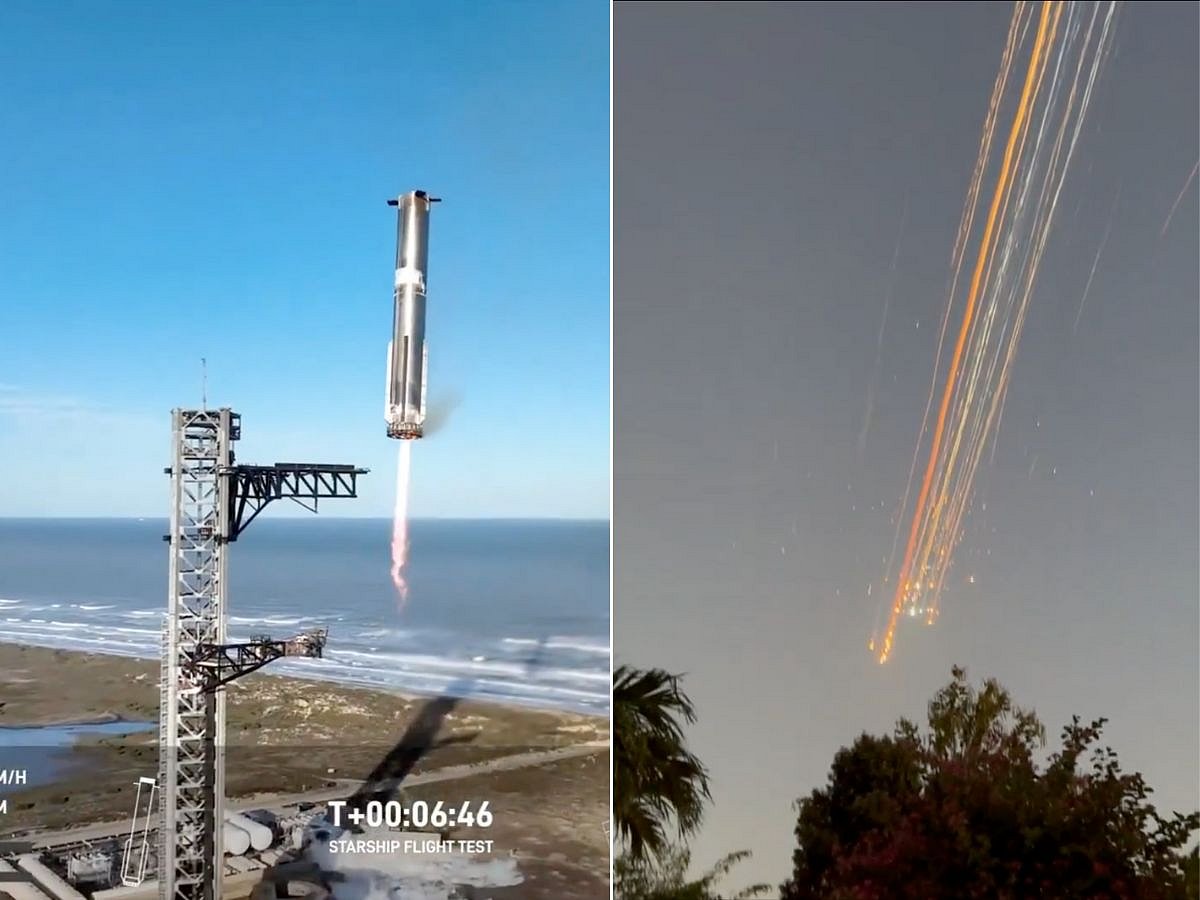
SpaceX’s Starship Flight 7 half-completed its landmark mission with a rocket booster catch, the second time it has done the significant feat, but the second stage exploded, forcing flight diversions.
Second megarocket catch
The company marked a major leap for Starship with Flight 7, with the second catch by its giant mechazilla "chopsticks", snapping the world’s biggest rocket as it returned to earth.
The uncrewed spacecraft launched at 4:37 pm CT on Thursday (January 16) from SpaceX’s Starbase facility in Boca Chica, Texas, and achieved full orbital velocity before executing a planned controlled re-entry and splashdown in the Pacific Ocean.
Second stage fails, burns up
Flight 7, using a redesigned and upgraded Starship, follows rigorous testing and adjustments after earlier flight demonstrations.
However, after the Starship (second stage) separated, it failed and broke apart. This marks a stark contrast to the initial success of the "Super Heavy" booster's ascent.
The mission was aimed at testing key systems, including the spacecraft’s heat shield, Raptor engine performance, and orbital refueling capabilities, critical for long-duration missions to Mars and beyond.
Posts on X have captured the moment, with users expressing both disappointment and optimism for SpaceX's future endeavours.
As the spacecraft’s debris made a fiery reentry, SpaceX CEO Elon Musk, marked the event, tweeting: “Success is uncertain, but entertainment is guaranteed!”
Space X statement:
“The first Starship flight test of 2025 flew with ambitious goals: seeking to repeat our previous success of launching and catching the world’s most powerful launch vehicle, while putting a redesigned and upgraded Starship through a rigorous set of flight demonstrations. It served as a reminder that development testing by definition is unpredictable.”
Challenges
Flight 7 was anticipated to test new capabilities, including the deployment of payload simulators and the reuse of a Raptor engine from a previous mission.
The failure highlights the inherent risks and challenges of space exploration, particularly with such an ambitious project.
The company will likely review the flight data to pinpoint what went wrong, aiming for a successful outcome in future tests.
What to expect:
The megarocket is the world's biggest and most powerful rocket, designed to launch the moon lander for Nasa's Artemis 3 (manned Moon mission) by 2027.
The setback, though significant, is expected to drive Space X to rapidly iterate and ramp up the cadence of tests.
Based on the latest test flight data, its engineers are expected to fine-tune the structural integrity and heat shield.
Space industry watchers say there may be roughly 5 more test flights designated to integrity and heat shield testing.
A key target is orbital refuelling: tests for this space manoeuvre may begin late 2025, in line with Musk's statements that Starship's Version 3 (V3) would carry out orbital refuelling tests by late this year.
In 2026, if all goes right, Starship could be ready to hit Mars.
Sign up for the Daily Briefing
Get the latest news and updates straight to your inbox
Network Links
GN StoreDownload our app
© Al Nisr Publishing LLC 2026. All rights reserved.