Samsung’s new Hearapy app: Can 60 seconds of sound stop car sickness? Here’s how it works
The core of the Hearapy experience involves listening to a specific low-frequency tone
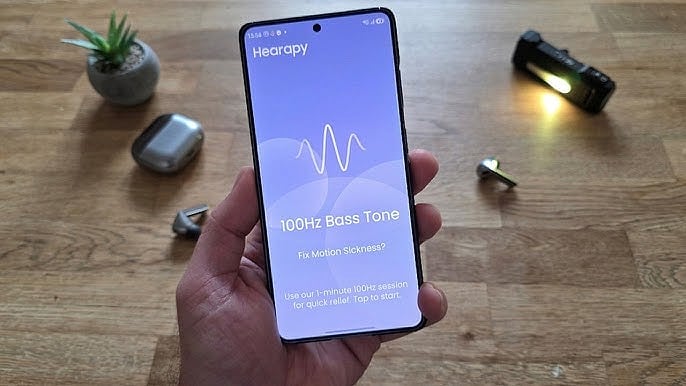
If road trips for you mean nausea before the playlist even hits its second song, you’re not alone, and you might finally have a fix.
Samsung has just launched Hearapy, a new app designed to ease motion sickness whether you’re heading out on a weekend getaway or stuck in a daily commute. Unlike solutions like Google Motion Cues, which rely on visual signals on your screen, Hearapy works without needing you to look at anything, making it a far more practical, eyes-free option when you’re on the move.
Built especially for those who start feeling queasy almost as soon as the car starts rolling, it could be instructive for anyone who’s ever dreaded long drives more than they enjoyed the destination.
The science of vestibular stimulation
The app’s technology is rooted in clinical research conducted by scientists at Nagoya University in Japan. Their studies focused on how various audio frequencies interact with the vestibular system, the complex part of the inner ear responsible for maintaining balance. By testing different sounds, researchers discovered that specific acoustic frequencies can actually help the brain better synchronise with the physical sensations of motion.
Frequencies that combat nausea
The core of the Hearapy experience involves listening to a specific 100Hz low-frequency bass tone. When played at a volume between 75 and 85 dB, this tone helps the brain process movement more effectively, leading to lower stress levels and a significant reduction in nausea. According to Samsung, the relief is remarkably efficient; listening to the tone for just one minute can provide comfort for a road trip lasting up to two hours. The app also includes a dedicated timer to help users monitor these short sessions.
One of the biggest draws of Hearapy is that it fits well into your journey. The app skips both medication and screen time, offering a non-invasive way to manage motion sickness without side effects or the need to keep your eyes glued to a device. Compared to visual-based tools like Google Motion Cues, it’s a far more seamless, set-it-and-forget-it experience.
That said, there’s a small catch: Volume matters. For the app to do its job, it needs to be set at just the right level, around 85 dB, strong enough to gently stimulate the inner ear, but still within safe listening limits. Get that balance right, and it quietly works in the background, turning even the bumpiest rides into something far more manageable.
Works best if you’re already in the Samsung ecosystem
For now, Hearapy is tailored with Android users in mind, and it truly shines when paired with Samsung Galaxy Buds 4 Pro. Built by Samsung, the app taps into the earbuds’ high-fidelity sound to deliver the precise low-frequency tones needed to ease motion sickness, making the experience feel seamless and finely tuned.
The catch: It’s still a bit exclusive. Samsung hasn’t confirmed whether Hearapy will play just as nicely with other wireless earbuds, so if you’re outside its ecosystem, you may have to wait and see how broadly it rolls out.
Network Links
GN StoreDownload our app
© Al Nisr Publishing LLC 2026. All rights reserved.