People using a GCash kiosk in the Philippines. Digital payments surpassed the BSP target of 50% of retail transactions in 2023 (52.8% in terms of volume and 55.3% in terms of value). In 2024, e-payments jumped further to 57.4% by volume and 59% by value, as per the Bangko Sentral ng Pilipinas (BSP) data. This steady year-on-year growth reinforces the momentum of digital payments via interoperable payment "rails".
No ‘super app’, no ‘Big Bang’: Philippines quietly hits digital payments milestone
No flashy tech: Digital payments 'majority' reached via interoperable infrastructure
Last updated:
4 MIN READ
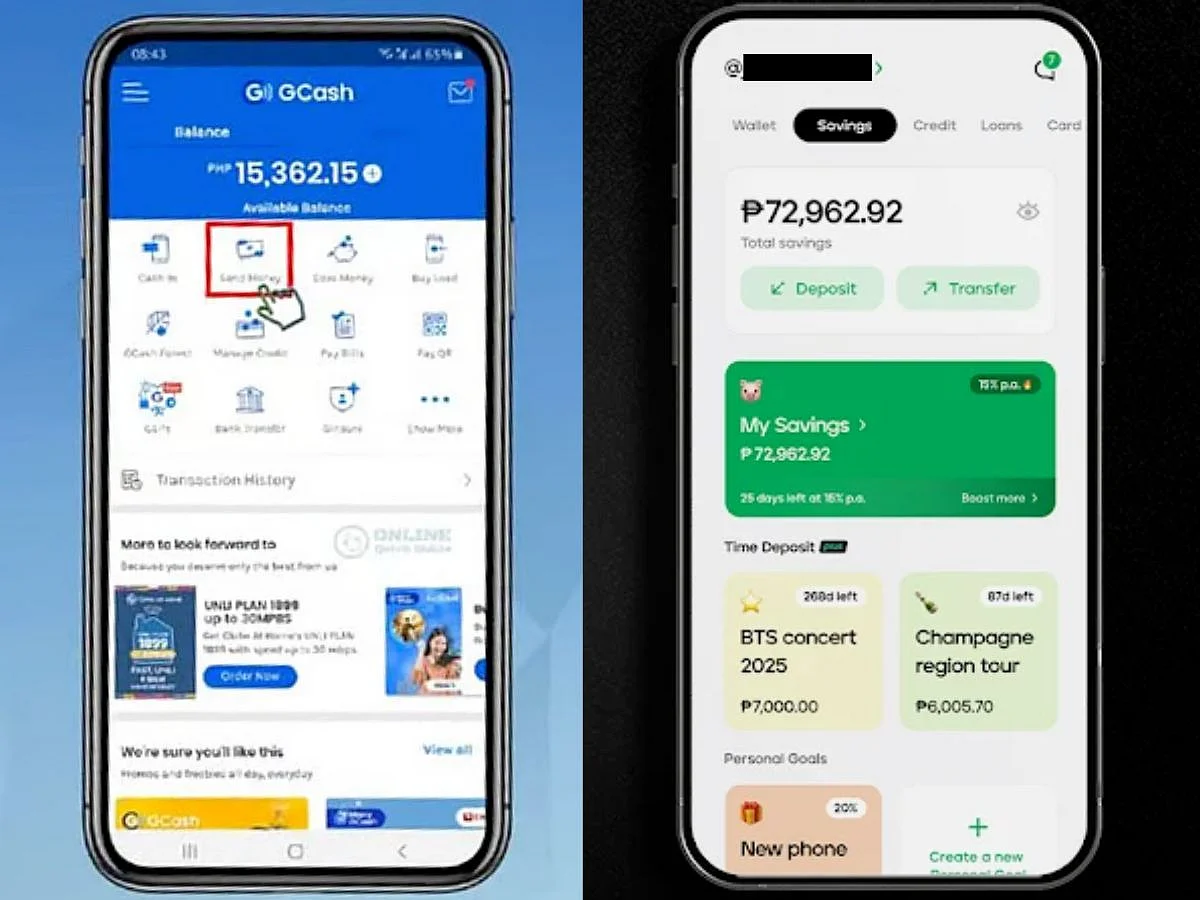
A scan of an e-wallet QR code using GCash or Maya QR is all it takes to buy food, groceries, cabs, electricity and services in the Philippines. Both e-wallets have built-in features that allow users to invest in local stocks and mutual funds directly within their apps. Photo for illustrative purposes only.
Screengrabs | GCash | Maya
Manila: While global policymakers debated central bank digital currencies and "all-in-one" super apps (or "everything app") as the path to modernising finance, the Philippines took a quieter route.
It built shared, interoperable payment “rails” and let private competitors innovate on top.
The result: Digital payments surpassed 50% of retail transaction volume in 2023, as per official government data.
It continues to climb, en route to hit up to 70% by 2028, Bangko Sentral ng Pilipinas (central bank) projects.
The secret behind the Philippines' digital payments surge — it’s not an app
The country's shift to majority digital payments was powered by shared payment infrastructure (or “rail”) linking banks and e-wallets, proving that connectivity — not a single dominant platform — can drive mass adoption.
The Philippines, an archipelago nation of 7,641 islands with a large "unbanked" population and significant overseas worker remittances, long relied heavily on cash.
In 2013, digital payments made up just about 1% of total volume.
Progress accelerated under the BSP's National Retail Payment System (NRPS), launched to promote “inclusion” and efficiency.
Core components include:
InstaPay: Real-time, low-value account-to-account transfers.
PESONet: Batch payments for larger transactions.
QR Ph: A national QR code standard enabling any wallet or bank app to pay at merchants.
These public rails emphasise "interoperability".
Digital payments volume and value have surpassed the 50% target of the Bangko Sentral ng Pilipinas.
How it works is quite simple: For example, a GCash user can pay a Maya merchant or transfer to a bank account seamlessly.
Private digital wallets like GCash (Mynt) and Maya compete vigorously on user experience while settling over the same infrastructure.
GCash has grown to tens of millions of users and eyed major valuation/IPO milestones (now valued at an estimated $8 billion).
Maya hit profitability. Maya boasts of an “end-to-end financial ecosystem” with a widely used e-wallet, an extensive digital remittance network through Smart Padala, and the largest non-bank merchant payments processing business.
The BSP approved on September 1, 2021 the digital banking licence of PayMaya, the financial arm of PLDT’s digital unit Voyager Innovations. The company said they will focus on the "unbanked and underserved” population of consumers and micro, small, and medium-sized enterprises (MSMEs). The BSP eyes up to 70% of transactions will be done via digital currency by 2028.
This model contrasts with allowing a dominant super app, or a marginal central bank digital currency — or multilateral wholesale CBDC experiments like that have seen limited volume.
The BSP, instead, has explicitly ruled out a retail digital peso, citing “limited added benefit” and potential risks, focusing instead on wholesale explorations like “Project Agila”.
Project Agila is the BSP's programme designed to pilot and test a wholesale Central Bank Digital Currency (wCBDC). Unlike a standard digital wallet for consumers, the wCBDC is a digital peso specifically meant to be used by commercial banks and financial institutions. Project Agila aims to modernise the country's financial infrastructure and offer 24/7 availability, risk reduction (lowering settlement risks and improving overall liquidity management among participating banks), and efficiency (via distributed ledger technology (DLT) driving high-value, large-scale interbank transactions)
The approach aligns with financial inclusion goals: Pairing payment digitisation with targets for transaction accounts.
Government payments (G2X) also lead in digital adoption.
How did the Philippines reach majority digital payments?
By prioritising “unglamorous” public infrastructure — real-time rails (InstaPay), batch systems (PESONet) and a unified QR standard (QR Ph) — that ensures interoperability.
Private wallets compete on top without owning closed ecosystems. InstaPay saw explosive growth in transactions.
What role did super apps or Central Bank Digital Currency (CBDC) play?
None for retail dominance. The country avoided anointing a single super app (“everything app”) – or issuing a retail central bank digital currency.
Now, competition between GCash and Maya flourished on shared rails.
A view of the Bangko Sentral ng Pilipinas (BSP), the country's central monetary authority.
What were the results?
The pandemic (2020 to 2022) helped. Then digital cash share hit 52.8% of transaction volume in 2023 and 57.4% in 2024.
Transaction volumes on the rails surged — InstaPay and PESONet together handled trillions of pesos.
BSP exceeded its 50% target early. Now the Philippine central bank eyes 60-70% by 2028.
Why does this matter for other countries?
It demonstrates a lower-cost, less centralising path to digitisation that delivers real volume in everyday person-to-person and merchant payments, according to Forbes.
Experts highlight it as a practical model for emerging markets prioritizing inclusion over novel forms of money.
A Philippine retail store offering digital transactions using GCash.
What challenges remain?
Cash persists in some segments, and full targets for 2028 may require sustained effort.
Financial inclusion continues improving, with gains among women and youth.
But gaps remain.
For example, a huge part of the country is served by 121 electric cooperatives that distribute power marked by aging infrastructure, underinvestment, and under-regulation, leading to constant power outages, especially in the provinces.
Digital payments work best with reliable power.
Still, Philippine model offers a blueprint centered on open infrastructure and competition rather than top-down technological mandates.
Sign up for the Daily Briefing
Get the latest news and updates straight to your inbox
Network Links
GN StoreAbout Gulf NewsTerms & ConditionsReach by GNSitemapContact usPrivacy PolicyGN FocusHave your sayWork with usAdvertise with usGulf News epaperPrinting Services
Download our app
© Al Nisr Publishing LLC 2026. All rights reserved.