Many electric trucks in China are now driverless. Autonomous trucks are particularlly useful in mines and at closed factory sites. China sold "231,000" new energy heavy vehicles in 2025 - an increase of 182%, according to one report. This development is driven by government mandates and by the new battery swapping technology. It takes five minutes to swap batteries. Electric trucks are also substantially cheaper to run than diesel trucks.
Mining beast unlocked: China’s massive 248-tonne truck ‘crabwalks’ through extreme terrain
Driverless K7 mining giant uses sideways ‘crab-walk’ to tackle narrow, risky pits
Last updated:
2 MIN READ
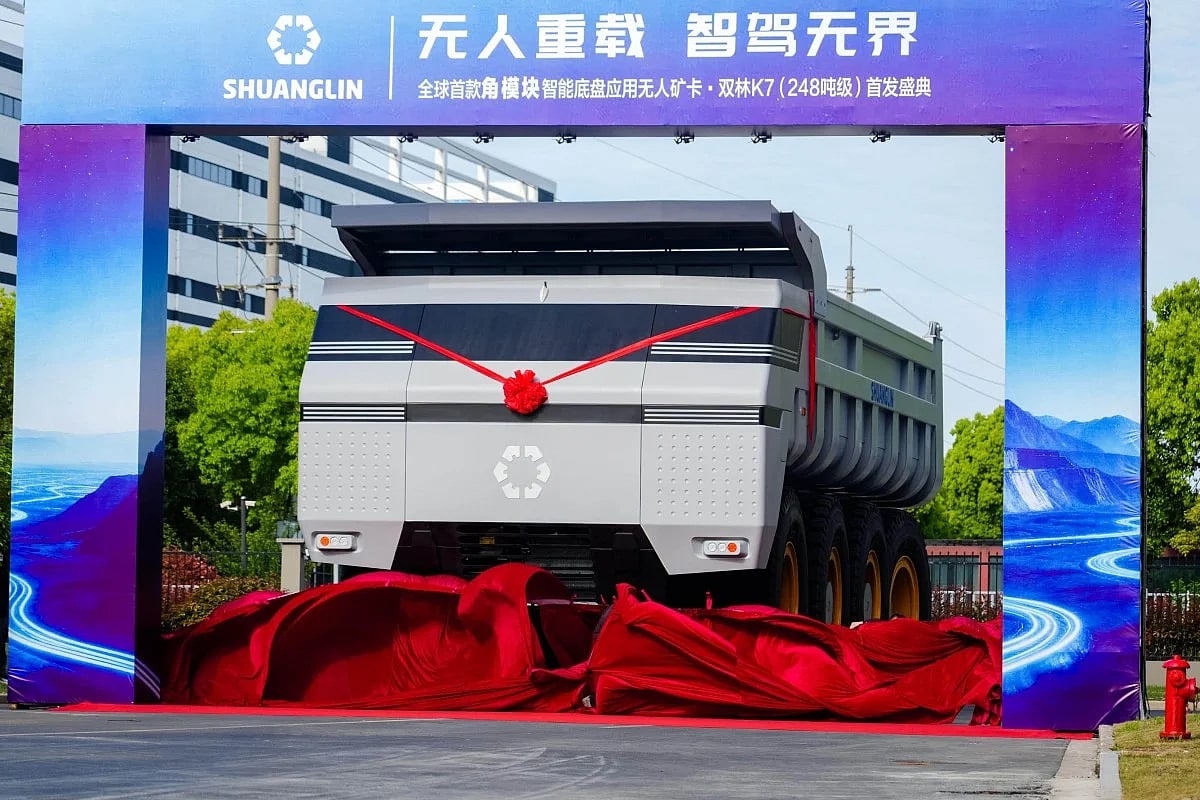
The Shuanglin K7, is a 250-tonne driverless mining truck capable of "crab-walking" across rugged landscapes. It is dubbed as the world's first mining vehicle to utilise distributed electric drive steer-by-wire corner module technology. Its ability to perform lateral translation and pivot on rough terrain.
Science and Technology Daily
China’s industrial frontier took a dramatic leap forward this week with the official unveiling of the Shuanglin K7 — a colossal, driverless electric-powered mining truck that blurs the line between mechanical brute force and robotic finesse.
At nearly 250 tonnes and capable of carrying 158 tonnes per load, the K7 isn’t just another heavy hauler; it’s a behemoth built to defy the most treacherous excavation sites.
Onlookers were left astounded as the vehicle demonstrated its ability to “crab-walk” sideways across rugged terrain and turn on a dime — moves once considered impossible for rigs of this scale — thanks to its cutting-edge distributed electric drive, steer-by-wire corner module system.
The result of a deep collaboration between Shanghai’s Shuanglin Group and researchers at Tsinghua University, the K7 marries immense payload capability with a level of agility and automation that marks the next leap in mining technology.
By dispensing with traditional mechanical steering and embracing an all-electric, wire-controlled corner drive setup, the truck can pivot, shift laterally, and navigate confined pits where conventional trucks would struggle.
Dubbed as an "engineering marvel", it isn’t just innovative — it’s revolutionary for autonomous heavy machinery and reflects broader Chinese ambitions to electrify and automate its extractive industries.
'Crab-walking' truck
Its ability to perform lateral moves and pivot on the spot addresses a longstanding industry challenge: the time-consuming and risky manoeuvres traditional trucks face in confined, narrow pits.
Beyond its unique manoeuverability, the K7 represents a major leap in intelligent, 24/7 autonomous operations.
Its builders say this beast of a truck features a battery-swapping system that allows for continuous work with only five minutes of "downtime", and a regenerative braking system that recovers up to 85% of kinetic energy.
Projections suggest that this model could increase transport efficiency by 35% while simultaneously reducing mining accidents by 90% and cutting full-lifecycle maintenance costs by 25%.
Industry impact
The unveiling aligns with China's broader national mandate to modernise its resource extraction sectors through 5G integration, cloud-network coordination, and full-process automation, according to Science and Technology Daily.
Other industry efforts currently reshaping the field include:
5G-enabled navigation: Remote, high-altitude trials in the Kunlun Mountains have demonstrated that unmanned systems can navigate extreme environmental conditions through multi-sensor fusion and cloud-updated mapping.
Large-scale fleet deployment: Mining giants like China Huaneng Group have successfully integrated fleets of autonomous trucks at major open-pit sites, achieving significant efficiency gains over manned, diesel-powered fleets.
Safety and sustainability standards: The industry is increasingly shifting toward zero-carbon autonomous systems, replacing traditional human-operated vehicles to mitigate the "Death Zone" risks associated with steep, high-altitude mining.
Sign up for the Daily Briefing
Get the latest news and updates straight to your inbox
Network Links
GN StoreAbout Gulf NewsTerms & ConditionsReach by GNSitemapContact usPrivacy PolicyGN FocusHave your sayWork with usAdvertise with usGulf News epaperPrinting Services
Download our app
© Al Nisr Publishing LLC 2026. All rights reserved.