MEA mobile handset shipments rise 9.2% to 33.2m
Research analyst says Android operating system will definitely become the No 2 platform much before 2012, behind Nokia's Symbian
Dubai: The age of the smartphone is well and truly upon us. More than one in 10 mobile phones purchased in the Middle East and Africa during the second quarter was a smartphone.
Judging by tech trends of the past, it looks like smartphones will soon be a commodity, rather than an item whose appeal is limited to just the affluent.
Smartphone growth momentum is set to continue through the rest of the year. With the recent launch of Samsung's Galaxy S, as well as the impending launches of Apple's iPhone 4, Nokia's N8 and Sony Ericsson's X8, it cannot be any other way.
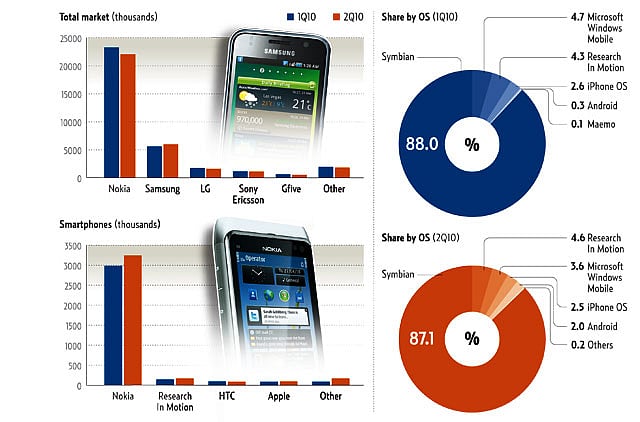
"Of the total units, smartphone sales reached 3.77 million, an increase of 16 per cent compared to 3.25 million during the same period last year," Annette Zimmermann, senior research analyst for mobile devices technology at Gartner, told Gulf News. "Mobile e-mail, rich messaging and social networking continue to drive demand."
According to Gartner, total handsets sold in the region rose 9.2 per cent in the second quarter to 33.2 million.
Smartphones accounted for 11.37 per cent of all mobile handset sales in the second quarter of 2010.
In the smartphone category, Nokia again remained the leader with 3.24 million units sold and a market share of 86 per cent, followed by RIM with 173,600 units and a 4.6 per cent share.
Apple sold 96,000 units for a 2.5 per cent stake, while HTC and Sony Ericsson sold 88,300 and 85,900 units respectively.
Nokia
In the overall mobile phone category, Nokia ruled with 22.07 million units, followed by Samsung with 5.98 million, LG with 1.62 million, and Sony Ericsson with 1.10 million. The last two brands actually saw a decline in growth rates during this period.
The Chinese manufacturer G-Five — which entered the ranks of the top five for the first time in the first quarter of the year — sold 544.6 million units for a market share of 1.6 per cent.
For the full year, total handset volume is projected to rise to 36 million in the region, of which four million are expected to be smartphones.
Among operating systems, Symbian still rules the roost with an 87.1 per cent share in the second quarter, though there was a slight decline from the 88 per cent in the first quarter.
In second place was RIM with 4.6 per cent, followed by Microsoft with 3.6 per cent. Apple had 2.5 per cent, and Android's share was two per cent.
The volume of phones running the Android operating system was very strong. Globally, Android has a 17 per cent market share and Apple iOS 14 per cent.
With HTC, LG, Sony, Motorola and Samsung supporting Android devices, Zimmermann said the operating system would register strong growth by the end of the year. By contrast, only one vendor, Apple, is supporting its operating system. Price-wise, Android is much cheaper than Apple's operating system.
"Android will definitely become the number two platform much before 2012, behind Nokia's Symbian," Zimmermann said.
With telecom operators promoting Sony and Samsung and all of the promotions going on during Ramadan, there could be a strong impetus for smartphones in the third quarter.
In the second quarter, smartphones running the Android operating system sold 76,200 units, compared to 2,000 in the second quarter of last year. Handsets with Symbian OS sold 3.28 million units and those with Microsoft OS 136,100 units.
Sign up for the Daily Briefing
Get the latest news and updates straight to your inbox
Network Links
GN StoreDownload our app
© Al Nisr Publishing LLC 2026. All rights reserved.