Elon Musk: AI could usher in an ‘age of abundance’ for everyone — what critics are saying
Musk argues AI revolution will transform work but boost demand for human labour
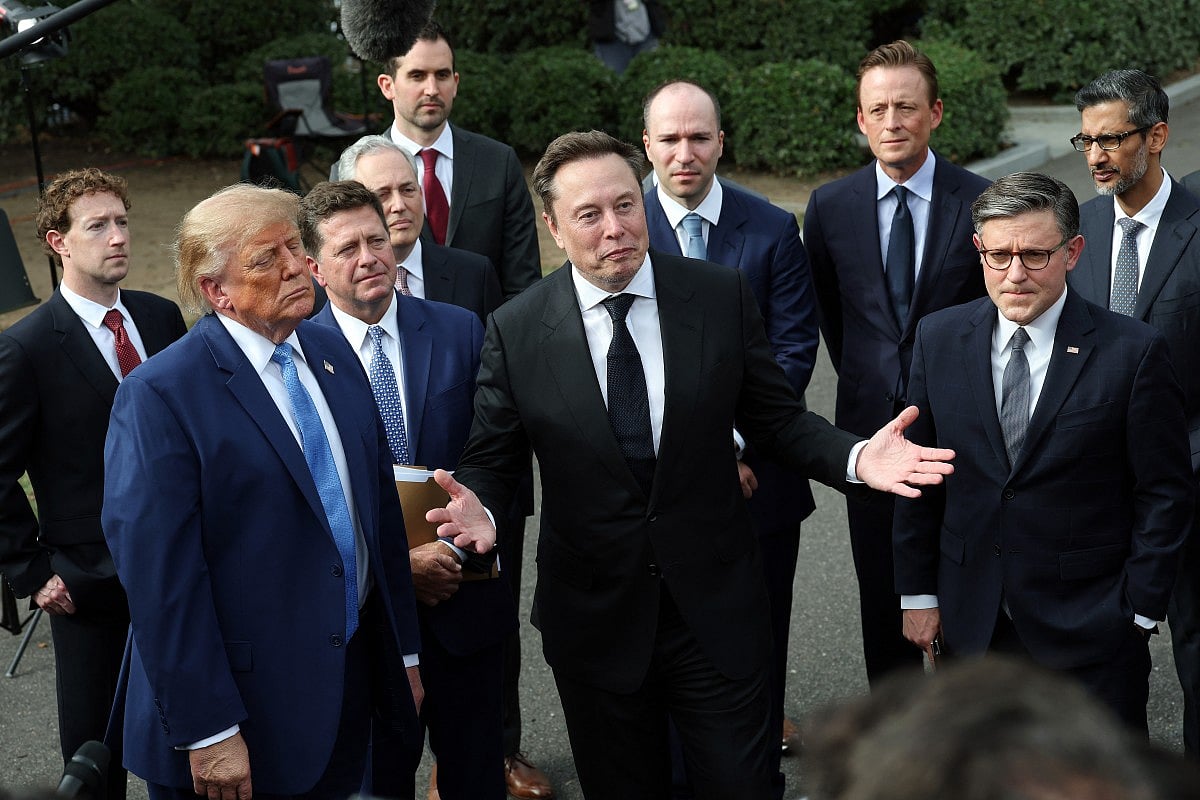
Musk: AI could usher in an ‘age of abundance’ for everyone
Elon Musk used a White House gathering of tech leaders to argue that artificial intelligence, humanoid robots and so-called "superintelligence" could ultimately raise living standards worldwide rather than create a permanently jobless underclass.
Speaking alongside US President Donald Trump at a White House AI event, Musk said he believed the most likely long-term outcome was an “age of abundance” in which people would have something more substantial than universal basic income: what he called “universal high income.”
“When you have robots and you have superintelligence, it means that everyone in the world can have better medical care than anyone here, including me,” Musk said.
“And wouldn’t that be wonderful?”
The remarks came as Trump gathered some of the world’s most prominent technology executives on Sept. 29 to discuss the future of AI, its regulation and the expansion of AI infrastructure in the United States.
Musk sat beside Trump during the event.
From unemployment fears to changing jobs
Concerns about mass unemployment should be viewed against earlier technological transitions, the Tesla/SpaceX chief argued.
“Jobs are going to change. Jobs have always changed,” he said, pointing to the historical example of human computers — people whose occupation was to perform calculations before electronic computers automated much of that work.
There were once buildings filled with workers calculating bank interest and performing scientific calculations, Musk said.
Today, a laptop and spreadsheet can perform those tasks vastly faster.
His argument is that AI and robotics could produce a similar transformation across a much broader range of occupations.
Musk was not arguing that employment will remain unchanged. Rather, he suggested that the nature of work will evolve, while demand for human labour could remain strong during the transition.
Musk has made similar arguments before.
In a 2026 discussion with Peter Diamandis, he said companies that fail to adopt AI would eventually be unable to compete with companies built around AI. His advice to young people: have the broadest education possible, embrace both arts and hard-core sciences; know what to ask AI and robots to do.
Why Musk thinks healthcare could change dramatically
Healthcare is central to Musk's abundance thesis.
He has previously argued that humanoid robots such as Tesla's Optimus could eventually perform increasingly sophisticated medical tasks, including surgery.
In one 2026 discussion, he said the long-term potential was for people worldwide to receive medical care better than what humans can provide today.
The logic is straightforward: AI could provide diagnostic and decision-support capabilities at enormous scale, while robots could perform physical tasks without the geographic and labour constraints faced by today's healthcare systems.
That could potentially make high-quality medical expertise available far beyond wealthy countries — if the technology becomes reliable, affordable and widely deployed.
Musk's prediction remains a forecast: they're not an established outcome. The technology, economics and distribution mechanisms required to produce such universal access have not yet been demonstrated at the scale he envisions.
‘Universal high income’ vs universal basic income
Musk's phrase “universal high income” is deliberately different from universal basic income (UBI).
UBI generally refers to providing people with a regular cash payment sufficient to establish a basic financial floor.
Musk's concept is more radical: AI and robots would produce such a large increase in goods and services that the economy could provide a much higher standard of living for everyone.
He has used the phrase for years. In a 2023 conversation with then-British Prime Minister Rishi Sunak, Musk similarly predicted that AI could produce an “age of abundance” and said there would be “universal high income” rather than universal basic income.
In more recent comments, Musk has gone further, suggesting that money itself could eventually become less important if machines produce most goods and services at very low marginal cost.
Assumption behind the prediction
Musk's vision depends on several technological breakthroughs occurring together:
AI systems becoming substantially more capable;
humanoid robots becoming reliable and inexpensive enough for mass deployment;
enormous increases in automated manufacturing;
plentiful energy and computing capacity;
AI-assisted medicine becoming demonstrably superior in many areas;
and the resulting productivity gains being broadly distributed rather than concentrated among owners of AI systems and infrastructure.
The point about productivity is significant: AI productivity by itself does not automatically create universal high income.
Who owns the machines, who controls the data and computing infrastructure, how companies are taxed, how workers transition between occupations and how societies distribute the resulting wealth will determine how broadly the benefits are shared.
Trump’s AI push
Musk's comments came amid a broader push by Trump to portray AI as an engine of American economic growth while resisting calls for heavier regulation.
At the Sept. 29 White House meeting, major technology companies agreed to a voluntary AI-safety framework covering internal controls, monitoring, external audits and board-level oversight.
The agreement is described as "morally binding" — rather than a legally enforceable regulatory regime.
Musk's message about which future he expects is unequivocal: change will be disruptive, but he believes the more likely destination is a world in which machines produce enough abundance that today's economic assumptions — including the necessity of working for income — could eventually change, too.
The result: a striking contrast between two competing visions of AI's future: one centred on productivity, abundance and higher living standards vs another focused on job displacement, concentration of wealth, safety risks and the need for stronger safeguards.
At its core, the argument is not really about whether artificial intelligence will transform the economy. It already is.
The debate is over who captures the gains, who bears the disruption, and whether institutions can manage the risks quickly enough.
Supporters see AI as a general-purpose technology — like electricity, computers or the internet — that can make workers and businesses more productive.
AI systems can draft documents, analyse data, write software, translate languages, handle customer queries, detect patterns in medical scans and speed up research.
If those tools help people complete tasks faster or perform work that was previously too expensive or difficult, output per worker can rise and could produce several benefits: Higher productivity, cheaper services, scientific acceleration, better public services, and new work and industries.
The IMF has said AI could “jumpstart productivity, boost global growth and raise incomes.” It estimates that AI will affect almost 40% of jobs globally, but exposure does not automatically mean job loss: roughly half of exposed jobs could benefit from AI complementing workers and improving productivity.
The risk case
Critics do not necessarily deny AI’s productive potential. Their concern is that technological gains could be concentrated in the hands of companies that own advanced models, computing infrastructure, data centres, chips and intellectual property — while workers and communities absorb the costs.
Even the IMF’s research finds that AI can increase wealth inequality even in scenarios where it reduces some wage inequality.
One reason: higher-income households are more likely to own capital and can therefore benefit from increased returns generated by AI-driven productivity gains.
Workers in highly AI-related, often higher-paid jobs may also receive larger gains than workers whose tasks are more easily automated, the bank stated.
The IMF’s 2026 analysis also warns that AI adoption could widen inequality — within and between countries — reinforce market concentration and displace routine cognitive and physical work.
Results will depend on how fast AI spreads, which tasks it replaces or complements, and how institutions respond, the IMF noted.
So while the debate is often framed as “AI will create jobs” versus “AI will destroy jobs”, both may happen at once.
Sign up for the Daily Briefing
Get the latest news and updates straight to your inbox
Network Links
GN StoreDownload our app
© Al Nisr Publishing LLC 2026. All rights reserved.