Apple tops forecast, not itself
Apple’s earnings report on Tuesday highlights some of the challenges company faces as it continues to expand overseas
The news on Tuesday was not particularly good for Apple: revenue was flat, profit was lower, and even the sales of iPads were down.
Investors did not seem to mind, at least in the short term, sending the company’s shares about 4 per cent higher in after-hours trading. Strong iPhone sales helped beat the expectations of Wall Street.
But Apple’s earnings report on Tuesday highlighted some of the challenges the company faces as it continues to expand overseas. The company sells plenty of devices in the United States, but sales have lagged in some larger overseas markets, which are crucial for its future growth.
China has been especially problematic for the company. Overall sales of Apple devices in China fell 4 per cent compared with the same quarter last year. And in Hong Kong, Apple’s sales were down about 20 per cent — a trend that Timothy D. Cook, the company’s chief executive, found puzzling.
“Hong Kong is an international shopping haven,” Cook said on the company’s earnings call in response to an analyst’s questions about Apple’s performance in China. “We saw some dramatic downturn there. It’s not totally clear exactly why that occurred.”
Gaining a foothold in foreign markets is becoming increasingly vital for Apple. Its growth has slowed in the most recent quarters, as its devices have largely saturated the United States and some top markets in Europe.
The tepid growth has led many investors to clamour for a new blockbuster product to restart growth and give Apple’s sagging stock a much-needed lift. But no such product has been announced. For several quarters now, Cook has suggested that the company has plenty of new products in the pipeline, and that some could reach the public this fall or next year.
Wearable computers
The company could decide to introduce a cheaper iPhone to spur growth in China and other foreign markets, or even a so-called smartwatch that would compete in a brand-new market of wearable computers. Those ideas have long been discussed and considered at the company.
“Competition is heating up,” said Laurence Isaac Balter, chief market strategist at Oracle Investment Research, which has clients that own Apple shares. “They need to come up with some game-changers pretty soon.”
The third quarter is typically a slow time for Apple. That is because the company traditionally introduces a new iPhone model in the fall, so in the summer many consumers are waiting for the next model to be released.
But sales of iPhones were strong. The company sold 31.2 million iPhones, up from 26 million in the same period a year ago. It was the most Apple had ever sold in a third quarter.
Those sales helped generate a net income in the third quarter of $6.9 billion (Dh25.3 billion), or $7.47 a share. But that was down from $8.8 billion in the same quarter a year earlier. The company said revenue was roughly flat at $35.3 billion, from $35 billion a year ago.
The net income beat the expectations of Wall Street analysts. They had expected $7.32 a share and revenue of $35 billion, according to a survey by Thomson Reuters.
Analysts closely watch Apple’s gross profit margins. For the third quarter, Apple’s gross margin was 36.9 per cent, down from 42.8 per cent a year ago. In April, Apple warned that its gross margin would continue to fall in the fiscal third quarter to 36 to 37 per cent.
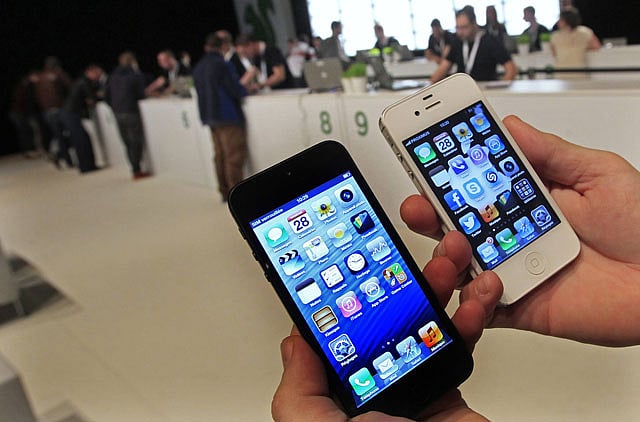
Strong sales of Apple’s cheaper iPads and older iPhones are putting the squeeze on the margins. Apple did not disclose how many of each phone or tablet model it sold. But it said that while its iPhone 5 was the best seller, sales of the previous generations, the iPhone 4 and iPhone 4S, were also strong. Late last year, Apple added the cheaper iPad Mini to its lineup.
Even with the Mini, Apple’s iPad sales were a disappointment, coming in at 14.6 million for the quarter, missing analyst estimates for 16.7 million. Mac sales were also down slightly, at 3.8 million, from 4 million a year ago.
Competitors
Investors concerned about Apple’s growth have punished the company’s stock. The stock price has fallen by roughly 40 per cent from its peak of $705.07 in September. Shares closed at $418.99 on Tuesday, down 1.7 per cent, before gaining ground in after-hours trading.
Apple may face a challenge in China, but the tech industry’s other two giants, Microsoft and Google, have their struggles, too. Microsoft posted a profit of almost $5 billion for the quarter, missing expectations of analysts, thanks in part to disappointing sales of its Surface tablet and an industrywide decline in sales of personal computers. Google also posted a profit, of $3.23 billion, but still missed analysts’ expectations as its desktop search business continued to slow and ad prices shrank.
Cook told investors to stay optimistic about Apple in China. About half a million people there are creating apps for iOS, Apple’s mobile software system for iPhones and iPads, he said. Sales of the iPad in greater China were up 8 per cent and up 37 per cent in mainland China, he said.
“Over the arc of time, China is a huge opportunity for Apple,” Cook said, “so I don’t get discouraged over a 90-day kind of cycle with economic factors.”
Sign up for the Daily Briefing
Get the latest news and updates straight to your inbox
Network Links
GN StoreDownload our app
© Al Nisr Publishing LLC 2026. All rights reserved.