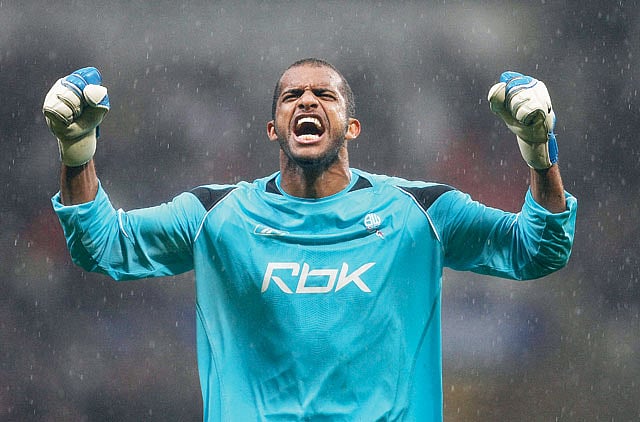
Dubai: Putting one professional player into a group of 30 amateurs will never be as beneficial as putting one amateur into a group of 30 professionals. So, why are local clubs reluctant to send players abroad?
It's a touchy subject among league and FA officials, club chairmen and coaches in the UAE.
Carlo Nohra, UFL CEO, puts the exportation of at least one local player into Europe as a top-five target for his three-year tenure, despite the fact that lost talent would detract from the league's appeal.
Yousuf Abdullah, UAE FA general secretary, also stressed that focus should be on player exportation to improve the national team. But ask Oman national team coach Claude Le Roy what he thinks of keeper Ali Al Habshi playing in England and he describes it as a "problem".
He may not get Al Habshi, the only GCC-born national currently playing in Europe, back to play in this November's Gulf Cup in Yemen. Wigan Athletic isn't obliged to release Al Habshi because it's not a Fifa recognised tournament.
Even if Al Habshi can feature, Le Roy will only get him the night before kick-off.
Ironically, UAE coach Srecko Katanec could actually have the advantage over Le Roy by having no Euro-based stars in his squad.
Ahmad Al Habshi, Ali's brother and agent said, "Clubs too, are afraid of losing talent. They pay entry-level players far more than they would get in Europe. Money talks, why would the players want to play abroad when it's less money?"
With enough pride at stake here — in the short term, coaches can't see the long-term benefits of sending players out. But perhaps that's because the coach won't be here in the long term — this remains the most volatile employment market for football managers.
Yahya Abdul Kareem, the recently resigned chairman of Sharjah Club added, "Clubs have spoilt players with money and treatment. Besides the fact no one has reached the pro level to play outside, players can't fight because they've been spoilt. They need to fight to play in Europe."
It's a view reflected by the former Celtic defender Derek Whyte who works as a local TV football pundit. "No one's good enough. They are talented, quick and athletic but don't have the professional discipline. Also, they have a good life here; cars, house, lifestyle, culture, weather and family network, it's a big step to go the other way."
Even Nohra says "a loan deal is a bilateral agreement" suggesting foreign clubs not knocking on the door is a reflection that no one's made the grade.
But John Burridge, the former Manchester City keeper, who discovered Ali Al Habshi, said mentality not ability is behind the fact no one else has followed Al Habshi's example to go and play in Europe.
"They [local players[ have the skill, the speed but not the mindset and that needs to be adjusted from a young age.
"It's ruthless, dog-eat-dog in Europe. They go down too easy here — that doesn't wash in England. They have to get up and fight, take an elbow, take a kick and give it back with interest."
Burridge agreed the mindset has to be changed with the help of a coach or player, who has experienced that league, coming into the UAE and catching raw talent young. "But is that person going to be interested in someone else's welfare? Do they want to put their reputation on the line by recommending a GCC player to their contacts back home? Do they want to? Do they have to? Or do they just want to concentrate on their own football?"
Of course before all this the issue of work permits for GCC players in Europe becomes an issue. Former Bolton boss Sam Allardyce recalled that to get Al Habshi to England was difficult. He needed to get 75 per cent attendance in Oman's Fifa recognised fixtures over a period of two years before getting into England — Al Habshi played in the Norwegian league until he achieved the latter.
Allardyce said in the meantime, "the best thing to do is to train your own players with these facilities [in UAE]. Get higher standards like Cannavaro in and be patient. Put a five-year plan into place."
While the UAE has put billions of dirhams into the English Premier League via TV rights with the Abu Dhabi Media Company, shirt sponsorship deals through Emirates, Etihad and even a club takeover by Shaikh Mansour Bin Zayed Al Nahyan, Deputy Prime Minister and Minister of Presidential Affairs, at Manchester City; the Emirates still doesn't have a face in the league to give the country global recognition. But without having spent a riyal, Oman has.
This will surely be something the UAE wants to correct.
While Saudi Arabia's Sami Al Jaber and Yasser Al Qah'tani both went to the EPL with Wolverhampton Wanderers and Manchester City respectively, both experiences ended quickly and in tears. Al Jaber played just five matches with no goals and Al Qah'tani left a trial because his club Al Hilal "needed him too much".
Foreign players
Al Shabab
- Julios Cesar (Brazilian)
- Carlos Villanueva (Chile)
- Lamine Diarra (Senegal)
Al Jazira
- Bare (Brazilian)
- Toni (Ivory Coast)
- Diaky (Ivory Coast/UAE)
Al Ahli
- Pinga (Brazil)
- Cannavaro (Italy)
- To be confirmed (TBC)
- Sharjah
- Marcelo (Brazil)
- Marcelinho (Brazil)
- Robinho (Brazil)
Al Ain
- Sand (Argentina)
- Soufianne Alloudi (Morocco)
- TBC
Al Wahda
- Fernando Baiano (Brazil)
- Modibo Diara (Ivory Coast)
- Magrao (Brazil)
Al Nasr
- Lima (Brazil)
- Tenorio (Ecuador)
- TBC
Dhafra
- Abbas Muriywa Lawal (Nigeria)
- Boris Kabi (Ivory Coast)
- Mohammad Berrabah (Morocco)
Bani yas
- Eder Gaucho (Brazil)
- Andre Senghor (Senegal)
- Fawzi Bashir (Oman)
Kelba
- Caca (Brazil/Italy)
- Feinoudo (French/Guinea)
Dubai Club
- Rashid Taba (Belgium)
- Yashid Qausi (Morrocan)
- Michel La Rent (French)
Al Wasl
- Yeste Navarro (Spain)
- Mohammad Shaiba (Oman)
- Oliviera (Brazil)
Sign up for the Daily Briefing
Get the latest news and updates straight to your inbox
Network Links
GN StoreDownload our app
© Al Nisr Publishing LLC 2026. All rights reserved.