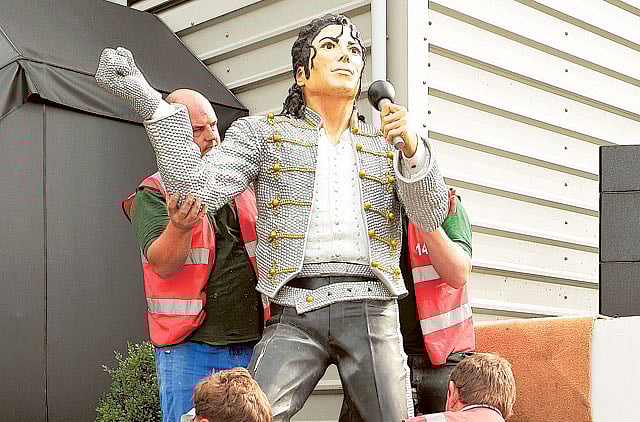
London: For decades, Michael Jackson was known for his elaborate entrances and glittery stage shows. On Wednesday, the King of Pop was hauled away in air bubble packaging by four burly stonemasons.
It was an unceremonious end to his nearly three-year run at Fulham’s stadium, Craven Cottage. After 90 minutes of chiselling, sawing and hacking, Jackson left the building, horizontally, on the back of a truck.
He will not be missed by Fulham fans. Since April 2011, a nearly 2.4 metre statue of Jackson, made of Jesmonite, stood facing the Thames, behind the home stands. A large sign that read, ‘Michael Jackson the Tribute’, hung next to Jackson, who stood atop two tonnes of black granite with a sequinned jacket, an ammunition belt and a glove on his right hand.
His presence was incongruous in the extreme. Mohamed Al Fayed, the team’s eccentric former owner, who called Jackson a friend, had the statue built even though Jackson seemed to care little about soccer and attended only one Fulham match.
Fulham’s fans were happy with Fayed, who spent lavishly to lift the club’s fortunes. But they helped pay for some of the cost of a tasteful and far more expensive bronze statue of Johnny Haynes, perhaps the team’s greatest player, which stands at the other end of the stadium.
While Jackson’s fans travelled from far and wide to pay their respects, in the intensely masculine world of English soccer, the homage to Jackson was considered a joke.
“It’s rubbish,” said Andy Hunt, a longtime fan who stood near the statue before Tuesday’s League Cup game against Everton, drinking beer with his friend, Malcolm Apted. “I don’t object to the person. If it was in bronze, maybe. But it’s tacky.”
Fayed, who bought Fulham in 1997, a few months before his son, Dodi, died in a car crash with Diana, Princess of Wales, was unrepentant. When asked in 2011 about whether a statue of Jackson made sense at the fabled stadium, he said, “If some stupid fans don’t understand or appreciate such a gift, they can go to hell.”
For good measure, he invited these unbelievers to root for Chelsea, Fulham’s arch-rival, which is two subway stops away.
Fayed got his way until he sold Fulham in July to Shahid Khan, the billionaire owner of the NFL’s Jacksonville Jaguars. At the news conference announcing the deal, Fayed threatened to cut off Khan’s signature handlebar moustache if the statue were removed.
Two months later, Khan made perhaps his most important decision of his young tenure as owner: Jacko would go.
“Our supporters’ views on the statue have been made clear,” he said in a statement last week. Removing the statue, he said, was “the right thing for Fulham Football Club.”
The decision won Khan instant credibility with fans who were otherwise unhappy with the team’s slow start this season.
For now, the statue of Jackson will remain in a warehouse while Fayed decides its fate.
Martin Jol, Fulham’s manager, is considering bidding for the statue and either auctioning it for charity or adding it to his art collection, which includes nearly two dozen other statues and several hundred paintings.
“It would be nice to keep it in the Fulham family, if he wants,” Jol said, referring to Fayed.
Sign up for the Daily Briefing
Get the latest news and updates straight to your inbox
Network Links
GN StoreDownload our app
© Al Nisr Publishing LLC 2026. All rights reserved.