London
People are unhappy. They’re unhappy at teams like Bayern Munich, who keep the ball, preserving possession and looking to pass opponents into submission, and they’re unhappy at teams like Chelsea, who defend deep, allow opponents to have the ball and try to pick them off on the break.
People, over the past fortnight, have declared themselves bored by and opposed to both proactive and reactive football.
That’s not actually as contradictory as it sounds. We live in an age of extremes. When Barcelona first started to play tiki-taka under Pep Guardiola, they began to achieve unprecedented levels of possession. For the first time probably since Arrigo Sacchi’s Milan almost two decades previously, there was a new philosophy about. This wasn’t just a minor tweak of positioning, a tendency for one centre-forward to drop slightly deeper, or for the full-backs to push a bit higher. It wasn’t a slight change of shape: It was a whole new style.
It took the basic tenets of Total Football to previously unimagined extremes, in part because of an exceptional generation of players, many of whom had been schooled in a particularly idiosyncratic style at La Masia, in part because of a visionary coach in Guardiola, and in part because of the changes in the offside law that increased the size of the effective playing area and so permitted smaller, more technical players to flourish.
When ‘totaalvoetbal’ emerged as a term in the Netherlands in the early 70s, the ‘totaal’ aspect of it was part of a wider movement in Dutch culture, particularly architecture. JB Bakema, one of the theory’s prime exponents, argued that all buildings should have individual characteristics but should be designed with their place in the overall environment in mind. The application of the term to football made sense in terms of Bakema — the whole point of it was that players were aware of their positions within the system and were constantly renegotiating it for themselves. But there was also, at least outside of the Netherlands, a more popular resonance. This was Total Football because everybody, it seems, could do everything: Defenders could attack and attackers could defend.
Slow to react
Although tiki-taka shared with Total Football the high defensive line, the interchanging of positions and the sense that the game could be controlled through possession, its characteristics were far from total: Everything became sublimated to the pass. The centre-forward became a false nine because that enhanced fluidity of movement and created additional angles to keep the ball moving; the full-backs played higher up the pitch than ever before; midfielders were selected in defence for their passing ability from deep; even the goalkeeper had to be able to play the ball out from the back.
For a time, football seemed not to know how to react. When Chelsea came so close to eliminating Barca in the Champions League semi-final in 2009, the assumption was that the great physicality of Premier League teams could brush them aside, yet Manchester United never got anywhere near them in the final. The semi-final the following year, and the defeat to Jose Mourinho’s Inter Milan, came as a watershed. Yes, Inter were fortunate in some respects, but at the same time there were spells in the second leg of that tie when Barca were reduced to endless sideways passing, bereft of imagination and verticality. Yes, Barca missed chances they would usually have taken and, yes, Bojan Krkic’s late strike should have counted, but the lesson was there: Radical possession football could be defeated by radical non-possession football.
In his controversial biography, Diego Torres explained the code Mourinho came up with at Real Madrid for handling games against high-class teams, particularly away from home:
“1) The game is won by the team who commits fewer errors. 2) Football favours whoever provokes more errors in the opposition. 3) Away from home, instead of trying to be superior to the opposition, it’s better to encourage their mistakes. 4) Whoever has the ball is more likely to make a mistake. 5) Whoever renounces possession reduces the possibility of making a mistake. 6) Whoever has the ball has fear. 7) Whoever does not have it is thereby stronger.”
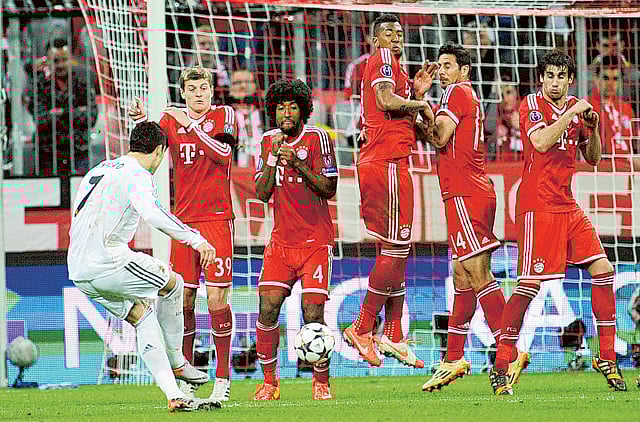
That’s the theory Mourinho used in the first leg against Atletico and last Sunday against Liverpool. Others, in a more diluted form, have followed: Real Madrid were quite happy to sit deep and absorb pressure against Bayern, both at home and away, capitalising on Bayern’s inability to counter the counter (Uefa’s technical reports show the number of goals scored from counter-attacks has fallen from 40 per cent in 2005-06 to 2 per cent last season; the increased efficiency of the attack-to-defence transition is one of the great developments of the last decade, and their haplessness at set-pieces (a persistent flaw in Guardiola sides, perhaps rooted in his insistence on picking defenders who can pass rather than those who can mark and win headers).
Mourinho was quite open about his switch to a defensive approach in this spell at Chelsea. “We may have to take a step back in order to be more consistent at the back,” he said in December after his side’s Capital One Cup quarter-final exit to Sunderland. “It’s something I don’t want to do, to play more counter-attacking, but I’m giving it serious thought. If I want to win 1-0, I think I can, as I think it’s one of the easiest things in football. It’s not so difficult, as you don’t give players the chance to express themselves.”
New tone
Their next game, nine days later, was the 0-0 draw at Arsenal and a new tone had been set. Against teams prepared to attack Chelsea, the change of approach was hugely effective, but against other counter-attacking sides or teams who prefer to sit deep, it left Chelsea vulnerable to mistakes, misfortune and moments of brilliance from the opposition.
As Mourinho himself noted on Sunday after the win at Liverpool, it’s one thing to set out defensively, quite another to have the discipline to complete the job. “When a team defends well you [the media] call it a defensive display. When a team defends badly and concedes two or three goals you don’t consider it a defensive display.”
There are those who have argued that Bayern destroyed tiki-taka in the semi-final last season and that it was therefore an enormous error to try to implement it at Bayern this season. That, though, is to ignore the fact that Bayern last season were a highly proactive, possession-oriented side in pretty much every game other than those against Barcelona: Domestically, only Barcelona had more possession in the top five leagues in Europe last season; only Barcelona had more possession in the Champions League group stages last season. In those semi-finals, Jupp Heynckes recognised that Barcelona were better at retaining possession and so set his side up to play reactively, with great success.
None of that means tiki-taka is finished as a system. None of that means teams will not continue to try to control games through possession. What does seem to be the case, though, is that the examples of Inter in 2010 and Chelsea, against both Barca and Bayern in 2012, has radicalised the approach of reactive teams when encountering tiki-taka, and that will probably prevent it ever again enjoying the pre-eminence it enjoyed at Barcelona between 2009 and 2011.
Once the evolutionary wheel has turned, it rarely goes back.
— Guardian News & Media Ltd
Sign up for the Daily Briefing
Get the latest news and updates straight to your inbox
Network Links
GN StoreDownload our app
© Al Nisr Publishing LLC 2026. All rights reserved.