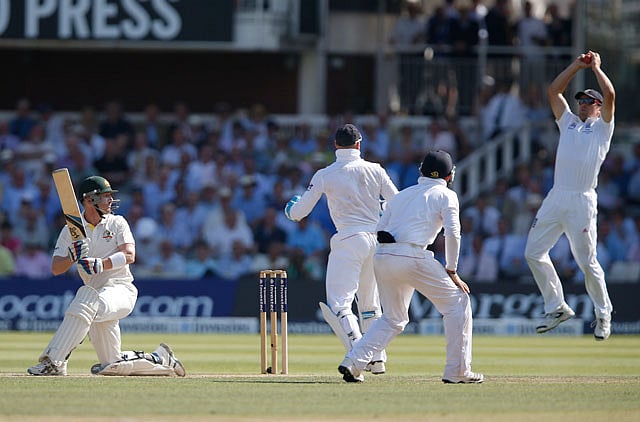
Now that former Australia cricket captain Ian Chappell has come out and suggested that the decision reviews should be taken out of players’ hands and left to the umpires, hopefully there will be some debate on a system which has been so much in the news. I have been saying for a while now that for time immemorial players have had to accept the umpires’ decisions and whether they like it or not, take them on the chin and move on. The ICC code of conduct also disapproves of players showing, by any signs or gestures, that they do not agree with the umpire’s decision. There have been innumerable instances of players being hauled before the match referees and either being warned, reprimanded or fined and even suspended for showing dissent at the umpire’s call. Yes, there is a fine line between dissent and disappointment, but players have had to face the music for that. Now with the DRS, players are being encouraged to blatantly disagree with the umpire’s decision, and then it is being sent up to the TV umpire for review after which either the decision is upheld or changed.
The ICC has restricted the reviews that each team can ask for to two per innings, so if in the first over a team gets two incorrect reviews, then for the rest of that innings it can be the recipient of some major umpiring errors yet can’t do anything about it. Apart from the ugly sight of a player asking for the umpiring decision to be reviewed, what happens if a player forgets that his side has lost both the reviews that it had and asks for one? He will in all likelihood be pulled up for showing dissent and face the punishment doled out by the match referee, for there is no excuse for showing dissent isn’t it even if the player has been dumb enough to forget that the team’s reviews have been exhausted.
What has been seen also is that there have been several occasions when the batsman has been clean bowled or caught and the third umpire has come on the ground and asked the batsmen to wait while the TV umpire checks if it is a no ball or a fair delivery. This review is asked by the on-field umpire and many a batsman has survived and gone on to change the course of the game. Now if umpires want to be doubly sure that the delivery was a fair one, then why is it wrong to leave it to them and their colleague in front of the TV monitor to ensure that the decision being made is the correct one? There are those who will say that the umpires will go ask the TV umpire for every call and that will upset the rhythm of the game, but if the intention is to make sure a fair decision is made then that should be the last argument if made at all. You simply cannot have a situation where just one or two decisions are reviewed while the others aren’t, for that could change the complexion of the game as was seen in the first Test in England.
If time is of the essence, then the ICC should be looking at doing away with the drinks interval except on extremely hot days. As it is, drinks are taken out to the players in the middle on the slightest pretext, whether it is while taking a change of bat or gloves or caps instead of helmets. And, for the fielding side, there are these huge cooler boxes with energy drinks at the boundary, which not only the bowlers can partake of, but the other fielders too. If the drinks interval is not taken, then there will be close to 15 minutes saved each day of a Test match. Not only will the quota of 90 overs be bowled in the six hours of play allowed, but any extra time taken for reviewing decisions can be made up for too.
The argument for allowing just one review also does not make sense, for after it has been exhausted, the wrong call can still change the course of the match. So all decisions where the on-field umpires and TV umpire feel have an element of doubt should be reviewed, and if that takes time then so be it as long as the correct call is made in the end. That is far more important than anything else.
Today some umpires go up to the TV umpire for a run-out appeal even when they have seen a batsman cross the stumps, and that does take a few seconds, but what it does is give a satisfied feeling all round that the correct call was made. That is exactly what will happen with decision reviews left solely to the umpires. There will be some time taken but not the kind of dull hollow feeling that the first Test provided because of the fact that Australia had run out of their reviews and so a terrible decision was allowed to stand.
As for the moralising that most of the media from England and Australia indulged in about all the incidents and decisions, the less said the better. As the West Indies cricket great Michael Holding said, it was hypocrisy, pure and simple.
Sign up for the Daily Briefing
Get the latest news and updates straight to your inbox
Network Links
GN StoreDownload our app
© Al Nisr Publishing LLC 2026. All rights reserved.