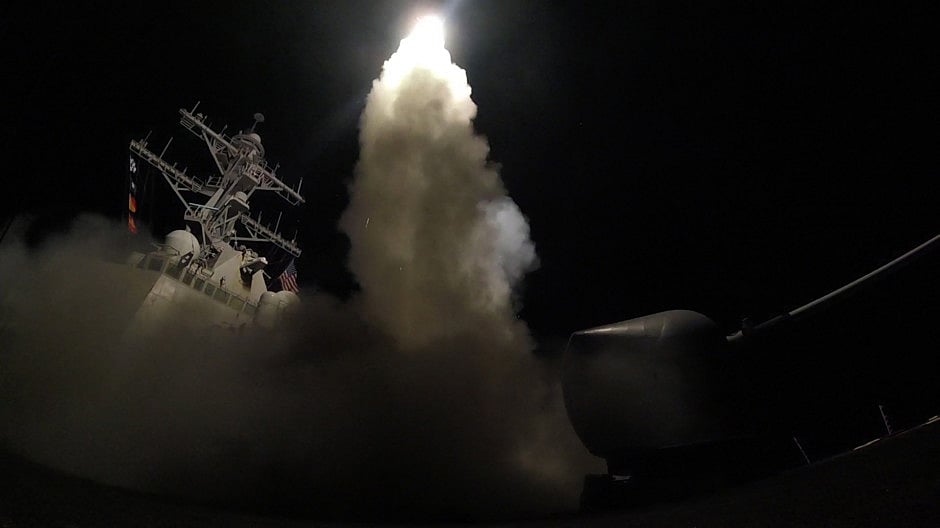
I am in no doubt that what will end the war in Syria is what ultimately ends every conflict: words and diplomacy, not weapons. But when diplomacy fails and civilians suffer, as they have been doing for many years in Syria, and when they are the victims of weapons that have been outlawed by the international community for their horrific and indiscriminate consequences, then we cannot shy away from proportionate military intervention. I’m proud of Charles Kennedy for facing down the political elite and condemning the Iraq war as illegal, and the justifications for intervention as flawed. But I am equally proud of Paddy Ashdown, who led the call for multilateral intervention in Kosovo to stop a humanitarian disaster in its tracks.
Last week, President Bashar Al Assad of Syria used chemical weapons to attack his own people. Men, women, children — every one of them was a target. In itself, the deliberate targeting of civilians in war is illegal under international humanitarian law, difficult though it is to prove. But the use of chemical weapons was banned long before even the UN existed.
Back in 1925 the world realised the horror of chlorine and mustard gases after 1.3 million people experienced their effect during the First World War. The strength of international condemnation of these weapons at that time was enough to largely prevent their use in the Second World War. This was not the first time Al Assad had used chemical weapons. But it must be the last.
In 2013 I abstained on the coalition’s plans against Al Assad, following a similar chemical attack then. In hindsight, seeing what has unfolded now, I believe I should have supported the action. This is why Liberal Democrats will not condemn the action taken by Donald Trump Thursday night, nor the intention behind it. We still believe in the doctrine of responsibility to protect, and there can be no clearer-cut case in which to evoke that than the use of these evil weapons. However, we disagree with the way in which he conducted it — unilaterally, without allies, outside of a wider strategy. Trump saw a wrong and wanted to react, no doubt in large part to differentiate himself from his predecessor Barack Obama. But taking matters into his own hands without thinking of the consequences, without a wider plan, without considering what next, exposes both his naivety about how the world works and his potential to create instability on an international scale.
So how should the UK respond now? Trump has made it clear that this was a one-off, which Michael Fallon has echoed, and we should welcome that. This wasn’t about intervention in Syria. The purpose was two-fold: to send the strongest possible signal of condemnation of Al Assad’s actions, and to ensure he is much less likely to be able to act in that way again.
The Syrian regime and their Russian allies may be acting outraged on their respective state television channels, but they have been sent a message they will surely not now ignore. That does not mean the war in Syria is going to stop any time soon. Millions of Syrians still live in fear, under siege, as refugees scattered throughout the region and throughout the world. International diplomacy hasn’t gone anywhere, and all the while Daesh (the self-proclaimed Islamic State of Iraq and the Levant) still thrives in Syria and will continue to while the war is continuing.
The UK now has two jobs. The first is civilian protection — and that means proper consideration of protected humanitarian zones. No-fly zones are complicated, and any coalition that creates them must be ultimately willing to shoot a plane out of the sky, an action with inevitable consequences. Further commitment from the international community to protect civilians could force Russia to question its support of Al Assad.
The second is what will end this once and for all: diplomacy. With our allies, we must kick-start the international process again. It’s not easy, it will not be quick, and it must be driven by the main actors in the region. Above all, it will not be driven by Trump. That is not his style. But now is the time for our prime minister to stand up to him and say: you’re involved in this now, let’s finish the job.
— Guardian News & Media Ltd
Tim Farron is the leader of Britain’s Liberal Democrat party.
Sign up for the Daily Briefing
Get the latest news and updates straight to your inbox
Network Links
GN StoreDownload our app
© Al Nisr Publishing LLC 2026. All rights reserved.