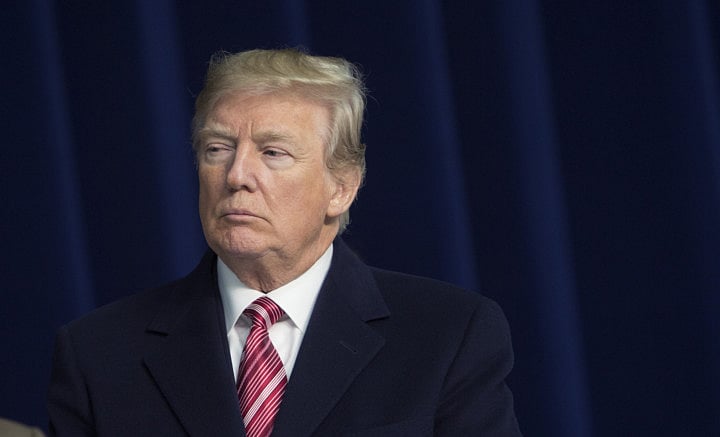
After almost a year in office, President Trump has yet to name a science adviser and director of the White House Office of Science and Technology Policy. Since World War II, no American president has shown greater disdain for science — or more lack of awareness of its likely costs.
The science adviser is the one individual who can quickly pull all the relevant information together for the president, cut through conflicting advice coming from other senior advisers and Cabinet secretaries, and get evidence-based options in front of him. Especially important has been the adviser’s role in helping the president deal with crises — Sept. 11, the subsequent anthrax attacks, the Fukushima nuclear nightmare in 2011, the Ebola and Zika outbreaks, hurricane devastation and cyberattacks.
The previous Office of Science and Technology Policy (O.S.T.P.) director, John Holdren, a physicist and energy-policy expert from Harvard, was named to the position hardly a month after the 2008 elections and was then quickly approved by the Senate. He served throughout President Barack Obama’s two terms. In June 2001, five months into his first term, George W. Bush nominated the physicist John Marburger, then director of Brookhaven National Laboratory, to the post; he served until Dr. Holdren stepped in.
Today, the O.S.T.P. maintains only a skeleton staff led by the deputy chief technology officer, Michael Kratsios, a technologically inexperienced Silicon Valley financier holding just a bachelor’s degree in political science. The posts of deputy director and four congressionally mandated associate directors remain vacant.
It’s difficult to know what Trump really thinks about scientific issues of public concern, but he has rejected the scientific arguments for human-caused climate change and questioned the public-health case for vaccinations. And he has ignored the negative impacts of his immigration bans on American science and technology.
But the lack of good science advice has not slowed the president and his administration in their assaults on health and environmental policy and in weighing in on national-security issues involving science and technology. His decision to pull the nation out of the Paris climate agreement is one example. So was his appointment of Scott Pruitt, a lawyer with little real understanding of climate science, as administrator of the Environmental Protection Agency.
Sound science advice was also conspicuously absent from the president’s revised budget for the fiscal year 2018, which features draconian cuts at the E.P.A., the Department of Energy, the National Institutes of Health, the National Oceanographic and Atmospheric Administration, the National Science Foundation and other federal agencies — especially those sponsoring climate-change research. Congress has largely refused to go along with the drastic cuts, but significant reductions will almost inevitably occur this year.
The assaults by Trump and his administration on American science and technology might have been avoided, or at least tempered, had the president already named, and the Senate confirmed, a distinguished scientist as his science adviser — especially if that individual had direct presidential access.
Nowhere is this need for advice more crucial than in the arena of nuclear weaponry. In fact, most presidential science advisers have been physicists, who can knowledgeably address the technologically sophisticated questions that always arise in this arena. For instance, in the case of the 2015 international nuclear agreement with Iran, President Obama benefited from the trusted advice of Dr. Holdren and his energy secretary, Ernest Moniz, an M.I.T. nuclear physicist, both experts on the science, technology and policy of non-proliferation. It’s unclear whose advice Trump relied on a when he refused last year to certify Iran’s compliance with that deal. This is an exceedingly dangerous situation, particularly in view of the looming threat of a nuclear confrontation with North Korea.
No president in recent history has needed a capable science adviser more while apparently but given Trump’s obvious disdain for science — and for evidence in general — it will be difficult at this point, if not impossible, to find an accomplished, reputable scientist who would agree to work with him.
— Neal F. Lane is a senior fellow in science and technology policy at the Baker Institute at Rice University. Michael Riordan, author of “The Hunting of the Quark,” has taught the history of physics at Stanford and the University of California
Sign up for the Daily Briefing
Get the latest news and updates straight to your inbox
Network Links
GN StoreDownload our app
© Al Nisr Publishing LLC 2026. All rights reserved.