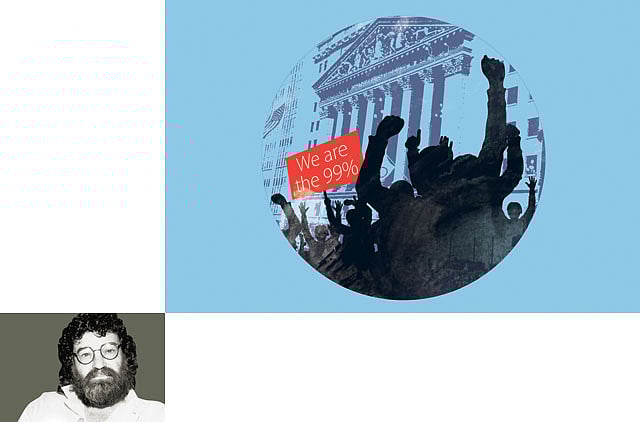
The movement started in that one square mile in New York City around Wall Street, an enclave where an inordinate amount of wealth and power are concentrated, and where, as if by sleight of hand, the financial elite — a miniscule one per cent of the population — have created a historic gulf between the richest Americans and everyone else, yet an elite that expect the rest of us, working stiffs, to bail them out in times of economic crisis.
Enter the Occupy Wall Street movement that magically appears to have duplicated itself in over 900 cities worldwide, from a lower Manhattan Park in New York to Trafalgar Square in London, from Madison to Madrid, from Dublin to San Francisco, from Athens to Rotterdam, and from Rome to Honolulu. The demands of the protesters clearly are different in different countries, but the theme is the same: the poor are paying for the sins of the rich, and while banks get bailed out, workers get sold out.
Unlike the anti-globalisation protests in Seattle that came to world attention in 1999, and that took aim at corporate power at a time of economic boom, thus lessening its mass appeal, the Occupy movement is one that has legs. Its message, “We are the 99%”, is both brilliant and timely.
As a ‘sixties Palestinian’, who grew up with activism like a man grows up with his skin, I was primed for a piece of the action. When I arrived in New York last week to join the protesters in Zuccoti Park, I found a soaked and windswept mass of youngsters huddled inside tents and sleeping bags, trying to keep warm and dry. It was a Saturday, a day that will live in infamy with meteorologists, a day when a freak, early season snowstorm hit the east coast, the result of unseasonably cold air mixing with a storm system that later in the evening turned into heavy wet snow. So you battle not just the establishment but the elements as well. Yet the protesters soldiered on, staying put, perhaps mindful of Naomi Kline’s address to them earlier: “Occupy Wall Street has chosen a fixed target. And you have put no end date on your presence here. This is wise. Only when you stay put can you grow roots”.
The target? Even the Economist, that bastion of the business elite, had to admit in a cover story last week that “People are right to be angry”. Or as Nation magazine, a bastion of a different kind, this of liberal thought, remarked in its own cover story on October 31: “[T]he vast majority of Americans recognise that kids in sleeping bags did not shutter this country’s factories, mangle our mortgage markets or create a pay-to-play system. The 99% did not ask for or approve a system that always has money for wars and bank bailouts but won’t ... help the 24 million Americans who can’t find full-time work, the 50 million Americans who can’t see a doctor when they are sick, the 47 million Americans who need government aid to feed themselves, the 15 million American families who owe more on their mortgages than their homes are worth”.
Extrapolate that for protesters in, say, Greece, where the state, relying for years on borrowed money and a mismanaged taxation system, finds itself in default and in danger of leaving the Eurozone. A half trillion dollar debt, after all, is a heck of a lot of money for a country with 11 million people to owe.
It makes one wonder if the the demands of the Occupy movement — predominantly decentralised and youth oriented — are not just aimed at unfettered greed, but at changes in the underlying values that define our social life as well. And yet at another level, it also makes one wonder, as one looks at those other protesters in cities around the world, in like manner encamped in their own parks, if youth speak to each other telepathically across oceans, cultures and historical experiences.
If you, dear reader, were around, as I was, in 1968, you would have seen it all unfold right before your eyes. For the youth of the world — as I recalled the phenomenon in a piece that appeared in the Journal of Palestine Studies well over a decade ago — that year young people around the world were to mount, in inexplicable, almost mystical syncronicity, a mighty uprising that year, and mount it with the uninhibited directness that only youth possesses.
It happened all over the planet, all at once, all the same year: From the general rebellion in France, known as “les evenements”, that brought down the de Gaulle government, to the anti-war movement in the US that brought down the Johnson administration; from the Tet Offensive in Vietnam to the Cultural Revolution in China; from the civil rights movement in Ireland (when Catholics and Protestants marched together for the first time) to the confrontations outside the Democratic Convention headquarters in Chicago; from the student protests against Communist rule in Poland to those similar protests against the Soviet invasion of Czechoslavakia; from the student takeover of Columbia University to the hippie “drop out” in Haight Ashbury. And, yes, lest we forget, the Palestinians, not to be outdone, had their own thing to do at Karameh in March of that year.
The protesters at Zuccoti Park looked to me, for all the wear and tear of the inclement weather, like Samuel Beckett’s pitiful vagrants. But then, didn’t Estragon and Vladimir, in Waiting for Godot, also have something relevant to say about the human condition? And didn’t the legacies of 1968 finally insinuate themselves into our popular culture, semantic fashions of expression and social values?
Fawaz Turki is a journalist, lecturer and author based in Washington. He is the author of The Disinherited: Journal of a Palestinian Exile.
Sign up for the Daily Briefing
Get the latest news and updates straight to your inbox
Network Links
GN StoreDownload our app
© Al Nisr Publishing LLC 2026. All rights reserved.