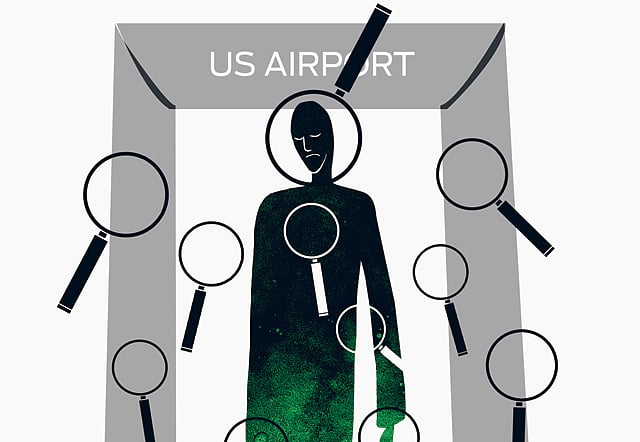
Airport profiling is back with a vengeance in US airports and on international flights to the US despite the fact that most experts agree profiling doesn't work; human rights advocates decry the erosion of civil liberties.
A series of foiled terrorist plots, most recently the Christmas Day attempt by Nigerian Omar Farouq Abdul Muttalib to blow up an airliner landing in Detroit and the arrest of five American Muslims from Northern Virginia in Pakistan on terrorism charges, escalated calls for greater airport security and profiling of Muslims, greater monitoring of Muslims and radical websites, and increased military intervention in Yemen.
While right-wing and Islamophobic commentators have been quick to call for increased airport security for a quick (and enormously costly) fix, enhanced security requires attention not only to airport security but also, and most importantly, to psychological, identity and political problems that feed radicalisation. It requires working more closely with Muslim communities in the US and around the world.
If some terrorists come from occupied lands or have lived lives of desperate hopelessness, many global terrorists or would-be terrorists are often well-educated and have integrated in mainstream society prior to their radicalisation.
If some are recruited and radicalised by preachers of hate, others become alienated and radicalised due to their own perceptions and experiences. Many are profoundly affected and changed by what they see as endless oppression, corruption and injustice in Muslim regimes and failed states and Western foreign policies which support them.
Double game
Western powers, particularly the US, are seen as supporting and aiding autocrats or as using power and military force to threaten, invade and ‘occupy' Muslim lands. Thus, the perception of occupation and injustice in Iraq, Afghanistan, Kashmir, Chechnya, and Palestine has been a potent catalyst, heavily exploited in the rhetoric and ideologies of terrorist organisations.
The Gallup World Poll and Pew polling have shown that mainstream Muslims — the primary victims of terrorism — are as concerned, if not more concerned, about the dangers of extremism and terrorism as westerners are. Increased religious and racial profiling targets and alienates entire communities rather than a very small and dangerous number of potential terrorists.
In the US, the number of convicted home-grown terrorists is a very small fraction of one per cent. A Pew Research Center 2007 study found that most Muslim Americans are "decidedly American" in income, education and attitudes, rejecting extremism by larger margins than Muslim minorities in Europe.
Similarly, a 2009 Gallup report found that 70 per cent of American Muslims have a job compared with 64 per cent of the US population. Muslim men have one of the highest employment rates of religious groups; Muslim women are as likely as Catholic women to say that they work.
After Jews, Muslims are the most educated religious community in the US. Muslim women (unlike their Jewish counterparts) are as likely as their male counterparts to have a college degree or higher. Forty per cent of women have a college degree as compared to 29 per cent of Americans overall.
American Muslims, like many Muslims overseas, are as concerned about extremism and terrorism as other citizens. Their families and friends in ‘the old country' have been the primary victims of terrorist attacks. Like other Americans, Muslims also were victims and lost loved ones and friends in the 9/11 attacks.
Moreover, they have seen their religion, not just the terrorists, vilified. As a result, those in the mainstream majority have been victims of profiling, discrimination and hate crimes. Major civil liberties organisations have identified a host of serious abuses including racial profiling; overzealous and illegal arrests and detentions, surveillance, and wiretapping of Muslims, undercover infiltration of Muslim civic and religious organisations and trials using ‘secret evidence'.
Yet, despite these extreme measures, as the FBI and Homeland Security have stressed, the majority of Muslims remain an integrated part of the American mosaic; many of their religious and community leaders and organisations work to fight extremism by cooperating and continuing to work with government agencies. The families of Abdul Muttalib and the five men accused in Virginia were the ones who reported them to the authorities.
The threat of global terrorism will not be completely eradicated any time soon, but its growth can be limited and contained. US President Barack Obama has justifiably pulled up his intelligence and law enforcement agencies for not working together effectively, as had been mandated by post 9/11 reforms.
However, greater security will not be achieved by profiling policies that place the Muslim mainstream under suspicion or by escalating military intervention. The surest path to greater safety and security is to address the causes of terrorism and widespread anti-Americanism and to work together in the multi-faceted fight against terrorism.
Dr John L. Esposito is director of the Centre for Muslim-Christian Understanding and co-author of Who Speaks for Islam? What a Billion Muslims Really Think.
Sign up for the Daily Briefing
Get the latest news and updates straight to your inbox
Network Links
GN StoreDownload our app
© Al Nisr Publishing LLC 2026. All rights reserved.