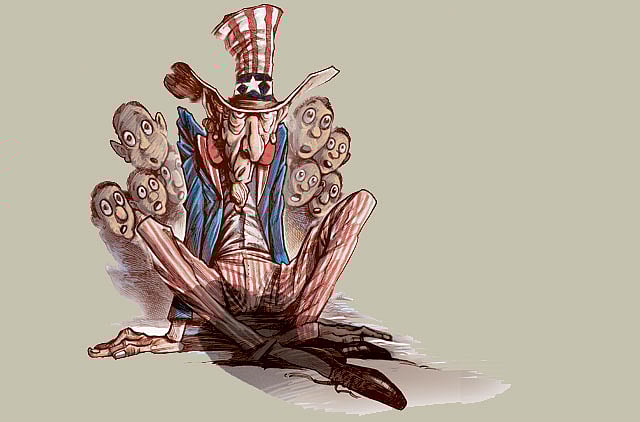
With the decline of America's global pre-eminence, weaker countries will be more susceptible to the assertive influence of major regional powers. India and China are rising, Russia is increasingly imperially-minded, and the Middle East is growing ever more unstable. The potential for regional conflict in the absence of an internationally active America is real.
Get ready for a global reality characterised by the survival of the strongest.
- Georgia
American decline would leave this tiny Caucasian state vulnerable to Russian political intimidation and military aggression. The United States has provided Georgia with $3 billion (Dh11 billion) in aid since 1991 — $1 billion of that since its 2008 war with Russia. Once-and-future Russian President Vladimir Putin harbours an intense personal hatred towards Georgian President Mikhail Saakashvili. At stake: Russian domination of the southern energy corridor to Europe, possibly leading to more pressure on Europe to accommodate Moscow's political agenda.
- Taiwan
Since 1972, the US has formally accepted the mainland's ‘one China' formula while maintaining that neither side shall alter the status quo by force. In recent years, Taiwan and China have been improving their relationship. America's decline, however, would increase Taiwan's vulnerability, leaving decision-makers in Taipei more susceptible to direct Chinese pressure and the sheer attraction of an economically successful China. That, at the least, could speed up the timetable for cross-strait reunification, but on unequal terms favouring the mainland. At stake: Risk of a serious collision with China.
- South Korea
The US has been the guarantor of South Korea's security since it was attacked in 1950 by North Korea, with Soviet and Chinese collusion. Seoul's remarkable economic takeoff and democratic political system testify to the success of US engagement. So America's decline would confront South Korea with painful choices: either accept Chinese regional dominance and further reliance on China to rein in the nuclear-armed North, or seek a much stronger, though historically unpopular, relationship with Japan out of shared democratic values and fear of aggression from Pyongyang and Beijing. At stake: Military and economic security on the Korean Peninsula; a general crisis of confidence in Japan and South Korea regarding the reliability of existing American commitments.
- Belarus
Twenty years after the fall of the Soviet Union, Europe's last dictatorship remains politically and economically dependent on Russia. At the same time, President Aleksander Lukashenko's 17-year dictatorship has stood in the way of any meaningful relations with the West. Consequently, a marked American decline would give Russia a virtually risk-free opportunity to reabsorb Belarus. At stake: The security of neighbouring Baltic states, especially Latvia.
- Ukraine
Kiev's relationship with Moscow has been as prone to tension as its relationship with the West has been prone to indecision. In 2005, 2007, and 2009, Russia either threatened to or did stop oil and natural gas from flowing to Ukraine. More recently, President Viktor Yanukovych was pressured to extend Russia's lease of a naval base at the Ukrainian Black Sea port of Sevastopol for another 25 years in exchange for preferential pricing of Russian energy deliveries to Ukraine. With America in decline, Europe would be less willing and able to reach out and incorporate Ukraine into an expanding Western community, leaving Ukraine more vulnerable to Russian designs. At stake: The renewal of Russian imperial ambitions.
Competing for influence
- Afghanistan
Devastated by nine years of brutal warfare waged by the Soviet Union, ignored by the West for a decade after the Soviet withdrawal, mismanaged by the medieval Taliban, and let down by 10 years of half-hearted US military operations and sporadic economic assistance, Afghanistan is in shambles. A rapid US troop disengagement brought on by war fatigue or the early effects of American decline would most likely result in internal disintegration and an external power play among nearby states for influence in Afghanistan. Pakistan and India would more assertively compete for influence in Afghanistan — with Iran also probably involved. At stake: The re-emergence of the Taliban; a proxy war between India and Pakistan; a haven for international terrorism.
- Pakistan
Although Islamabad is armed with 21st-century nuclear weapons and held together by a professional late 20th-century army, the majority of Pakistan is still pre-modern, rural, and largely defined by regional and tribal identities. Pakistan's political instability is its greatest vulnerability, and a decline in US power would reduce America's ability to aid Pakistan's consolidation and development. Pakistan could then transform into a state run by the military, a radical Islamic state, a state that combined both military and Islamic rule, or a "state" with no centralised government at all. At stake: Nuclear warlordism; a militant, anti-western, nuclear-armed government similar to Iran's; regional instability in Central Asia, with violence potentially spreading to China, India, and Russia.
- Israel and the Greater Middle East
If America's decline were to occur with the Israeli-Palestinian conflict still unresolved, the failure to implement a mutually acceptable two-state solution would further inflame the region's political atmosphere. Regional hostility to Israel would then intensify. Perceived American weakness would at some point tempt the more powerful states in the region, notably Iran or Israel, to pre-empt anticipated dangers. And jockeying for tactical advantage could precipitate eruptions by Hamas or Hezbollah, which could then escalate into wider and bloodier military encounters. Even worse, such conflicts could rise to truly horrific levels through strikes and counter-strikes between Iran and Israel. At stake: Direct Israeli or US confrontation with Iran; a rising tide of Islamic radicalism and extremism; a worldwide energy crisis; vulnerability of America's Gulf allies.
— Washington Post
Zbigniew Brzezinski, national security adviser under US president Jimmy Carter, is author of the forthcoming book Strategic Vision: America and the Crisis of Global Power.
Sign up for the Daily Briefing
Get the latest news and updates straight to your inbox
Network Links
GN StoreDownload our app
© Al Nisr Publishing LLC 2026. All rights reserved.