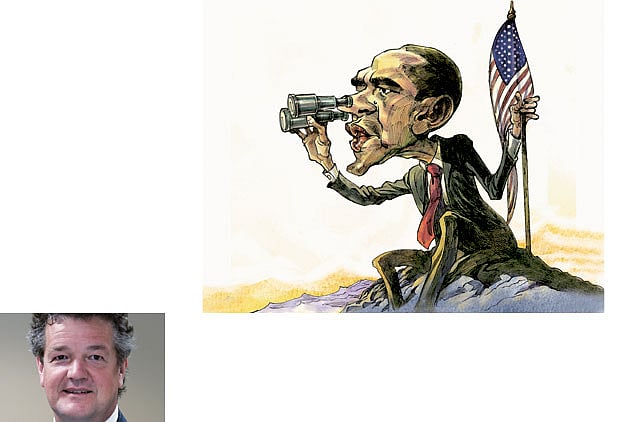
Afghanistan remains the cockpit of Asia, and while the death of Osama Bin Laden will make it easier for the Obama administration to draw down its troops more quickly, it will not change the long-term importance of Afghanistan to American foreign policy in the Middle East and South Asia.
Obama inherited the mess in Afghanistan when he took office. During his election campaign he had promised to add more troops to the Nato forces there and find a military way out of the situation. But when in office, many in Obama's team argued for the opposite strategy of using diplomacy to find a political end to the war while reducing the number of troops on the ground.
Obama appointed former diplomat Richard Holbrooke as Special Representative to Afghanistan and Pakistan, and in 2009, Holbrooke tried to argue that sending 40,000 troops (the famous surge) would be counter-productive as it would have little impact on Al Qaida, which was based largely in Pakistan. (These words were written two years ago by a senior US official. It is strange to re-read them a few days after Bin Laden was killed in Pakistan, and reflect on how misguided US policy has been.)
Holbrooke's views were overruled, in particular by his Secretary of State Hilary Clinton, who has made it a point to always work with Secretary of Defence Robert Gates, a keen supporter of sending more troops.
A fascinating article in the New Yorker by Ryan Lizza makes it clear how bitter Holbrooke was before he died, speaking of "a fractured relationship between the State Department and White House".
But it is good to see that this failed policy has been reviewed. The administration seems to have a new and healthy recognition that the Taliban and Al Qaida are two different organisations, even if they have been allied several times in the past. The Taliban are a political party with an extreme Islamic ideology, but are also firmly based on their Pashtun identity. Al Qaida is an Islamic terrorist organisation with a destructive message focused on the Arab Gulf and the West.
The success with finding Bin Laden points to the administration finally using special forces and others to track Al Qaida, while understanding that tens of thousands of regular troops cannot find individual terrorists hiding in a much wider population.
Positive signals
The administration is heading for a new strategy, in which it will hand over the lead military role in Afghanistan to the Afghan Army (and the killing of Bin Laden means that this might happen earlier than the previous 2014 deadline); that it will help support talks with the Taliban, bringing them into the political process of reshaping Afghanistan; and will continue to hunt Al Qaida, but with special forces and intelligence and not with regular armed forces.
There are signs that this might be working. The current Taliban leaders did not comment directly on Bin Laden's death, but Arsala Rahmani, a former Taliban member who is now part of the High Peace Council told the New York Times that he thought it would drive the Taliban toward negotiations and making peace with the government "because they don't have any other way".
"This is a big blow to Al Qaida and Al Qaida's followers because he was a popular and famous figure, and he was a very expert man and was planning major attacks," he said, adding that "I don't think this will affect the Taliban fight in Afghanistan in the short term, but in the long term it will because Al Qaida helped the Taliban in fighting and other activities."
What is fascinating in Washington is that this new strategy will be implemented by the same cast of characters despite a change in all the top jobs in Washington's defence and intelligence community. Robert Gates will retire as secretary of defence, whose job will be taken by current CIA Director Leon Panetta; but his position as head of the US's intelligence community will be taken by General David Petraeus, the current US commander in Afghanistan.
This means that both Panetta and Petraeus come into their new roles with substantial political clout. Panetta is the architect of finding Bin Laden, a primary aim of the US which eluded them for over nine years, and so he will be able to reshape the military in anyway that he wants.
Petraeus is the architect of what is seen as success in Iraq, and of what is at the very least, a manageable exit from Afghanistan, so he also will have huge political influence in his position at the CIA. Obama is clearly aware of this authority they will carry, and will want to use it to push through his new thinking.
It will be a challenge for both men to move on from the strategy that they have built over the past few years, and on one hand learn to work with the Taliban in building a new Afghanistan, while on the other hand they are hunting down Al Qaida cells.
Sign up for the Daily Briefing
Get the latest news and updates straight to your inbox
Network Links
GN StoreDownload our app
© Al Nisr Publishing LLC 2026. All rights reserved.