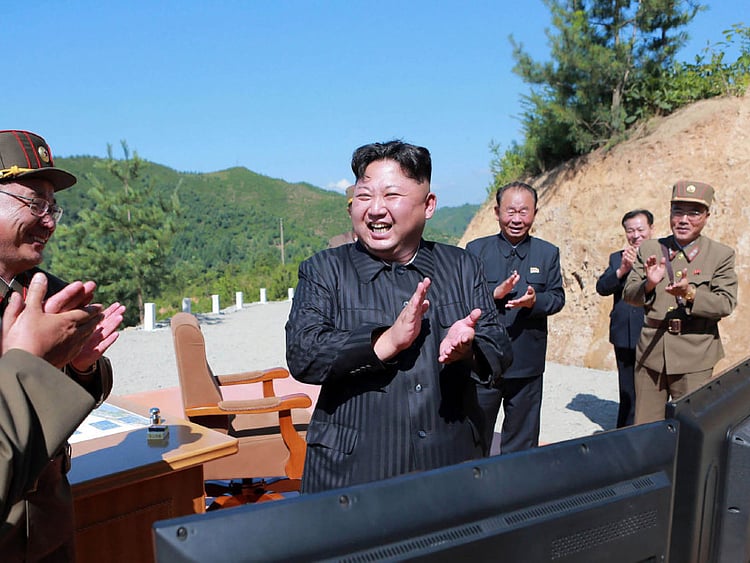
This is not just another North Korean missile launch. The “successful” testing of a supposed inter-continental ballistic missile takes the Korean Peninsula one step closer to a conflict that could drag in the world’s great powers and cost millions of lives. This time, it is different because it threatens a reaction from the United States.
The US closely monitors North Korea’s ability to strike cities on the West Coast, and significant progress towards that goal is unlikely to go unanswered. Worryingly, the test also has the potential to bring Beijing and Washington to crisis point.
China’s position is to press for denuclearisation on the peninsula by getting the US and South Korea to stop their annual defensive military drills, which, Pyongyang claims, are a threat. The North would then suspend missile launches and testing.
Given that the North invaded the South in a surprise attack in 1950, this is a non-starter for US and South Korean leaders. The reaction of South Korea’s new President, Moon Jae-in, was telling. Fresh from a successful summit with US President Donald Trump, he must know the president’s thoughts better than most and his warning was stark: “I hope North Korea will not cross the point of no return.”
Trump put the ball in China’s court, asking if Beijing would “end this nonsense once and for all”. How can the situation be resolved? We do have options, but few have been truly tried.
Contrast with South Africa, which, as an apartheid regime, also tried to establish a nuclear weapons programme. Unlike North Korea, sanctions were rigorous, and the state was more isolated internationally. Largely down to its anti-western rhetoric and claim to be a socialist state, which has made it a useful geopolitical tool, Pyongyang has escaped this level of pressure.
Russia and China are the two main enablers, helping North Korea outwit sanctions with front companies and quiet cross-border trade. Pyongyang’s largest trading partner by far, Beijing made a great show of turning back coal ships in February. However, its outrage over Washington’s sanctioning of a Chinese bank complicit in North Korean money-laundering showed where its interests really lie.
Russia, while pressing for a peaceful resolution, is increasing business links and regularly “rents” North Korean labourers to work in its timber camps. Again, South Africa provides a template. Under US leadership, the international community resolved the issue without the use of force.
Countries in the Middle East and Asia could stop accepting North Korean labourers. We could sanction any financial institution that enables more than the bare minimum of North Korean trade. Certainly, the small arms market that has sprung up between North Korea and China could be stopped and international tourism could be halted. The answers are there, but they demand political will.
It is not merely North Korea sleepwalking towards a conflict. By not taking steps to stop it, we are all doing the same — and it will be a conflict in which Koreans will suffer the most.
— The Telegraph Group Limited, London, 2017
John Hemmings is the director of the Asia Studies Centre at the Henry Jackson Society.
Sign up for the Daily Briefing
Get the latest news and updates straight to your inbox
Network Links
GN StoreDownload our app
© Al Nisr Publishing LLC 2026. All rights reserved.