A string of tragedies in Germany and France has raised identity questions in Europe. An axe attack on a German train, a massacre in Munich, a suicide bombing in a pretty German market town and the murder of an elderly priest at Mass in a village in Normandy — all coming after a series of mass-casualty atrocities in Nice, Paris and Brussels. Europe is on edge. Yet, the reaction of governments is dramatically different. French President Francois Hollande declares that his country is “at war”.
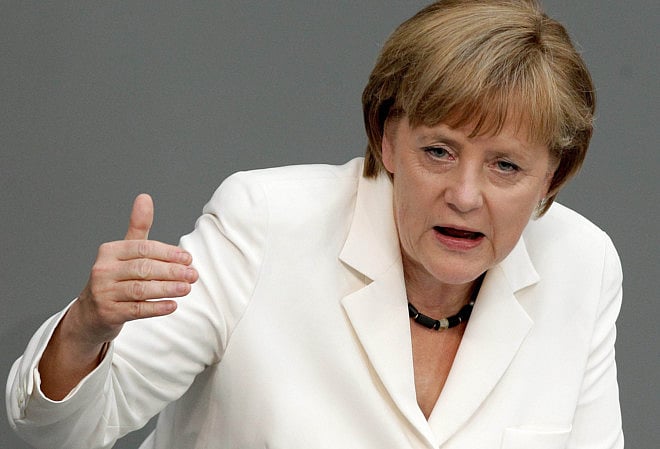
But Europe’s defining response will come in Germany, the country that last year officially offered open house to more than a million migrants. And the mood there is conflicted. Which way will it go? In Berlin, German Chancellor Angela Merkel knows that great strains have been put on the social and physical fabric of her nation by the sheer scale of immigration.
Yet, she remains convinced that honest discipline and administrative efficiency will enable Germany to cope with the surge. “We can do this,” she says again and again. She believes that the controversial “open door” refugee policy was the right — the morally right — thing to do. And she certainly knows that Germany’s own ageing demographics mean that its powerful economic machine needs the skills the migrants can bring (or acquire through its excellent apprenticeship systems).
Increasingly, however, German voters are sceptical. The latest surveys, taken in the wake of the terror attacks and just released, show Merkel’s ratings have dropped by 12 per cent month-on-month. Though she remains popular by standards elsewhere in Europe, just a third of people are happy with her refugee policy and critics have seen their rating rise. All this just a year from the German general election.
Can Merkel respond? Even for a figure as skilful and experienced as she is, the politics of national identity remains an all but taboo topic in Germany, a country still hyper-sensitive to its Nazi past.
The problem is that if establishment politicians do not tackle this issue, other less palatable forces will. In Germany, as elsewhere, virulent resentment is growing among those who feel left behind and ignored by “elites”, stirring uncomfortable memories of the Weimar years. There is a dangerous disconnect. What seems rational to Germany’s leaders — the “open door” policy — threatens the identity of many of the country’s voters. Too many migrants suffer an identity crisis born of a toxic mixture of uprootedness and rejection. And too many of their new neighbours see their identity threatened by the alien cultures of others who compete for their jobs. Too often each acts to confirm the other in their mutual fears and resentments. And for those whose living is hard, the resentment boils over into violence, because they have nothing to lose.
Right to peaceful religious observance
Germany is not unique in this. France knows it well. Terror attacks there have also been a more direct assault on a country that sees itself above all as a secular democracy, where the right of free speech is as sacred as the right to peaceful religious observance. This is why the French establishment — not just the far Right — has reached for the vocabulary of war.
And those in Britain know the problem too. The Brexit referendum was in the end about identity. A secularised establishment reared on the principles of the European enlightenment — whether in Germany, Britain or France — finds it hard to recognise that for voters, identity runs deeper than rational self-interest.
What is to be done? For Germany, honest confrontation with the cultural and social challenges of integration is clearly going to be more important than ever. But this is not just a matter of the right policies of economic, education and care for the marginalised — important though these things unquestionably are.
Something else is called for throughout Europe, including Britain: Open debate about identity. None of us can go back to simpler times when we could take the answers for granted. None of us can duck this debate, uncomfortable though it undoubtedly is.
With a general election coming, this is Merkel’s greatest challenge yet.
— The Telegraph Group Limited, London, 2016
Stephen Green is the author of The European Identity: Historical and Cultural Realities We Cannot Deny.
Sign up for the Daily Briefing
Get the latest news and updates straight to your inbox
Network Links
GN StoreDownload our app
© Al Nisr Publishing LLC 2026. All rights reserved.