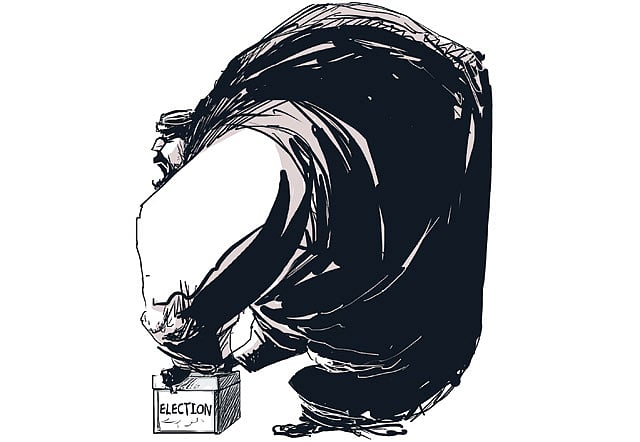
The Iraqi campaign for the upcoming March elections was launched officially on February 12, amidst a highly tensed up atmosphere between the different participating political groups and foreign and regional powers.
This situation was expected by observers, as a result of the importance of the elections internally and on the regional level, in addition to its importance to the countries that established the foundations of chaos in Iraq.
No doubt this election is more important than the last one which had put Iraq on a new track. These elections will be the acid test to find out about the true feelings of Iraqis towards the new route set for them and their country.
In this election campaign, the Independent High Electoral Commission is not alone in the field. Political coalitions and parties are competing for votes as new players have entered the game.
The Justice and Accountability Commission, which took the place of the De-Baathification Commission, is one such entity.
Moreover, the prime minister and other political blocs have also entered the field, politicising the atmosphere and raising doubts about the independence of the Iraqi judicial system. Big foreign players have also entered the game, such as Christopher R. Hill, the US ambassador to Iraq, Joe Biden, US vice-president, and Hillary Clinton, secretary of state.
Other players have joined in behind the scenes, such as a number of neighbouring countries, while Iran's President Mahmoud Ahmadinejad has not concealed his determination to build a new Iraq which responds to the demands of Tehran's Council for National Interest.
The participation of all these players who have no business in Iraq's internal affairs is not positive nor neutral. In fact, this interference contributes to adding more stress to the election atmosphere and increased tensions in Iraq, especially when different parties entrenched against each other rally people to demonstrate against one another in an aggressive manner. It also casts doubt on the impartiality of the election's outcome.
It is worthy to note here that the sectarian issue is not being used as a basic element to gain votes. The Iraqi Accord Front, which was a basic parliamentary bloc representing Sunnis has become secondary in importance after many of its members left to seek more effective entities that work on bigger non-sectarian issues.
The United Iraqi Alliance, the biggest Shiite parliamentary bloc, which dominated political decision-making during the past few years in cooperation with the Kurdish alliance, has also dissolved to become two blocs, the Iraqi National Alliance headed by former Iraqi prime minister Ebrahim Al Jafari and the State of Law Coalition, headed by Iraqi Prime Minister Nouri Al Maliki.
Great game
Some observers consider these new blocs a continuation of the past Shiite dominated bloc despite a few additions of non-Shiite elements. However, the Al Dawa Shiite party, the Islamic Supreme Council of Iraq and the Sadrist movement is still in control.
The Kurdish alliance on the other hand has become weaker as a result of the splits that took place lately in the National Kurdish Union, forcing new balances in the Kurdish region's parliament.
Two secular blocs have also emerged on the political scene, the Unity Alliance of Iraq, headed by Minister of Interior Jawad Al Boulani, and the Iraqi National Accord headed by former premier Eyad Allawi. Both blocs have a special attraction to the voters because their mostly nationalist members do not move under the banner of sectarian divisions.
That is why Allawi's bloc was targeted by the Justice and Accountability Commission. A number of its candidates were barred from joining the elections on the pretext of their being ex-Baath party members, or were accused of promoting its policies.
Iraqi elections today have nothing to do with the ordinary parliamentary competition programmes, nor do they reflect a democratic approach to the elections. It is a real bone-breaking battle. Political blocs that have ruled Iraq and profited from their positions consider these elections a battle for survival.
Four years ago in the previous elections, the general atmosphere allowed the employment of religion, sect and ethnicity. People were misled by candidates who hid behind religious figures to acquire their votes. As a result a huge number of people sat under the parliament's dome, which Iraqis knew nothing about, and did nothing for the country except multiply the problems it faces.
Today, because Iraqis have come to understand the political situation that was forced upon their country, these political groups have decided to change their agendas, employing new faces to dissect and divide the Iraqi community in the hope of dominating the country for another four years.
The battle set up by these political groups is completely imaginary. The political groups and parties known to Iraqis during the 1950s, 60s and 70s are mostly gone and the popular support they enjoyed has diminished. The Baath party is one of these political entities.
However, using the Baath party as a false pretext to ban people from joining the political process entails other goals that are not to the advantage of Iraq.
Dr Mohammad Akef Jamal is an Iraqi writer based in Dubai.
Sign up for the Daily Briefing
Get the latest news and updates straight to your inbox
Network Links
GN StoreDownload our app
© Al Nisr Publishing LLC 2026. All rights reserved.