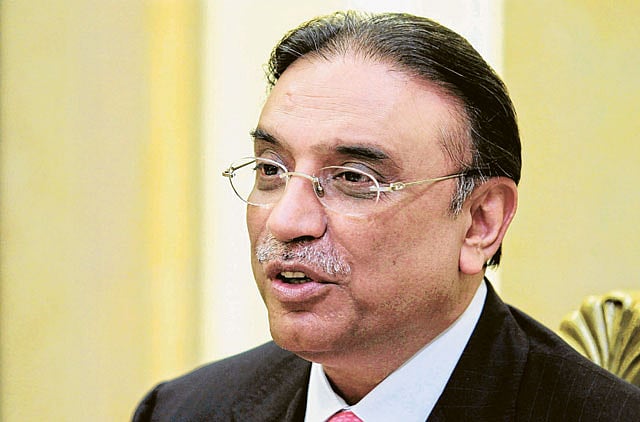
When Pakistan's President Asif Ali Zardari was met last week by a group of visiting US dignitaries, he promised to clamp down hard on the Haqqani network whose members inhabit the Afghanistan-Pakistan region. But it was natural for many Pakistanis to simply not take him seriously.
In over three years since becoming president, Zardari's ability to deliver on any of his promises has been increasingly in doubt. His failure to oversee even a relative improvement in Pakistan's outlook has only made Zardari the butt of criticism.
For Zardari's coterie of supporters, his hands in many instances have been clearly tied. Working under the shadow of a powerful army which has ruled over Pakistan in the past clearly brought out limitations in the leadership.
Zardari's backers would even claim that accusations of wrongdoing notably corruption targeting the Pakistani leader, have clearly been exaggerated. Though he has faced past accusations of graft on a number of charges, none has been conclusively proven. Theoretically, this may be true. Yet, there are powerful counter-arguments to each claim in defence of Zardari.
Without elaborating on the details of these counter arguments, suffice it to note that Zardari's reputation either as an individual or as a statesman has made him more vulnerable during his current tenure. Consequently, it is not surprising that the Pakistani president's already weak and compromised moral authority, necessary to help him lead from the front, has simply eroded further.
It is not surprising that few may have taken him seriously on his promises to his American visitors last week, seeking to target the Haqqani network — a goal the sizeable US military presence in Afghanistan appears to have. If indeed Zardari was even to try to deliver on his commitment, many in Pakistan would have ample reason to ask if he has the means to take the country's army and security services along.
While the defence services are already engaged in a vigorous battle against Taliban militants in the border regions next to Afghanistan, their ability to redouble their efforts on Zardari's call may just be part of the means that are necessary to press ahead. A far more vital ingredient for successfully opening a wider front against hardline militants along the border region relates to Pakistani public opinion.
An attack on the Haqqani network, which the US has been pushing Pakistan to undertake for some years, will inevitably provoke a fierce militant backlash. Eventually, it will be far more essential for Pakistan's army and the intelligence services to also receive the essential backing from the country's mainstream population.
Rise of Khan
Battles fought on the home turf in Pakistan in its ongoing campaign against hardline militants can simply not be won unless it becomes an effort that is embraced by the majority of the country's population. Yet, Zardari seems to lack the ability of inspiring Pakistan's mainstream population, clearly tired of his government's failure to begin tackling some of the biggest challenges surrounding their lives.
In a related development in recent weeks, the beginning of the build up of a popular momentum in support of Imran Khan, Pakistan's cricket star turned popular politician, clearly points towards the writing on the wall. While Zardari and leaders of the ruling Pakistan Peoples Party (PPP) appear to have lost the support of the country's mainstream population, Khan by contrast seems like the new winner. Still, it is difficult to predict the outcome of Khan's political journey given that the popular build-up in his support has just begun. But unlike politicians such as Zardari, Khan has the distinct advantage of having a favourable personal history. Left untainted in the murky world of Pakistan where individuals in high places include many surrounded by financial controversies, Khan built the country's first exclusive cancer hospital followed by what seems like a promising educational project.
Any visitor to Khan's home in the suburbs of Islamabad will be stunned by the virtual absence of personal souvenirs such as bats and balls from some of the most memorable events in the history of cricket.
Khan even chose to auction his prized personal belongings, only to gather funds for his philanthropic work. It's not surprising that while Pakistanis have lost hope in their leaders of today, many are eagerly searching for a political messiah to rid their country from its many deepening challenges.
Farhan Bokhari is a Pakistan-based commentator who writes on political and economic matters.
Sign up for the Daily Briefing
Get the latest news and updates straight to your inbox
Network Links
GN StoreDownload our app
© Al Nisr Publishing LLC 2026. All rights reserved.