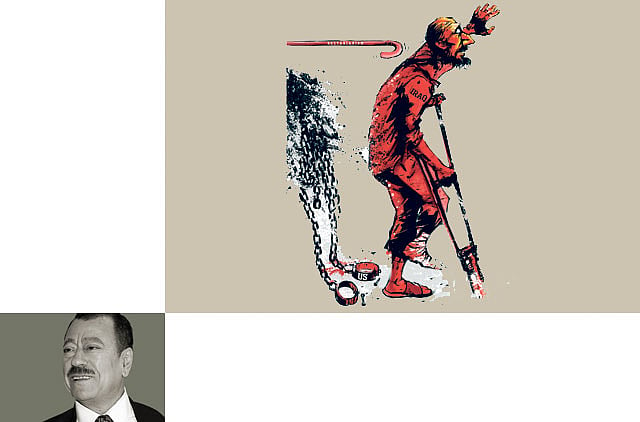
In 2003 US president George W. Bush announced that the US invasion of Iraq would result in a "model of democracy" for the whole region to emulate. Now the US army has withdrawn from Iraq and President Barack Obama tells us that it does so with "heads held high", leaving behind them a "stable, solid Iraq and a friend of America".
The first great lie about the Iraq war, of course, was that Saddam Hussain possessed weapons of mass destruction that could reach the west in the blink of an eye.
The Middle East has not been offered a model of democracy in Iraq. Earlier this month Transparency International released its annual Corruption Perceptions Index. Iraq is the seventh most corrupt country on the planet. Water, electricity and education are in short supply to Iraq's long suffering populace — things were better, in these respects, under Saddam Hussain.
Nor is Iraq "stable". The Al Qaida dominated Islamic State of Iraq (the umbrella for the Sunni insurgency) responded to Obama's announcement that the US was bringing its troops home, "mission accomplished", with a series of deadly bombings on government targets. There are presently around 30 serious attacks a week across the country according to the US ambassador in Baghdad.
Iraq is not "solid". The country's political blocs have failed to resolve their differences, and enmity between Prime Minister Nouri Al Maliki and his rival for power, Eyad Allawi, is more vicious than their combined enmity towards Saddam Hussain ever was.
Sectarian conflict, which scarcely troubled Iraq before the arrival of American troops on its soil, was fomented and exploited by Al Qaida, leading to many deadly attacks on civilians, even at their places of worship. Now it is embedded in the national mindset.
With the Americans gone, civil war between Sunni and Shiite factions is a real possibility. The rot of sectarianism is at the heart of government: asked to define himself recently, Al Maliki replied "a Shiite first, an Iraqi second, an Arab third and a member of the Dawaa party fourth".
No mention in Al Maliki's reply of being America's "friend". Iraq's friends now that the US has gone will be found in Shiite Iran. Most of the Shiite dominated new Iraqi government have close ties with Iran — many having been in exile there. After Iran, Iraq's next new best friend is Turkey. America is firmly on the reserve list.
Obama is bringing his troops home but that was not the original long-term plan. The US had constructed four huge military bases in Iraq, each the size of a small city and equipped with everything the American soldier could possibly require from burgers to baseball pitches. They were there for the duration but things did not go as expected.
The US did not anticipate the ferocity and steadfastness of the resistance which now claims a bloody victory.
The war has cost a million Iraqi lives, the deaths of 5,000 coalition soldiers and 30,000 wounded. The $1.5 trillion (Dh5.50 trillion) spent on war has greatly damaged the US economy. America's reputation among the world's 1.5 billion Muslims has been ruined and the Stars and Stripes has become the object of the deepest hatred and resentment for the majority of them. Nor did the US expect the regime it installed and nurtured in Iraq to be quite as treacherous and self-interested as it has turned out to be. The US toppled the Sunni dictator Saddam Hussain to make way for it, but having secured its position thanks to American arms and security, Al Maliki's government has turned its back on its erstwhile champion and got into bed with Iran, America's current nemesis, instead.
Militarily the occupation of Iraq was a humiliating failure for America. The "shock and awe" campaign succeeded in terrifying the Iraqi population and sent Al Qaida running for cover (only to return when the coast was clear) but the soldiers on the ground did not succeed in wresting even a street corner from the control of insurgents in the course of the entire eight years .Wider repercussions should be anticipated. From the perspective of Al Qaida and other violent jihadi groups, the insurgency has prevailed over the world's greatest superpower in Iraq. As the Taliban and its allies (including Al Qaida) seem similarly poised for victory in Afghanistan, the jihadi movement is experiencing renewed momentum and there are already calls for a mujahideen army to muster in Syria.
Iraq limps into the future, battered and bloodied. The new regime and its acquisitive entourage, is looting the nation's wealth and has little interest in the Iraqi people, human rights or the establishment of a democratic society based on the principles of justice, equality and freedom.
Far from leading the way in the Arab world, the Iraq of 2012 will find itself way behind the nations of the Arab Spring. The rumblings of revolution have spread throughout the region and valiant, full-blown uprisings are under way in Syria and Yemen. In Libya, Tunisia and Egypt the dictatorial regimes have been removed.
The noble Iraqi people, awakening from the nightmare of an eight-year occupation by America, have yet to make out, in the grim new dawn, the reality of their political landscape: Saddam Hussain's brutal dictatorship has been replaced by another, sectarian, dictatorship in a full blown alliance with Iran.
Abdel Bari Atwan is editor of the pan-Arab newspaper Al Quds Al Arabi.
Sign up for the Daily Briefing
Get the latest news and updates straight to your inbox
Network Links
GN StoreDownload our app
© Al Nisr Publishing LLC 2026. All rights reserved.