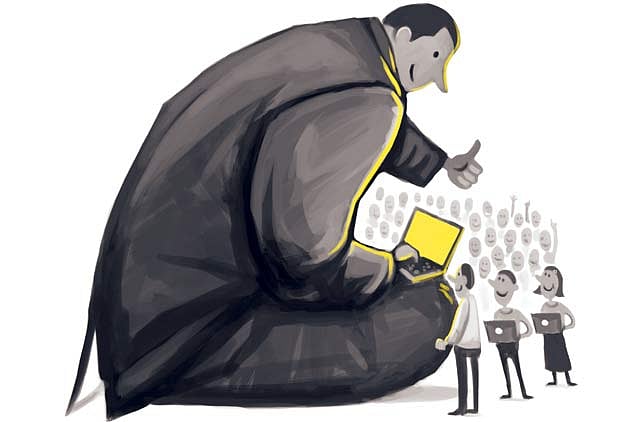
It does not look like Egyptian President Hosni Mubarak nor Vice-President Omar Sulaiman will leave office anytime in the next few weeks, but this apparent lack of action hides an underlying truth that the Arab world cannot be the same after the past two weeks of action on Cairo's streets.
Notice has been served to Arab leaders that they will have to adapt to a new world or risk being sidelined and deposed. This emerging social reality is not yet a firm political fact, and the process is so new that it is not automatic and so cannot be taken for granted. But leaders will have to learn new skills in order to keep in touch with their populations. And more importantly, they will need to want to keep in touch with their people.
Leadership in the future cannot be restricted to chairing an obedient cabinet, and giving a few nationwide addresses on important national anniversaries. It has to become a much more active process of inclusive dialogue, which will be much more challenging.
It will brutally expose those leaders whose sole idea is to hang on to power, and it will mean that successful leaders in the future will have to understand and engage with the aspirations of their people.
This process is not restricted to the Arab world, but that is where the change is the most dramatic because the unchanging regimes have managed to hang on for so long. They now face the full impact of the social and information revolution which has been gathering pace around the world for the past decade.
Of course, there will still be dictatorial leaders around the world who will survive for a long time, but they are sure to have their exit-strategies planned a lot more carefully than they did a month ago.
The shock to the Arab world is not that the marches occurred, nor that brave men and women faced their security forces, in the full knowledge of what fate might strike them. The shock is that the police and security forces in Tunisia and Egypt did not round up thousands of protesters, did not shoot their way to control the situation, and did not frighten the people back into their homes, as they have done for decades.
This acceptance of change by the leaderships in Tunisia and Egypt was not due to phone calls from US President Barack Obama, although international pressure will have weighed in the balance.
It was far more due to an internal realisation that it is no longer possible to dominate a population by force. Even Mubarak's government, which ultimately derives its legitimacy from the Free Officers' revolution in 1952, recognised that military and security force must give way to social forces.
The key skill that future successful leaders will have to have is the ability to work with their populations, and the reality is that the present young generation's aspirations are much more focused on social and lifestyle (and even business) issues, rather than the ideological forces which drove their parents.
Economic aspirations
The Arab nationalism which drove their parents and grandparents into the streets to protest against their colonial legacy has given way to more career and family focused hopes. Many Arab 20-somethings speak of their plans for an MBA or other professional qualifications, rather than of joining the struggle and seeking political glory.
What is likely to happen is that leaders around the Arab world will recognise this, and may even try to match their peoples' hopes. Economic liberalisation and social freedoms are relatively easy to organise in today's world, particularly if the government makes a crucial transition and accepts that its role is only to set the rules, rather than being the dominant player.
But what happens after this will probably surprise the leaders, because once these social and business advances are put in place, the huge wave of young people taking their place in society will demand more inclusive politics.
In most Arab countries, more than 60 per cent of the population is under 25. They have grown up in an internet-friendly world, and they will expect their leaders to work with them, rather than lecture them.
The naturally slow pace of demographic change hides a much more urgent social reality. People will not wait forever, and this is what has been happening in Egypt and Tunisia.
This dramatic shift has been personified in the unlikely person of Wael Ghonim, the 30-year-old Google marketing executive whose net activism was key in getting the crowds into Cairo's Tahrir Square.
He was held by Egypt's security forces for 12 days, and after his release this week, Ghonim told reporters that he was repeatedly asked if he was part of a plot by the Muslim Brotherhood, the outlawed opposition party.
He said that the authorities did not seem to understand that the current rebellion has been fuelled by a technological revolution that has encouraged savvy young men to speak out.
This situation offers two huge challenges. Firstly to the protesters, who are "dreamers" according to Ghonim. They will need to turn their dreams into coherent political demands. Secondly, the leaders, who will prosper in the future, will have to incorporate their people's dreams into their political thinking.
Sign up for the Daily Briefing
Get the latest news and updates straight to your inbox
Network Links
GN StoreDownload our app
© Al Nisr Publishing LLC 2026. All rights reserved.