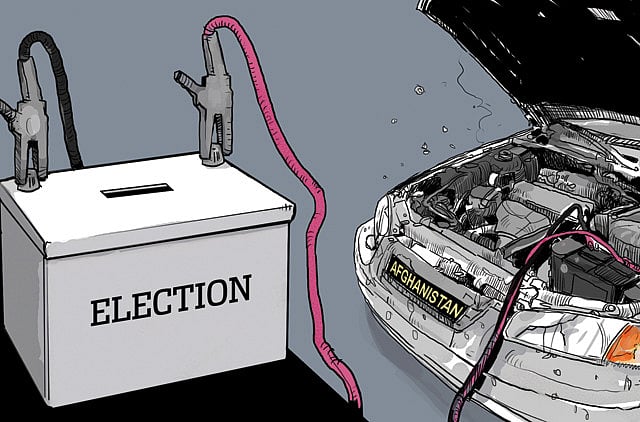
Tomorrow, Afghans will head to the polling stations to vote for their next president — the first transfer of power since 2001 when President Hamid Karzai came into office. Parallel to this, the US and Nato troops are continuing to withdraw as part of ending their mission by the end of this year. A few questions remain, though. How will Afghanistan and the Afghan National Security Forces (ANSF) cope after their withdrawal? What will be the outcome of the elections and what will happen next?
Beginning this spring, the ANSF will start their task of giving civil society room to develop politically and economically. Without a doubt, Afghanistan has come a long way since 2001 in terms of women’s rights, education, health and so on. But more challenges remain. Afghan governance is weak, corruption is still at large and we have no control over our borders. Instability throughout Afghanistan remains, there is no access to basic services in rural areas, the economy is highly dependent on international funding and there is no certainty about where the April 5 elections will leave Afghanistan.
The relationship between the Afghan government and Washington has been on a downward spiral since Karzai’s re-election in 2009, with his most recent refusal to sign the Bilateral Security Agreement, which he negotiated with the US but refused to sign. The agreement allows the US to keep some troops in Afghanistan post-2014. Other factors have also strained the relationship further. In early February, it was reported that Karzai was involved in secret talks with the Taliban to reach at a peace deal without the knowledge of the US or other western allies. Also, the release of the 65 prisoners, who were claimed to be Taliban associates, was ordered directly by Karzai despite strong US and Nato criticism. The Afghan president has come under heavy pressure to sign the Bilateral Security Agreement. The US is considering keeping about 10,000 troops behind in Afghanistan to fight the Taliban. The force will train and mentor Afghan troops and some US Special Forces will also be left behind to hunt down Al Qaida. All 10 candidates seeking the presidency in tomorrow’s elections have said they will sign the security agreement. Among the front-runners are Dr Abdullah Abdullah, who came second in 2009, former foreign minister Zalmai Rassoul and former World Bank economist Ashraf Ghani. A poll conducted by an Afghan TV channel showed Abdullah leading the presidential campaign followed by Ghani with Rassoul as third.
The ethnicity question is important and plays a huge role in Afghan politics. From the main presidential candidates, Abdullah is an ethnic Tajik but he is also half Pashtun; Rassoul and Ghani are both ethnic Pashtuns. The inclusion of all ethnic groups is important in the upcoming elections, so all candidates are strategically using the ethnic card to win votes. Afghanistan is hardly ideal soil for growing democracy, but it is not as infertile as other places where democracy has taken root. Afghanistan does not have a strong history of democracy and an imported model of democracy will not work or be accepted. The 2009 elections were a test of the level of democracy that could be achieved in Afghanistan. The results clearly showed that there was not much understanding of true democracy. Of course, democracy cannot be planted like a seed in a country and of course, one cannot expect Afghanistan or its people to learn about it overnight. I mean, how long did it take for the US to practice the true form of democracy? Similarly, it will take a few more decades before Afghans can practice true democracy. The ample electoral fraud and alleged claims of rigging of the votes by Karzai’s supporters proved that the 2009 elections were a failure in all respects.
An inclusive, fair and free election process is crucial and a perquisite for a successful political transition. The legitimacy of the elections will determine whether or not the Afghan people can put their confidence in the political order of their country. More importantly, the elections need to address the needs of the Afghan people. The international community and the US need to ensure that the election process is a smooth and peaceful one in order to encourage the involvement of civil society. Afghans will not tolerate another fraudulent election.
The Taliban have already threatened to disrupt the elections. [Following a series of attacks over the past few weeks, the Taliban launched a major attack last Saturday on the Election Commission headquarters in Kabul, killing at least five people]. A violent election will only undermine the claims of the Afghan president and the international community that Afghanistan has a functioning state system. Negotiations with the Taliban remain a key issue as all attempts in the past have failed. Unless a deal can be reached that will protect all the humanitarian achievements made in the last 10 years or so, Afghanistan will be faced with uncertainty about its future.
The US has played an integral role in the country’s development since 2001, so it is important for Washington to support the Afghan people in this defining period. Its involvement is critical, but at the same time, it should be sensible, in order to help the country achieve political sustainability and economic stability. A failed transition will only put Afghanistan in a state of instability and further fragmentation. The next president will be faced with the challenge of a new era where the Afghan Army and police will confront the Taliban without the help of international troops and a decline in international aid. The absence of electoral monitoring by the United Nations and the lack of attention by international community will lead to an absence of political participation of Afghan people.
The Afghan National Army and the Afghan Police are in no position to fight the Taliban and other extremist movements on their own. Therefore, the US should maintain its relationship and fulfil its commitments by making sure that the international community financially and politically supports Afghanistan. These variables are needed for its stable future. A sharp decline in international aid will leave Afghanistan crippled and struggling for its economic survival.
Fatima Rabbani is an Afghan women’s activist and has an Msc in State, Society and Development from the School of Oriental and African Studies, London. You can follow her on Twitter at www.Twitter.com/@fatoomrabbani
Sign up for the Daily Briefing
Get the latest news and updates straight to your inbox
Network Links
GN StoreDownload our app
© Al Nisr Publishing LLC 2026. All rights reserved.