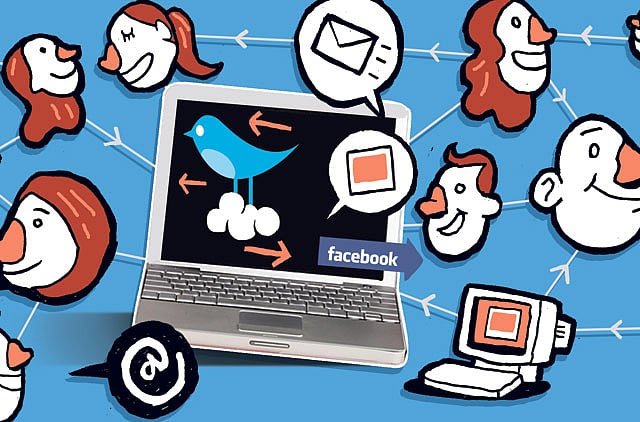
From being panned as a time-killer to being hailed as ‘the digital epicentre of the Arab Spring’, social networks have come a long way in the past decade. They are now redefining how we communicate and connect as a society. From Facebook, Twitter, LinkedIn and Tumblr to the youngest entrant into the social media scene — Google+, wall posts, tweets and personal updates seem to have become a part of our daily discourse. Whether it is talking to a friend in New Mexico, or finding a business contact in New Delhi, social media tools are being used by millions every day to enhance their social interactions. So, has social media truly revolutionised communication?
In this month’s live debate, Gulf News readers debate whether social media has made our interactions more fulfilling, our connections stronger and our friendships last longer. Here are the excerpts from the discussion. If you would like to share your views, post them on our Facebook page ‘Gulf News Al Nisr Publishing UAE’ or tell us at readers@gulfnews.com
People on social networks are more willing to trust others.
Anureet Kaur: I agree. I study in Toronto, I have grown up in Dubai and some of my friends are in India, UK and Australia. So, when we have to interact we use Facebook and messaging services. At that level, yes, I think we do build a lot of trust. But, giving your information to everyone and making your life an open book can be really risky at times. Some people could be hiding their real identity and could try to misuse the information you provide. So, it is important not to add people you don’t know.
Aisha Samrah: I partly agree. Since I have a blog, often unknown people try to add me, and I add them too. But it depends on the conversation you are having. If they would just like to add you because of your work, that’s okay. It all depends on the person and the situation.
Sunetra Gupta: I don’t add strangers as Facebook friends, because I am aware of the dangers. But I do know of friends who add random strangers and start chatting with them. But I would definitely say that Facebook has made the world a friendlier place, because before the social networking boom, people would not open up so quickly, they were less eager to make friends and they didn’t want to give their opinion on so many things.
M. Ashraff Nazim: There are millions of users of Facebook and Twitter today and companies advertise their products and services on these websites, which will no doubt enhances business development. They are turning out to be the best marketing platform today.
Mohammad Zaher: There are two elements to this. Firstly, the process of meeting people, which social media has definitely made easier. If you look at social media, it is a reflection of society. If you met someone at the restaurant, it would take you up to two, three hours to really know them, but on Facebook in a second you can open their account and find out about them. In their Twitter account, their last few tweets can give you an insight to who they are. From the information point of view, social media has definitely made it easier for people to get information and also trust this information. Wikipedia is the biggest example — it is created and edited by people, its information has been proved to be highly accurate. This is due to a very interesting theory called ‘wisdom of the crowd’ — that a crowd, collectively, is more likely to give you the right answer, and while you may stumble upon some wrong information every now and then, we also have the power and tools to search for and verify such information.
Aisha Naseem: When it comes to meeting and talking to people, it all depends on what kind of a person you are. If you think you can handle yourself, you know how to present yourself, what [information] to hide and what to give, adding people as friends on Facebook shouldn’t be a problem. When you talk about social media having made the world a friendlier place, when celebrities gradually started joining Twitter and started tweeting about their everyday lives, it brought down that wall between the common people and celebrities.
The Internet is not linked to social isolation.
Anureet Kaur: From my personal experience, when my friends post on Facebook telling me they are going to a particular place, I just tell them I can’t make it. So, yes, it is isolating, because I am also a victim of that isolation.
Aisha Samrah: Keeping a proper balance between your virtual and real friends is extremely important. Going outside and interacting with people is more fulfilling and satisfying than a virtual friendship. I prefer meeting people in real life, and then probably just keeping in touch with them online.
Sunetra Gupta: I don’t agree, because you can go into communities and find people who have the same interests, even if it is something as obscure as 15th century poetry.
M. Ashraff Nazim: It can be a fun place to spend our time, but on the other hand it is not the safest place for children. Parents who allow their kids to access Facebook should take the time to make sure their experience is as safe as it can be.
Sunetra Gupta: Meeting up on Facebook can also lead to reunions in the case of grown-ups. They are too busy with work so they don’t have the time to talk to people or meet up, but Facebook and Twitter have provided such a platform for them to be able to do so.
Mohammad Zaher: Research has shown that more than 50 per cent of the time spent on social media networks is spent communicating with others. We are not isolated, we are just communicating with people in a different way. Also, ‘subjective isolation’ is a term for when a person is isolated because they do not feel comfortable talking to others, not having the confidence to go out and meet people. In such cases, social media is actually helping people because it is acting like a walking stick. There are people who are extremely shy and cannot talk to others. Social networking sites are giving them a chance to talk and slowly building their self-confidence. There was also research that I came across which said that people who are active on social networking sites are also more likely to say “Hi” to their neighbours.
Aisha Naseem: It is not possible for me to be with my sister who is in India right now. People ask me if I miss her, and I say, no. I am in touch with her every day and we talk about all the things we would normally. There are school friends who I may not have normally spoken to in school because they are interested in different things. But, I can go online and get to know about them, what they do, their interests. It gives me something to talk about with them.
Imran Shah Khan: I completely agree. It gives you many options; you find many new people to meet. I have just met this group of people right now. But if I had met them online earlier and we knew that we are meeting here at Gulf News, I would get to know them better and we could probably talk more freely and understand each other better.
Social-networking users are much more politically engaged, as demonstrated by the Arab Sp ring.
Anureet Kaur: Yes, a lot of people formed groups in Toronto and are starting protests there [to support the uprisings in the Arab world]. So, you can see people being extremely engaged politically.
Aisha Samrah: It does make you more politically engaged. It also lets you voice your problems, they get a platform and the smallest of your problem gets recognised.
Aisha Naseem: I don’t think I would have been able to go physically and be a part of the protests in the Middle East, walk down a square with a board in my hands. But by at least ‘Liking’ a Facebook group I can support their work.
Mohammad Zaher: I actually disagree. I think if you can just rephrase, social media users are more engaged in general. We have to understand that social networks are a reflection of society, so if there is unrest in society, it will be reflected online. If my society is now cheering for the World Cup, that will be reflected online. We cannot say that because somebody is active on social networks, they are more politically active. The right thing to say would be that if we are active on social networks then we get the opportunity to express our opinions more easily.
With social networks, friendships formed at a young age stay with you forever.
Anureet Kaur: If you have around 700 friends on Facebook, it is a bit ridiculous. You don’t know all of them, you may have interacted with them once or twice and then you added them. Yes, if you really know them and constantly interact with you, that’s different. But if you just have someone who messaged you once, you’ll just delete them. That’s what I do.
Sunetra Gupta: Later on in life, I might delete some of the people on Facebook friends right now for various reasons. So yes, friendships can stay forever, but only if you want them to.
Aisha Naseem: On the last day of school, we were running high on emotions, but we also had the knowledge that we will still be able to be in touch with each other through Facebook. It is like an invisible support system. In the future, if things go wrong, if you move to another country, don’t worry. Facebook’s there.
Imran Shah Khan: I had to go to Chennai, India, for a Model United Nations conference. I didn’t know anyone there, so I went to their website, looked at the people attending, put their names on Facebook and added them as friends. So, when I reached India, they already knew me and we are still friends. Social networks help you make new friends, and they do stay with you for long.
Sign up for the Daily Briefing
Get the latest news and updates straight to your inbox
Network Links
GN StoreDownload our app
© Al Nisr Publishing LLC 2026. All rights reserved.