How Filipinos can thrive amid Marcos-Duterte split
Challenges the Asian nation of 116 million faces amidst Marcos-Duterte breakup
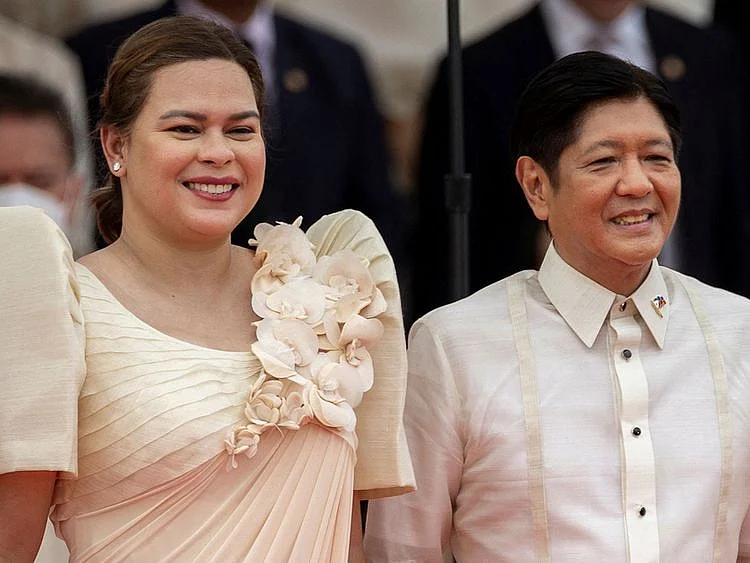
Manila: At a raucous 2022 campaign rally, the two most formidable names in Philippine politics stood side by side, sealing an alliance that seemed unstoppable.
Before a sea of roaring supporters, then–vice presidential candidate Sara Duterte turned to her running mate, Ferdinand Marcos Jr., and declared, “I love you.”
It was more than a promise: it symbolised the union of two political dynasties long rooted in opposite ends of the vast archipelago.
Marcos carried the legacy of his father, the late strongman who ruled from the north. Duterte was the daughter of a firebrand president whose power base lay in the middle and south.
Together, they formed a ticket that fused geography, machinery, tribalism and myth — north, centre and south, restoration and continuity.
The result was decisive: Marcos Jr won the presidency by a landslide 31.6 million votes, more than 16m ahead of second-place Leni Robredo.
Sara Duterte overwhelmingly won the vice presidential race, with 32.2 million votes, a 22m gap over her closest rival, Francis Pangilinan.
In one sweeping mandate, the victory bolstered two of the Asian country’s most powerful political brands.
That was then, this is now.
After few months into his term and following a short honeymoon period, Marcos Jr started drawing insults hurled by ex-president Rodrigo Duterte, repeatedly calling him "bangag", i.e. drug addled.
Once closely aligned, the Duterte-Marcos tandem has dissolved into a bitter rivalry.
The Duterte faction, led by Sara, withdrew support from Marcos and began to amplify criticism of his leadership, particularly on foreign policy, drugs and corruption.
And in Manila’s ever-dramatic political theatre, critics say the Marcos camp isn’t just governing — it’s allegedly staging a full-blown demolition derby aimed at Sara.
First came the impeachment rumblings, sounding less like whispers and more like construction wrecking balls.
Then came the geopolitical plot twist: former president Rodrigo Duterte, Sara’s father, faced scrutiny at the International Criminal Court.
Allies cry political vendetta; rivals call it accountability.
The rupture reflects deeper fractures within Philippine society. Historical divides along ethnic, regional, tribal and clan lines now intersect with partisan politics.
In Mindanao and the Visayas, for example, Duterte’s legacy still resonates among his staunch supporters, many of whom reject narratives critical of past policies.
Conversely, among younger and urban voters, broader concerns about governance and civil liberties have driven dissatisfaction with both dynasties.
Tensions, challenges
These fault lines are increasing. Social media reflects the abyss of verbal brutality and disinformation, driven by AI, that further deepens distrust and divisions.
Beyond domestic politics, the Philippines must contend with pressing regional and global challenges.
Geopolitically, Manila’s position between Washington and Beijing places it at the center of strategic big-power competition.
Tensions over overlapping territorial claims and military security compel Manila to balance partnerships with the US and ASEAN allies without alienating China, which remains a major trading partner.
It’s not all bad news
There are bright spots on the diplomacy and energy fronts.
Moreover, a number of game-changing laws had been enacted in recent years enhancing the country’s attractiveness to investors.
These include the 1935-era Public Service Act amendments (now boosting foreign investments, competition, and lowering costs for consumers and investors); the Accelerated and Reformed Right-of-Way (ARROW) Act (RA 12289) which modernises land acquisition for infrastructure projects, cuts delays and unlocks investment potential; the Public-Private Partnership Code (RA 11966); the CREATE More Act; the New Government Procurement Act (RA 12009); updates on the Mining Law (RA 12253), as well as the EVIDA Law (RA 11697, aimed at boosting electric vehicle adoption).
More reforms are needed.
One: a badly-needed tweak to improve ease of doing business (cutting down high logistics/power costs, and curbing complex bureaucracy).
Two: an update to the Bank Secrecy Law originally passed in 1955, which critics say protect the wrong people in 2026.
Three: The long-overdue Anti-Dynasty Law, prescribed by the 1987 Charter, but never done.
Given the opportunities, economic and geopolitical tailwinds, the Philippines continues to face an uphill battle to sustain growth and sandbag against external vulnerabilities.
Boosting investor confidence, improving the business climate, and creating more jobs remain as key imperatives.
Tourism — once a key engine of growth — has struggled to recover fully, while infrastructure commitments persist.
Energy sector: Bright side
The energy sector is one bright side, having seen a massive spike in investments, and job creation.
For example, the Board of Investments (BOI) reported that energy-related projects topped investment approvals for consecutive years, with 2024 and 2025 both breaching ₱1.5 trillion ($25.9 billion), marking a "golden age" of energy infrastructure.
In 2024, the Philippines ranked 2nd in the world as the most attractive emerging market for renewable energy investments, thanks to the government’s target of 35% RE in the power mix by 2030 and 50% by 2040.
Education and skill development remain national priorities as younger generations compete in a globalised economy.
But systemic corruption and weaknesses in governance undermine public trust and service delivery. The proliferation of fake narratives online — targeting public figures, institutions and even historical memory — compounds this challenge.
Clearer digital literacy initiatives and regulatory frameworks are needed to counter misinformation that distorts public discourse.
Term limits
Amidst these shared challenges, constitutional term limits (6 years, single term for president and vice president) emerge not as arbitrary constraints.
It’s a sacred insurance: 6 years is too short for a good leader, and too long for a bad one.
Still, they provide crucial safeguards against abuse of power.
Term limits encourage political renewal, create space for emerging leaders, and reduce incentives for entrenched patronage networks. Abuses of the party-list law also need to be curtailed.
Amidst all these, Filipino voters are the ultimate judge on how they want to be governed. At the moment, it’s not very encouraging: 4 sets of siblings (Cayetanos, Estrada/Ejercito, Tulfos, Villars) are sitting in the 24-member Senate.
They call Manila home. This upper chamber is supposed to represent an entire nation of 116 million.
Come 2028, Marcos Jr's successor must navigate these challenges and opportunities well.
On Wedneday, Sara Duterte, born and raised in the southern city of Davao, decalred: she wants to run for the country's highest elected office.
Now, the battle lines are clear. Will Filipinos give her the mandate?
Between now and May 2028, wild things could still happen, and fast. In declaring her bid for the presidency, Sara is sandbagging against potential political floods that could inundate her.
Her father, ex-president Rodrigo Duterte, remains detained in The Hague awaiting trial for crimes against humanity arising from the deadly drugs war unleashed during his six-year rule (2016-2022).
In announcing her presidential run early, Sara could scare Congress enough to ditch the impending impeachment process against her on corruption charges.
In the Philippines, as elsewhere, the most effective check on abuse is a vigilant people, committed to defending democratic institutions, driving accountability, and ensuring that the country's resources are used well and power is exercised in the service of all citizens.
Ultimately, the promise of accountable, transparent and responsive governance cannot rest with leaders alone — it relies on an engaged and informed citizenry.
Six years is long enough
Six years is not a blink of history — it is a lifetime in public office.
It is long enough to build roads that outlast applause, to reform systems that outlive personalities, to lift millions not with slogans but with substance.
It is long enough to prove that power was never the goal — purpose was. That great things start not with big words or declarations, but with tiny choices. It's about sharing — knowledge, influence, opportunity to make growth possible for others.
If, after six years, lives remain unchanged and promises remain poetry, the fault cannot be time.
When leadership is seen not as a matter of tribe, rank or position to be attained, but a service to be given, six years is more than enough for a leader to carve his legacy into the nation’s story.
The question is not whether time was given — but whether it was time well spent.
Sign up for the Daily Briefing
Get the latest news and updates straight to your inbox
Network Links
GN StoreDownload our app
© Al Nisr Publishing LLC 2026. All rights reserved.