Turning over a new leaf
Nissan hopes to purify the motor industry with its zero-emission, all-electric Leaf. Is it a breathof fresh air?
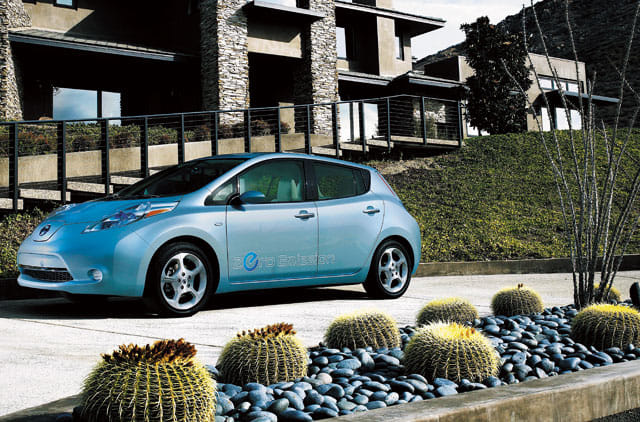
The future of motoring starts here — at least one possible future. The Nissan Leaf is the first mass-produced electric car to go on sale, and although it's still some time away, it will be way ahead of the opposition. Yes, there are electric cars you can go out and buy now, but they are either conversions of existing combustion-powered cars or odd little plastic machines that few would classify as a proper car.
The Leaf is different because it was designed from the outset to be an electric car, and it will be built in sufficient numbers that you will be able to go out and buy one rather than lease it. Its appearance therefore might come as something of a surprise: with no lump of a petrol engine under the bonnet nor a complicated drivetrain, the packaging restraints of a regular car no longer apply. Nissan says they wanted to make the Leaf acceptable to conservative buyers rather than being radical in its packaging and design.
It's still distinctive however with a soft, organic shape, which certainly reflects its status in the automotive hierarchy: this is a car at the opposite end of the scale from an aggressively-styled supercar. If you're buying into the idea of the Leaf, then its calming and unfussy demeanour makes perfect sense. It makes sense that a car that is kinder to the environment in terms of emissions has a kinder face too.
The same intentions are clearly delivered on the inside too. It's unlikely you'll see a friendlier or more welcoming cabin for the price, as the Leaf majors on gentle curves and much lighter colours than in most modern cars. All the dashboard information is illuminated in a calming blue, with a comprehensive display covering all the car's vital functions.
The key to the whole system is the connected navigation system, which links remotely to a global data centre to provide guidance, charging information and diagnostics. Programme your destination into the navigation and if your route is longer than or close to the remaining range, the system will highlight charging points along the way.
Better still, the car connects with your mobile phone, allowing you to pre-set the cabin temperature before disconnecting from a charge (hence saving battery usage), programme an overnight charge to start when the cheapest electricity rate begins and the Leaf will even notify you if its charge is complete.
What these features do is help to reduce the phenomenon of ‘range-anxiety', and allow you to use the car as flexibly as its design will allow.
And how flexible is that? Well what sets the Leaf apart is the novel cell design, using lithium-ion batteries like those found in mobile phones. Being long and thin means they can be mounted under the seats and the floor of the Leaf, putting all the mass in the best place as well as minimising the impact on cabin space. With a full charge, the Leaf is capable of 160km, with a top speed of over 144kph and rapid acceleration to match. The range is around a third as much as a conventional petrol engine, but Nissan expects battery improvements to extend this in time.
More importantly, however, since a majority of motorists on average cover less than half the Leaf's claimed range, a return commute without a charge in the middle seems plausible. Nissan expects most users to charge overnight to utilise cheaper tariffs, with a charge expected to cost a little over £1 in the UK. However, dedicated high-power charging points will be able to deliver an 80 per cent charge in just 30 minutes.
Of course, public acceptance will be much more restricted if the driving experience isn't up to scratch. But after a brief drive, the Leaf demonstrates a number of attributes that will make it an appealing prospect in its own right. For starters, the electric motor delivers 280Nm of torque from zero rpm, so plant your right foot from rest and the Leaf zooms forward with real vim. There are no steps in the transmission either, so the acceleration does not let up.
The weight distribution helps in the corners too, for although the Leaf fits into the small family hatch template, turn into a corner with vigour and it stays largely flat and roll-free. The other huge boon with electric power is noise: there's a faint whirr from beneath as the motor and drivetrain do their thing, but even at speed it amounts to nothing more than a background hum.
Finally there's the bottom line. New technology costs money, and Leaf will be the first full-scale production electric car you can buy when it goes on sale in February next year in Europe. The initial price tag of about £28,350 (Dh153,413) isn't exactly cheap but factor in an estimated saving of about Dh2,700 a year on fuel bills, and the Leaf gets close on cost to conventional power. Yet the environmental savings could be worth so much more.
Specs and Rating
Model Nissan Leaf
Engine AC electric motor Transmission NA
Max power 107bhp @ NA
Max torque 280Nm @ NA
Top speed 144kph
0-100kph 10sec
Price Dh126,379 (Approx.)
Plus Green credentials
Minus Takes time to recharge
Sign up for the Daily Briefing
Get the latest news and updates straight to your inbox
Network Links
GN StoreDownload our app
© Al Nisr Publishing LLC 2026. All rights reserved.