The dhow sailors of Dubai Creek
The sailors and their old vessels risk life and limb on every voyage, Shiva Kumar Thekkepat says
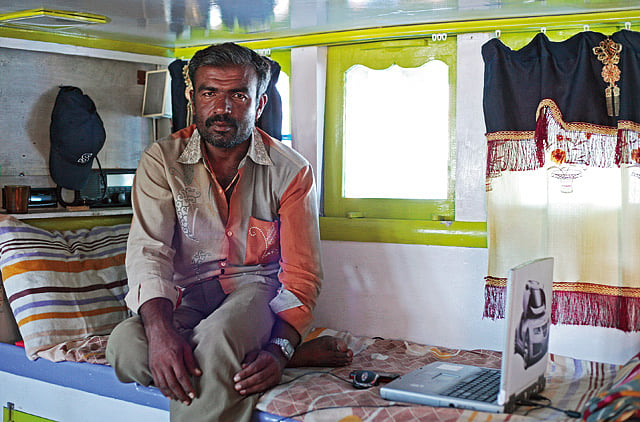
Abbas Ali is no Arnold Schwarzenegger, but he pullsa crate of soft-drink cans onto his shoulders in one sweep. His wiry body has to strain to trudge the 15-odd metres to his dhow on the edge of the wharf, opposite the old Spice Souq on Dubai Creek. He's sweating in the mild sun by the time he reaches the plank placed on the side of the boat. Gingerly, Abbas, 24, balances his haul onto one end, and watches as his two colleagues raise the plank so the cans slide down onto the deck.
"It's worth it," he says as he trudges back to collect more cans, mopping the sweat running down his forehead with a soiled scarf he then throws over his shoulder. "We get paid extra for loading!" His crew mates grin and nod, their ragged shirts sticking to their thin, sweaty bodies. "There's so much sweat and grime inour lives that we seldom take the trouble to bathe!" quips Ebrahim, 18, with the carefree abandon of youth.
Welcome to life on the Dubai Creek as it unfolds every day. While a casual observer will see picturesque scenes that appear to be frozen in time - of men like Abbas loading goods onto rickety old boats; of small groups sitting on the deck and shooting the breeze; of a wizened man holding the mast of the boat and staring out into the sea contemplating life, the behind-the-scenes stories can be heartbreaking if the characters who live them didn't have a sense of humour and irony that keeps them smiling despite the odds. Business is the bottom line, whether it's the crew who double as loaders, cooks, mechanics... whatever they are required to do at any moment, or the dhow owners, dealers, agents and middlemen.
A sailor's life
Abbas Ali has been sailing since he was 13, but is barely able to send Rs10,000 (Dh695) a month home to his wife and child back in Jamnagar, Gujarat, India.
"We sail for a year, then take a couple of months off if we are lucky," he says, looking wistfully at the shops across the road in Deira.
"I want to buy a doll for my five-year-old daughter, but by the time we are finished loading for the day the shops are closed. Besides, there's no guarantee that we'll reach our home at the end of the voyage."
He's not being melodramatic. In February this year, he tells me, a ship heading for Dubai from Jamnagar was supposedly hijacked near the Iranian coast, by pirates. "Probably Somali pirates," he shrugs. Neither the ship nor the nine crew members have been heard of since.
There's no sign of concern on his face as he narrates tales of close encounters with pirates on the high seas.
Asghar, 22, an engine ‘boy', eagerly butts in: "Last time when we sailed to Somalia…" before Abbas silences him with a withering look. When I ask why, Abbas replies, "The captain has told us to never talk about such incidents to the press."
"Times are tough," says Esmail, at 45 the oldest among the crew of 13. "I used to makea lot 20 years back, and life was much simpler." What he means is that though he used to earn less than what he earns now, the rupee went a lot further.
It's time to start loading again. Huge crates of sauces, cans of Coke, noodles from China, furniture, sacks of rice, a load of coal, just about everything is being loaded. "It doesn't matter what," says the captain of the ship, Salim Khan, 40. "As long as they pay, we'll transport it!" There's even an old Ford pick-up waiting to be loaded onto one of the larger boats. It's like a huge eclectic market place without any buyers.
The wharves are teeming with life even when the goods are not being loaded. The boat crews are from places as diverse as India, Iran, Pakistan, Bangladesh and Somalia. There's a lot of swearing and shouting as the loaders, mostly Pakistanis in their loose Pathan suits, jostle for custom.
"Bad times," mutters Jalaluddin, 26, a Pakistani loader on the docks. "We've not had a single day's work for the past week. All we do is sit and wait." He tells me he hasn't had a proper meal for two days. Jalauddin is a real gentleman. He apologises for not being able to buy me tea. The ship he's banking on is a vessel from Bandar Abbas, Iran.
Farzin, the Iranian captain, is smiling, but his story is the same. "I've been hanging around for the past 16 days without any stuff to be loaded." The reason apparently is the political tension between Iran and the UAE. He usually makes three trips to Iran and back every month, sailing for 12 hours one way. "We have to berth in the port for four to five days for the loading and unloading," he says.
Each trips nets the owner around Dh30,000. Farzin makes around Dh3,000. "Everything depends on luck!" he grins.
There's nothing people like Farzin can do about the situation so they'd rather make a joke of it than moan. "People from my village are known for our humour," he chortles. His crew, all from the same village, grin widely. Jalaluddin doesn't find it funny. "Why are they always grinning?" he mutters.
Further down ‘Captain' Ali, 32, is lounging on the deck of his vessel, having his toenails cut by a crew member. Ali smiles a lot despite the fact that he's not taken a break for the last 18 months. "Why would he want to go home?" jokes Mohammad, 30, who does everything on the ship ‘except cut Ali's toenails'. "He not married. Me? I have two wives and 14 children!"
A few feet away, Hussain is preparing a meat curry which the sailors will have with bread for lunch. A lot of the food prepared on the boats comes from tins. "Sometimes we get tired of eating fish,'' says Hussain. "So we look forward to eating fresh meat when we reach shore.''
Behind the jokes and camaraderie there are concerns about how much longer the crew can afford to wait for loads. "The municipality charges around Dh230 to berth here every day," says Ali. That's the reason why they stack goods impossibly high on their ships - to make up for money lost in berthing.
Stiff competition
Trouble comes in the shape of stormy seas, especially when they sail down to Yemen and Somalia, says Mohammad. "The ship then goes unh, unh, unh," he says, mimicking a boat being tossed in the waves. "Sometimes you lose some stuff to the sea, sometimes to pirates!" Has the ship been hijacked? "Neither Mohammad nor Ali will say, though they exchange knowing looks.
While they idle their time away waiting for custom, others have their work cut out for them. There are eight wharves on the Creek. Dozens of boats line each of them, and there is almost never a vacant berth. A boat is waiting to get in the moment one leaves. Only wooden ships are allowed to enter the creek to keep the traditional image of it alive. Some of the dhows weigh up to 800 tonnes.
"The wharves here are almost what they were about a century ago," says Mashallah Garibi, an Iranian who came to the creek 50 years ago, and set up shop in the Spice Souq. "I am sure it will be here 100 years later!"
Port Rashid and Jebel Ali may have the latest equipment and move millions of tonnes of cargo every year, but Dubai Creek has its place. "Dubai wouldn't be Dubai without the creek," says Mashallah.
Neither can it do without the boats and the men who move the world.
Along the creek
Dubai resident's book of photos
Imran Ahmad, a Bangladeshi passionate about photography, came to the UAE in the Seventies when his family moved to the country. "I first saw the Creek in 1976," says Imran, 46. He moved to Dubai in 2002, and chose to stay in a building on the banks of the Creek. "I've been here almost a decade and my connection with the Creek just keeps growing," he says. He started taking pictures of the Creek three years ago, mostly on weekends. "What I love about the Creek is it is rooted in the past," says Imran. "So much of Dubai has changed down the decades. The Creek is one place where time has stood still."
A curator, Hester Keijser, saw his pictures and advised Imran to get them published. The result is Dubai Creek, which is available at the Empty Quarter Gallery in Dubai costing Dh235. All proceeds from sales will go to charity.
Copies can also be ordered by emailing im.theblindsnapper@gmail.com
Sign up for the Daily Briefing
Get the latest news and updates straight to your inbox
Network Links
GN StoreDownload our app
© Al Nisr Publishing LLC 2026. All rights reserved.