Making old new
Heritage hotelier Aman Nath's passion is in restoring ancient structures in India "Our purpose is not to possess the present, but to improve the past."
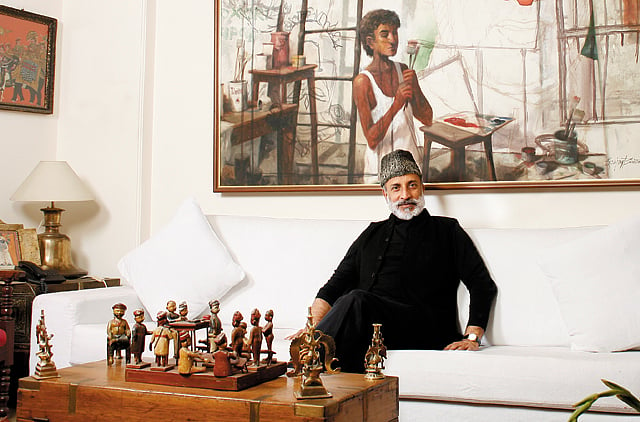
In fact, I’m so nonplussed for a moment that I wonder whether I should mention it to him, until he volunteers: “Yes, I know what’s running through your mind: you are also amazed that I look like the Afghan president.’’
“Yes!” I blurt out, before making myself comfortable in his living room in his tastefully decorated apartment in New Delhi’s Nizamuddin East. “In fact quite a few people have mentioned the similarity in looks,’’ he says.
“I was having breakfast in Roosevelt House in New York some time ago when a gentleman came up to me and, mistaking me for the famous leader, asked if he could shake hands with me. Of course, I obliged!
“On another occasion at a conclave in Delhi recently, Hamid Karzai was invited as a keynote speaker. I was also present at the meeting. While I was waiting, a security official came up to me and said that a dignitary wanted to meet me. The Afghan President had been told about my resemblance to him and was keen to meet me. When I walked in, the President exclaimed, ‘Good grief, you look absolutely like me!’ He insisted that we have a photograph together.”
Nath is co-chairman of Neemrana Hotels, a major chain of heritage hotels in India. He is also an author of over a dozen books on various subjects including one on Rajasthan.
Nath was born and educated in New Delhi. A post-graduate in history, he has dabbled a bit in advertising, art and photography. A lover of Indian heritage and culture, he’s actively involved in the restoration of old properties – some of which are then converted into heritage hotels.
As a keen researcher of Indian heritage, he’s travelled extensively across India photographing and chronicling the life of rural India. His coffee table book on Rajasthan was very well received, and he’s also a national award winning author for his book Jaipur: The last destination.
“Besides travelling across the length and breadth of the country and overseeing hotels, I’ve authored 12 books on history and heritage. These include books ranging from the President’s House to the House of Tatas, the well-known industrialist family,’’ he says.
I, ME, MYSELF
I was fascinated by the future when I was young.
But when I reached college, I realised that the past is equally important, especially in a country such as India whose history goes back hundreds of years. India’s structures can be anywhere from around 500 to 1,000 years old. We have a responsibility to preserve our ancient heritage.
I was taught by my parents to be independent.
There were many refugees from Pakistan who had left everything behind when they arrived in Delhi after the partition in 1947. The experiences of those times gave families the strength to learn to live in the present, with the aim of focusing on the future.
I was born and educated in New Delhi
where I completed my Masters in history. I was interested in poetry and art, and these took me to a career of copywriting and graphic design in advertising.
I met my associate Francis Wacziarg
Who had settled in India in the 1970s. Wacziarg was born aboard a Portuguese ship in the Caribbean Sea and spent his childhood in Cuba, Morocco and France. He completed his MBA at a leading business school in France. While working as a French diplomat in Mumbai and then as head of the representative office of a French bank in New Delhi, he developed a passion for India’s cultural heritage.
In the 1970s, Wacziarg wanted to make a film on the water systems of India. He had an amateur interest in photography. We both travelled to Rajasthan and Haryana to work on the film. But even after all the hard work that we put into that film, it never quite made it.
I first thought of restoration work when I was researching my book on the havelis of the Shekhawati districts of Jhunjhunu and Sikar in Rajasthan with Wacziarg in 1977. We happened upon a ruined fort atop a hill overlooking the Aravalli range. The sun was setting and Francis and I were driving back from Jaipur. The landscape darkened a bit during the evening but the Neemrana Fort Palace, which is made of lime and mortar, stood out. Although it was in utter ruins, I knew that it was an extraordinary place.
I was delighted to buy my first property, the Neemrana Fort.
It is a 15th century structure that had been lying vacant since 1947. Its past glory was reduced to a few legends and a building infested with bats. The family of King Rajinder Singh who owned it had moved out when the ramparts started falling. Not having any source of income and finding it impossible to raise the 40 feet high walls to restore it to a fort again, the family abandoned it.
We bought it in 1987 for Rs7 lakhs (around Dh56,000). I later came to learn that the property was for sale for 40 years before we bought it. Its prospective buyers had included Jackie Kennedy among others but somehow the deal did not materialise.
It was not like the Red Fort, which is in the middle of the city (New Delhi) and has inherent value. Neemrana was neither in a town, nor usable. The 25 acres of land had no trees or greenery. It was all rocky hills and rubble. But it was there, waiting for someone like me to give it a facelift.
I, ME, MYSELF
Me and the flagship fort
Today, the Neemrana Fort Palace about 120 km from Delhi is the flagship of Neemrana Hotels. It is a heritage hotel that draws both national and international celebrities. Wacziarg and I are the co-founders of Neemrana Hotels, a group of 25 historically significant buildings that have been restored and turned into hotels. It was a great challenge for us in the beginning. It was a journey of exploration, renovation and romance with heritage structures. There were no drawing board discussions, no meetings and no plans. In fact, the very idea of the fort that was constructed to keep people at bay has been turned on its head by turning piles of rubble into a successful business model. As it was in such utter ruins, it was probably too intimidating an idea to restore it. It needed somebody relatively insane to actually work on it. I am proud to say that I fit the bill.
Me and choosing restoration projects
All my projects are in partnership with Wacziarg and include hotels all over India. I would say that choosing a building to restore has a lot to do with personal chemistry with buildings. The place has to have unique charm. Location is important. People will go to Neemrana Fort Palace to flee the city and take time out for a while. It’s a place to get lost
in and unwind. It allows exploration and discovery.
As a rule, our places are historic, often hidden, usually with a view and always set in picturesque locations. From the 14th century to the 21st century, we have restored 700 years of buildings including mansions, palaces and forts.
Of course, funding plays a big role. Sometimes we buy properties that are unlisted monuments. But in most cases, we lease the places.
Me and the art of designing
I was never an architect or a hotelier. Although I have not studied any related subject, I have a passion for restoration. Architecture and interior design to me are about aptitude and not education. Every day we come across well-dressed women, but none of them have necessarily been to fashion school. Style is, to a degree, innate. One might get a degree in interior design but you could still get it all wrong.
I believe that design is about having a sixth sense. It’s connected with personal taste and a skill of observation. That is how you learn it.
Doing up any property is exactly like doing up a house. I think we have contributed to a broadening of perspective in India by introducing a concept: restoration for re-use, where waste is turned into an asset.
Me and creating beauty
I am not interested in churning out profits. I am a creative person who aspires to generate a wealth of beauty. Of course money is important and necessary to any business, but making money is not the goal; it is merely the means to achieving goals.
What we do is package an Indian hospitality experience. We aim to present it with genuine warmth. Currently, we must have around 200 files from people asking us to convert their old homes into heritage properties. We cannot undertake them all, but the fact that they ask us to take the property and make it into Neemrana speaks volumes about its success. I am happy that we have created a consciousness among people to be pro-restoration.
Ownership of a heritage building is not as important as the responsibility to improve it once you’ve acquired it. Our purpose is not to possess the present, but to improve the past. Owning a ruin is a liability. But if we put in the money, restore the structure and give a percentage of the earnings to the owner, the agreement suits both parties. And an old building gets second life.
I, ME, MYSELF
If you were given endless money and time, would you do things differently?
Yes, I think I would probably do things differently. But then it would become a rich man’s folly. I think that when you touch the past, you should keep intervention at a minimum.
Restoration is about adaptive re-use.
I am a perfectionist by nature. We have never taken a loan for any of our projects; each development has been accomplished within a limited budget and a set time frame in mind.
Have you ever regretted not buying a property?
There is a fort in Pune we wanted to invest in and renovate. But the owner preferred ready cash and sold it to someone else. When we saw it next, it had been completely wrecked. It was sad to see the degradation.
What lessons have your varied experiences taught you?
I have learnt a lot from my mistakes and experiences. In a way, things were never all that difficult, even in the beginning, but things certainly became easier over the years as I learnt the ropes better. I can now just look at a building in ruins and say whether or not it can be restored.
I have learnt to work privately and not in joint ventures outside our existing arrangement. When someone new joins in who does not understand what restoration is all about, there is no continuity in the project. Dealing with such people becomes difficult.
Owning so many properties across the country, do you ever stay in hotels any more?
I do like to stay in other hotels provided they embody the local flavour of the place I’m visiting. I think it is more exciting to stay in our own hotels because my relationship is not just with the building, but with people who live and work there. Moreover, there is always something new to add to the interiors, or something to work on, which makes the visits more meaningful.
What creative constraints do you face?
Design principles teach that a colonial building should remain as is. This is
a discipline, more than a constraint. It is important to maintain the original essence of a building.
Sign up for the Daily Briefing
Get the latest news and updates straight to your inbox
Network Links
GN StoreDownload our app
© Al Nisr Publishing LLC 2026. All rights reserved.