Kozhikode district collector leads by example
A district collector in Kerala is helping the less privileged by mobilising the spirit of volunteering
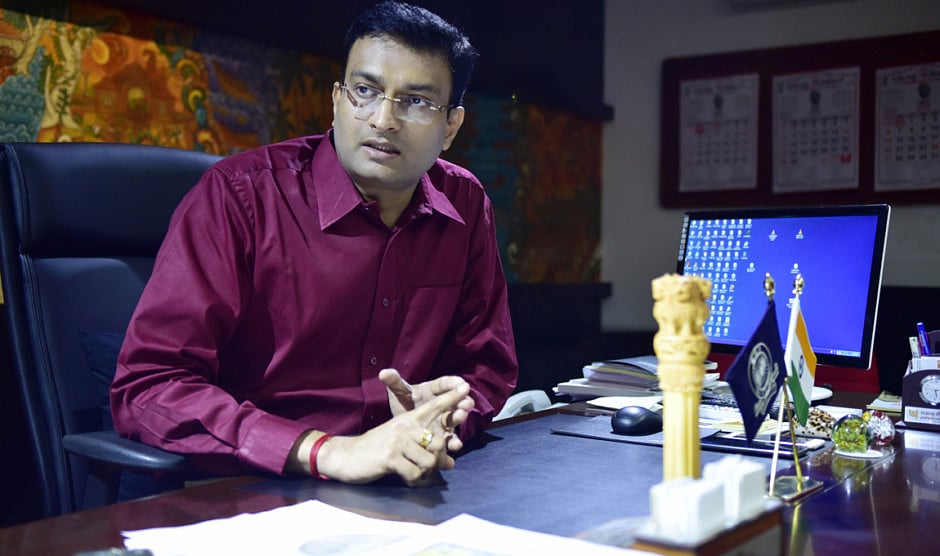
Dressed casually in denims and a light yellow shirt with sleeves rolled up to his elbows, 36-year-old N. Prasanth — an avid movie buff, now script writer for an upcoming Indian regional language film and commanding almost 200,000 followers on Facebook — defies every description of the archetypal Indian bureaucrat.
Ever since he took administrative charge as District Collector and District Magistrate of Kozhikode in February 2015 — one of the 14 districts in the south Indian state of Kerala — Prasanth has endeared himself to the city’s residents for his proactive and unconventional approach in tackling civic issues with public participation and his innovative welfare projects that have helped strengthen the spirit of volunteering and teamwork among the community.
“The altruistic nature of the people of Kozhikode is legendary,” says Prasanth, “and it was by tapping into this rich social capital the city is renowned for that I was able to put the welfare initiatives into action.”
Inspired by Mahatma Gandhi’s mantra — “Whenever you are in doubt ... Recall the face of the poorest and weakest man you have seen, and ask yourself if this step you contemplate is going to be any use to him” — Prasanth was motivated to use his position to direct his work towards reaching out to the weakest and marginalised sections of society. “These are people who lack any kind of political muscle or backing and whose needs are shunned even in the annual budgets.”
Prasanth recollects that during training for the Indian Administrative Service (IAS), the premier administrative service of the Government of India, “many of us voice our hopes of engaging with the poor and the underprivileged by being a citizen-centric administrator. Becoming a district collector is a golden opportunity to make such an impact as by directly dealing with the public, there are plenty of avenues to translate this vision into reality.”
However, the idea of tapping into the social capital took root much before he took up the position of district collector last year, says Prasanth. “It was a friend who pointed out that among the numerous bureaucratic positions in an IAS officer’s career, the only guaranteed role was that of a district collector. He suggested the idea of working towards it in advance. That set me thinking, and as I began to seriously contemplate what I could do, I realised that focusing on the social factor by reprioritising our responsibilities towards the weakest was the way to go forward. This meant ensuring that every decision taken and time spent in the administration is done with their needs in mind.”
When Prasanth was appointed district collector of Kozhikode (which has a population of 3.08 million), a visit to the local government mental health institution less than two weeks into his job served as a shocking eye-opener. “I was appalled to find that apart from mentally challenged people, there were also around 100 mentally fit people, all of them cured, but confined to living in the hospital either because their families refused to accept them or they had nowhere to go,” he says.
“Even more distressing were the inhuman conditions of living that I witnessed firsthand. The inmates were locked up in dark, humid cells that resembled prisons, a foul stench permeating the premises. Many were squatting in their own excreta, and one person was attempting to eat his own waste. That this was happening right in the heart of the city and in a state famed for its 100 per cent literacy was beyond belief.”
It was evident that the health centre, built in 1872 during the British era and housing more patients than it could accommodate, was in urgent need of a revamp. Moved by what he saw and recognising that quality of day-to-day life for its 600-odd inmates was greatly affected by lack of basic necessities, Prasanth requested the superintendent to provide him with a list of immediate requirements.
“One option was to present the case before the government, wait for budgetary allocation and the lengthy procurement process. I wanted to circumvent that because here, immediacy was the need of the hour — these were people whose lives would change only with immediate intervention.”
It was then that Prasanth decided to post the list of requirements sent by the superintendent on Collector, Kozhikode — the newly created official Facebook account — sharing details of his visit to the mental health centre and appealing to the public to donate generously.
“Who will speak for their needs, when they cannot organise themselves or protest,” he asks in the post, which requested for cots, wheelchairs, airbeds, plastic chairs, water purifiers, buckets, mugs, tables, dustbins, nail cutters, bulbs, tube lights and water taps, among others. No cash would be accepted, he emphasised.
The reaction from the public was overwhelming, he says. “In less than 10 days, we had received all the items and it reaffirmed my faith in the inherent compassionate nature of people.”
This was just the beginning; public apathy soon began to give way as Prasanth actively used the power of the social media to motivate people to volunteer with similar need-based projects across the city. Writing in a friendly manner with colloquial slang and film dialogues woven in for greater impact, the collector uses the FB forum to announce new welfare initiatives, respond to queries from citizens, and even chide critics in a friendly banter.
Prasanth’s dream of cultivating a community genuinely concerned about the welfare of others led to the formation of Compassionate Kozhikode, a unique programme that works as a volunteer base for socially productive works that are largely crowd-funded.
“It is founded on the faith that there is innate goodness in each one of us,” he says, explaining that by working with juvenile centres, old age homes, women’s shelters and palliative care units among others, the district administration merely plays the role of a facilitator or a matchmaker. “We identify the specific requirements in each case and link the people who need help with those who can provide support in kind. It is an entirely volunteer-based initiative.”
“A compassionate society is viable and possible and good for governance,” he says. “It is lack of compassion that leads to violence and other ills.”
Compassionate Kozhikode operates under the twin principles of “no cash, no photography”, and under its banner, Prasanth rolled out Operation Sulaimani in May last year. Taking its name after the iconic tea served in the district, this project is based on the principle of “food with dignity”. Launched with the participation of 30 restaurants — now encompassing more than 100 — it enables those without resources to satiate their hunger without having to beg for food.
Food coupons are available at 25 distribution centres across the district and the project is funded through collection boxes kept outside participating restaurants.
Apart from the ongoing collaboration with several welfare homes and the mental hospital — where plans are afoot for a major Rs300 million (Dh16.4 million) facelift with government funds, more than a dozen other projects have been launched under Compassionate Kozhikode, including Legends of Kozhikode, which documents and shares the stories of the unsung heroes of the region, and Project 4N, which tackles the issue of road maintenance.
In January, a single Facebook post on Collector, Kozhikode saw around 500 citizens gather together to clean a large 6-hectare pond filled with water hyacinth and slush in exchange for a plate of sumptuous Kozhikode biryani. With the collector himself joining in, it has since spawned similar projects across the district with residents uniting voluntarily to clean up water bodies in their localities.
Incidentally, Compassionate Kozhikode was chosen in March as one of the 50 inspirational projects from around the world and the only one from India at ITB-Berlin, the world’s largest travel trade show.
Prasanth, who believes that even a simple act of kindness or a random deed of generosity can help change lives, recollects a childhood incident when he accompanied his mother, a doctor, to the principal of the medical college where she worked, for some assistance on an official matter.
“Without even a cursory glance at her or checking her file, he asked her to meet a higher up. Here too, the same scenario played out. We were then instructed to meet the health secretary. After a long wait, he entered office at 6pm. But as soon as he walked in, he called my mother inside, asked her to be seated and patiently listened to her case. As a 7-year-old, I remember being impressed with the dignified manner in which he behaved, treating her with respect despite his long day at work. Perhaps it was also the realisation that he wielded more power for he seemed to be the final authority on the case. As I walked out, I noticed the IAS tag beside his name; I had this aspiration to be like him and that was when the idea of becoming an IAS officer first took root,” he says.
Now completing 15 months in service as district collector of Kozhikode, the one cherished memory that vividly stands out for Prasanth is that of an elderly woman who waited patiently in his office well past lunch time until the last of the hundreds of petitioners had left to finally walk up to him, and with folded hands say the two magic words: thank you.
“Very rarely do you get to hear this and it is not that I expect it in my line of work, but when it comes from one who is neither well educated nor well off, the power of it is indescribable; it is both humbling and gratifying.”
Sangeetha Swaroop is a writer based in Dubai.
Sign up for the Daily Briefing
Get the latest news and updates straight to your inbox
Network Links
GN StoreDownload our app
© Al Nisr Publishing LLC 2026. All rights reserved.