Allana* is fondly referred to as a chameleon by her friends because every two weeks, this 23-year-old changes her hairstyle and her hair colour. What makes her do it? The scores of fashion and lifestyle TV shows she watches and the glamour magazines she flips through. Celebrities Hannah Montana and Emma Roberts also inspire her.
Allana is not alone in this category. Hundreds of women, young and not-so-young, belong to it as well.
Every time a fashion show reveals a new hairstyle or a new hair colour, they want the very same look. They don't ever consider whether the new trend will suit them. So how do hair trends come about and how far should we go to copy them? More important, is there a way to be trendy and fashion-forward without going to such extremes?
Melvin Farrugia, a senior hairstylist at Go Fuchsia Salon in Dubai Marina likens hair trends to a passing phase - and as such they come and go. "For women like Allana it can be a challenge to keep up with the latest hairstyles," he says. "Yes, hair trends are hugely publicised and popularised by celebrities and pop icons" and a major part of his job is to convince women not to blindly copy the latest style without giving much thought to whether it would suit them or not.
What goes into ramp hairstyles?
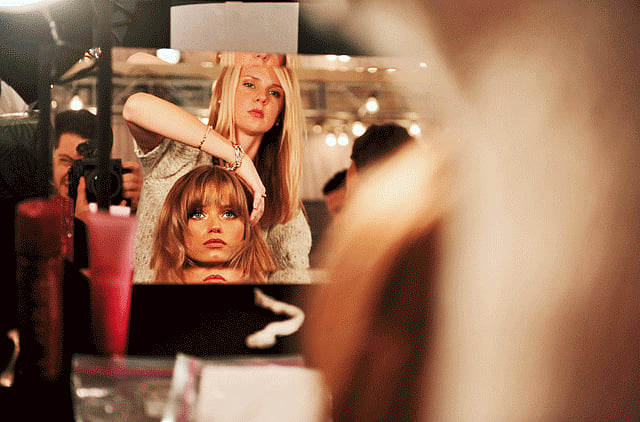
Farrugia, who works closely with Framesi, an Italian hair colour brand, to create hairstyles for the runway says that the process involves working closely with globally-acclaimed fashion designers. He says, "Most of the creative hairstyles you see on the runway are conceptualised to go hand-in-hand with the clothes the model wears. I remember an incident when I was in London working closely with a renowned designer label for a show. After working hours, the entire team of creative directors went out for dinner. There we saw a young girl whose hair was cut in different lengths and had the wet-set look. When asked what inspired her, she said it was her own creation. The next day we gave the same look to the models, of course with slight modifications. And a brand new hairstyle was born!"
Catwalk hair creations are not the sole work of hairstylists. Many others are involved as well. "Most of the time," says Farrugia, "it is the (clothes) designer who demands a particular look and then it's the hairstylist and the make-up artist who work together to achieve the required look. Designers usually go with the theme of the season and the design of the clothes being unveiled on the runway."
Before a hairstyle is actually seen on a model strutting down the catwalk, it is put to a rigorous test in the green room with hours of trial and hopefully few errors. "We practice and create hairstyles the way we have been asked to. Unless there is a specific designer garment requiring a special hairstyle, hairstyles are usually very simple. It's a deliberate tactic to keep hair simple so that the attention isn't drawn away from the clothes. But yes, sometimes we also create freaky and eyebrow-raising hairstyles, which you won't find anyone wearing in real life."
Even the most artfully messy look is an artistic effort and not a result of the hair dryer dying or missed deadlines. The other challenge, says Farrugia, is to create the same look on each and every model in the show. Considering the fact that there are about 20 or more models walking the runway, that's quite a challenge!
"It's a feat to achieve uniform hairstyles as each model has a different hair texture and volume," he explains. For example, creating a ‘messy' look on a model with fine hair is not that easy. "We have to first infuse volume and texture into her hair and this is time-consuming.
"Rollers or hot irons need to be deployed to create voluminous and textured hair. Plus, the hair needs to be ‘teased'. Only after all this can we start to work on creating that ‘just out-of-the-bed' messy look."
Given that the messy look finds different avatars each season, are there other variations on the same theme? How dramatically do hairstyles change from one show to the other?
"Across the world, every year, four collections are launched," says Farrugia. "Two are launched around February (spring, as well as summer looks) and two around September (autumn and winter looks)."
Recreating the style in salons
That's a lot of trendiness to incorporate into one' own fashion statement! Which is where a lot of thinking comes in. Translating a style from the runway to a personal, everyday look needs a little bit of practicality, says Farrugia. "One can take a cue or a hint from a trendy hairstyle but try it with caution-driven zeal."
"As a hairstylist, I give women advice on whether it will suit them. The truth is, what might look good on celebs in fashion magazines or on the ramp, may not look good or be practical in real life."
Happily, his clients more often than not follow his advice and go back home with a happy head on their shoulders.
"Although most women want to have a new look every now and then, they should realise that when changing hair colour, it is not easy to go back to your original colour just as quickly. It is important to be sure you'll be comfortable wearing the change."
His take on trendiness is rooted in reality. Every woman, he says, can look hip, trendy and up-to-date round the year, provided she follows some basic ground rules. For one, "Don't get a trendy haircut to look younger.It never works. Nor should women with very pale complexions colour their hair in darker shades such as stark black or stark blue-black. Even if you are keen on doing that, you may try softening that effect by going for highlights. If you are above 40, stark black or dark hair will make you look even older."
His other suggestion is that women do not grow their hair in one length. "By going for layers of different lengths, you can add more volume and bounce to your hair."
Farrugia also warns against attempting a creative colour and a new haircut both at the same time.
"It will overpower your personality," he says. "At the same time, do not be tempted to try a new collection of hair colours unless you are sure they suit you."
Studying style icons and looking for ideas is not a bad thing. But in doing so, the changes being contemplated must be tempered with an awareness of one's personality. "For example, rather than going for a complete makeover, simply add a fringe to your existing hairstyle," he says. "It is very important to consider your own taste and personality when you decide to go for a makeover."
*Name changed upon request
Sign up for the Daily Briefing
Get the latest news and updates straight to your inbox
Network Links
GN StoreDownload our app
© Al Nisr Publishing LLC 2026. All rights reserved.