An Acumen to help
Find out how a former Wall Street banker is setting up a non-profit microfinancing global venture capital fund to help the poor
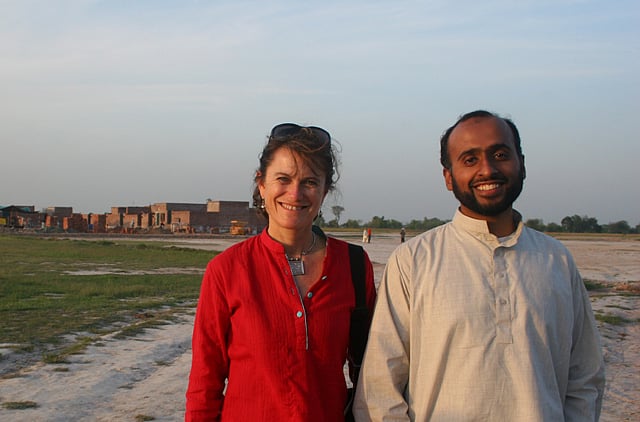
Who: Jacqueline Novogratz
What: Setting up non-profit microfinancing global venture capital fund
Where: Developing countries across the globe
Why: Initiative aimed at extending finance for sustainable enterprises for the poor
Imagine that you are a millionaire. That's the easy part. Now imagine you have to put to good use all those millions that you possess. Aha! That's the difficult part. Just how do you ensure that your money is being put to good use? How much of it would you, for example, decide to set aside as an education fund for the poor? What percentage of it would you want to donate to a charity that does credible work? Or would you use a chunk of it to set up a string of basic health centres in remote regions where medical aid is so scarce?
According to Jacqueline Novogratz, you shouldn't do any of the above. Yes, you read that right. As a millionaire, you shouldn't even consider any of the above.
So who is Jacqueline Novogratz and why should we take her rather unconventional advice seriously.
For one, Novogratz was invited by the Rockefeller Institute to put together a four-week programme targeted at philanthropists who are keen to learn how to give strategically. The course she put together has become so popular and is so successful that Bill Gates and other VIP personalities are among her clients.
They love her programme and they back her projects financially too. Novogratz is the founder and CEO of Acumen Fund, a non-profit venture capital for the poor that invests in sustainable enterprises bringing healthcare, safe water, alternative energy and housing to low-income people in the developing world. A serial entrepreneur in the social sector, she is constantly on the move and was in Dubai recently to discuss her projects with philanthropists in the region.
When I arrive to meet her at the Abraj Capital building in DIFC, I'm not sure what to expect. A big smile comes to my face when I stand to meet Novogratz who is also greeting me with a warm smile. I think this is called mirroring (in body language) and I believe it helps people connect. Well, it certainly works.
They say the best place to begin telling a story is from the beginning. Novogratz, an American, was nine years old when she was given a blue sweater by her uncle Ted as a gift. It had two cute zebras on it with the snow-capped Mt Kilimanjaro in the background. It was a favourite, but eventually she outgrew it and gave it to charity. Before she did that, she put a name tag on it and donated it to Goodwill (a charity organisation in the US). Sixteen years later, while in Kigali, Rwanda, she was ambling along a street when she spotted a young Rwandan boy wearing a sweater which looked exactly like the one she had donated years ago. She couldn't believe her eyes and nearly chased him down the street to see if the sweater had her name tag on it. The little boy, terrified at the sight of a woman chasing him for his raggedy sweater, fled like the wind.
The tipping point
That moment was the tipping point for Novogratz. It underscored the belief in her that all of us on this planet are in some way connected to one another.
"I had taken from my elders a strong feeling of wanting to ensure a sense of dignity for everyone. We believed in the notion that we are as connected to a woman sitting in her home in a remote village... as we are to our neighbour with the painted fence,'' says Novogratz.
She has immense gratitude for her grandmother who helped give her this awareness. "Our household was run by my grandmother Stella, a salt of the earth kind of woman, who was an Austrian immigrant. She had no formal education whatsoever but firmly believed in family values and the solace of bonding with family and friends. She was the kind who would say: ‘Tell me who your friends are and I will tell you who you are.'"
After graduating, Novogratz joined a leading bank in America and was enjoying her career. She would give presentations, meet VIP clients, travel around the world... It was during one such trip that she went to Brazil, and was amazed to see a whole new way of living.
"I was amazed at how alive the Brazilians were," she recalls. What caught her attention, being in the field of finance, was the condition certain sections of the population were living in. "I wondered why the low- and middle-income classes were not interested in approaching the bank to avail of loans to set up businesses and improve their lot," she recalls. So Novogratz, who was 25 at the time, marched up to her boss and suggested that they target the low-income group by encouraging them to set up businesses and helping them to do well. She was sure this was one way to improve their condition.
Novogratz still remembers the look of astonishment on the face of her boss. It was the early '80s and the idea of a leading bank targeting low-income groups was radical to put it mildly. He was not sure whether her idea would even work.
Novogratz, on the other hand, was very clear about her plan. She then did something few would have done - she quit her well-paying job and joined an organisation headed by a woman who, like herself, had given up a career on Wall Street to set up a non-profit microfinance organisation which assists the less fortunate people in the world.
Since Brazil was still fresh in her mind, Novogratz was keen to set up a few projects in that country, but she was offered to work on a project in Africa. Not one to shy away from a challenge, she took it up and got on the first available flight there. "I was on a quest for a life of adventure as much as I was on a quest to change the world and leave it a little better than the way I'd found it.
"My first assignment was in Côte d'Ivoire, and I failed unequivocally. I failed again in my next assignment in Nairobi." But the silver lining to this cloud was that Novogratz understood why she was not succeeding.
"I decided I would spend time with the local people to get to know them and their issues better," she says. In turn, Africa taught her a very important lesson. She realised that in order to contribute to the country, she would have to get to know herself better and clarify her goals. She needed to take Africa on its own terms, not hers, and to learn her limits while presenting herself not as a do-gooder with a big heart, but as someone with something to give and gain by being in Africa. Compassion, she found, wasn't enough.
One step forward
With her priorities now in place, her next post was in Kigali. "I was determined to do better. But for every step I took forward, I [ended up taking] two backward." She realised it was the way life would teach her to stay on the path and that she had to hold on and persevere.
"I was idealistic in my twenties, a bit hardened in my thirties, but I rediscovered my idealism in my forties," she says.
"This time around, I knew I had the skills to chisel things exactly the way I wanted to. As you grow older, you realise that you have only one chance and you have to decide what you want do with it. You can never be phoney with yourself. Now I can say with confidence that nothing in my life is tentative anymore."
Novogratz is pleased with the work she did in Kigali. "I helped start Duterimbere (which in Kigali means ‘to go forward with enthusiasm') a non-profit organisation run by the local women. Here, credit was provided to the needy at very low rates of interest to run their own business, however small it might be. They did not have to provide collateral, which most of them did not have in the first place. All they had to do was commit to returning the amount within a stipulated time."
Initially they raised money locally. The members of the founding group put in whatever money they had, before she received her first major grant of $50,000 (about Dh183,000) from Unicef. "Bilge Ogun Bassani, the former director of programmes at UNFIP, also supported us by giving us a temporary office, drivers when we needed them, a stamp of legitimacy and my salary too.
"I wanted the women to have a sense of dignity for the work they did and for the life they were building for themselves. I'm glad we finally ran Duterimbere exactly on those lines and were very successful," she explains.
This success spurred her on to dream bigger. She was keen to set up a business that actually created jobs for the poor, but knew that the scheme would take a long time to formulate.
A sweet project
She turned her attention to help organise a group called Femmes Seules (or single women) to run a bakery.
It was a monumental task organising and setting up this project. The Ministry for Family and Social Affairs gave the team a grey cement building that housed Project AAEFR (Association Africaine pour des Entreprises Féminins du Rwanda). There was no advertising, little baking and even less hope among the women.
"The women were poor, had large families to support and the 50 francs they earned barely helped make ends meet. The project was losing about $650 (Dh2,387) a month and the two charities that were supporting it were refusing to renew the funding," recalls Novogratz, who has an MBA from Stanford and a BA in Economics/International Relations from the University of Virginia. But the group refused to give up. Novogratz initiated a series of measures and together with the women managed to turn the bakery around and make it a successful business. It came to be known as The Blue Bakery after they painted it blue - the symbol of hope and success for the locals. The project taught Novogratz a few lessons: "I learned that language is perhaps only one half of the way we communicate with each other; the other half is with the heart.
"I also learned that generosity is far easier to preach than justice to deliver," says Novogratz who serves on the Board of the Aspen Institute as well as the advisory councils of Stanford Graduate School of Business and MIT's Legatum Center.
Setting up the Acumen Fund
Once she had cut her teeth in developmental projects in Africa, Novogratz decided to realise her larger dream - of setting up an organisation that would help spur greater progress in developing countries. The result was the Acumen Fund.
Acumen Fund is a global non-profit venture capital fund that invests in enterprises that provide health, water, housing, energy and agricultural products and services to four billion people who earn less than $4 (Dh14.6) a day. Set up in 2001, the grand plan is to touch 50 million lives by 2012. Novogratz, who has received innumerable honours including the prestigious Ernst & Young 2008 Entrepreneur of the Year Award, believes that life is one big apprenticeship workshop. The first six-month period in Africa was not an easy one and she admits that they goofed up a bit. In all these years of pursuing her dreams, what is the most important piece of advice she has been given? It was from a CEO of a healthcare company, says Novogratz.
"We [the core group of Acumen] had set ourselves up, got people who believed in the Acumen Fund and knew intellectually what we wanted to do, but we were unable to get our project off the ground. The reason? We were worrying about getting our first investment right. We wanted it to be perfect and foolproof. We were rooted with that desire for perfection and frozen into inaction. That was when our CEO friend said: ‘Just start. Don't wait for perfection. You'll learn more from your mistakes than you will from your early success anyway.' And we did just that! We started with a framework of ideas and built on it steadily."
Another project by Acumen that has been a great successs is the ‘Dial 1298 ambulance service' in Mumbai. This is an initiative started by a group of young professionals that offers a network of life support ambulance services to anyone, anytime and anywhere through an easy to remember four digit telephone number. None of us imagined it would expand and do so well so soon.
"Life teaches you. We have invested $40 million (Dh146 million) in 40 companies and now, nine years after setting up the fund, we can see patterns emerging."
The future
"The first nine years were about learning," says Novogratz. "The next 10 years will be about expanding our influence and seeing major breakthroughs in businesses that are helping the poor to live their life with dignity.
"In Dubai, we have entered into a strategic partnership with Abraj Capital and will rely on their skills to promote equity. It will help us expand our reach in MENASA," she says.
As I'm about to leave, she gives me a signed copy of her book The Blue Sweater and a thought to mull over: She recalls her meeting with a wise man in Phnom Penh, Maha Ghosananda who told her: "If you move through the world only with your intellect, then you walk on only one leg. If you move through the world only with your compassion, then you walk on only one leg. But if you move through the world with both intellect and compassion, then you have wisdom."
The acumen fellowship
Novogratz and her team decided to take their concept forward and have instituted a Fellowship "where we could identify individuals who were imbued with our philosophy". In 2006, we started the Acumen Fund Fellows programme to build a corps of leaders who would use their talent to build sustainable businesses that are appropriate for local contexts. Each year, 10 extraordinary people from all over the world, between the ages of 25 and 45 are selected. "Our Fellows (the fifth batch will commence soon - there is still one place to be filled as we have only found 9 suitable candidates) go out after having been tutored by us to deal with social entrepreneurship the way we would and we know that they will be honest and thoughtful towards each other. Since they come from developing countries as well as developed countries, they often contest their views on human rights issues and it is interesting to monitor the debate."
On bridging the gap
Referring to her book, The Blue Sweater about bridging the gap between rich and poor in an interconnected world, Novogratz has this to say: "While I do know that there can never be a completely egalitarian society, I believe that every human being should have access to the means to enable him or her to make fair choices about the way they live. While I agree that people should be rewarded for being innovative and business wise, society should never be so polarised as to have one section of society bereft of choices." Quoting a line from Tennyson's Ulysses she says, ‘I am a part of all that I have met'."
Do you know of an individual, a group of people, a company or an organisation that is striving to make this world a better place? Every responsible, selfless act, however small or big, makes a difference. Write to Friday and tell us who these people are and what they do. We will bring you their stories in our weekly series, Making A Difference. You can email us at friday@gulfnews.com or to the pages editor at araj@gulfnews.com
Sign up for the Daily Briefing
Get the latest news and updates straight to your inbox
Network Links
GN StoreDownload our app
© Al Nisr Publishing LLC 2026. All rights reserved.