American University of Sharjah Chancellor building a lasting institution
Dr Heath is working towards building an institution that will serve people for centuries to come
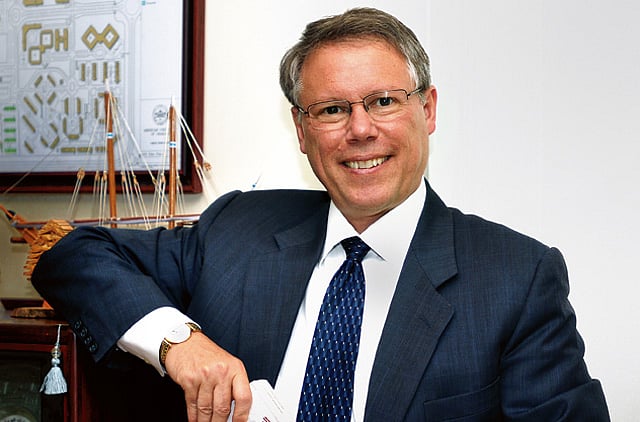
An American who speaks fluent Arabic is hard to find. If it's someone who makes speeches to an audience that includes His Highness Dr Shaikh Sultan Bin Mohammad Al Qasimi Member of the Supreme Council and Ruler of Sharjah and President of the American University of Sharjah (AUS), then it must be the Chancellor of the AUS, Dr Peter Heath. If his title gives you the impression that he's a stuffy academic, perish the thought. He's easy-going, charming and instantly puts you at ease. In fact, Dr Heath is scheduled to address an important gathering that includes the Ruler of Sharjah immediately after the interview with Friday, where he will deliver his speech in Arabic but there are no signs of nervousness or even the slightest rush to finish our conversation early. Dr Heath is a consummate professional.
He was headhunted by the AUS in 2008 at the conclusion of an extensive eight-month search. The reasons he was selected are easy to see. Prior to joining AUS, Dr Heath was the provost at the American University of Beirut for ten years where he played a leading role in building the distinguished institution. Past laurels rest easy on Dr Heath.
He still is disappointed that he's not able to indulge in his first love - teaching. But the sixty-two-year-old still makes time for his second love - research. Dr Heath has his feet firmly planted on the ground. "Education should benefit society as a whole," he says. "If it doesn't, we have failed in our mission."
Work
When I joined the American University of Sharjah in 2008, it was in a sense a natural progression in a journey I began in 1967 as a freshman at Princeton University in the US. I almost studied Spanish and Latin for my language requirement but decided to try Arabic instead. I'd always been interested in medieval European history and in high school I did a course and wrote a paper on the Crusades. At the last minute I was inclined to try Chinese. But the queue in front of the Chinese desk was very long, so I went back to Arabic.
That started me off on my journey to learn not only Arabic but also about Middle Eastern cultures and people. After a year of Arabic, I took some courses in modern history and 19th and 20th century Middle Eastern history. The surge of knowledge during the medieval period interested me so I continued studying Arabic for four years. Around that time, the US government decided to fund language training for students at the American University in Cairo. So at the end of my sophomore year I spent eight weeks in Cairo honing my Arabic. When I finished my undergraduate studies in 1971 I continued intensive study of the language for a full year.
I had met my future wife at Princeton and she, being Danish, had returned home. So I took a break and followed her to Denmark. I spent a year there doing odd jobs until we got married. Then it was back to Harvard for three years for a PhD in Near Eastern language and civilisation. I also did a course in Persian language and a couple in Turkish on the history of literature, thought and religious studies.
When I completed my dissertation in 1981 I started looking for jobs in the Arab world. But it was during the Iran-Iraq war and the Lebanese civil war. Egypt did not offer many opportunities and Syria and Saudi Arabia had not fully opened up. I ended up getting my first academic job in Birzeit University, a Palestinian university, in the department of cultural studies. I taught there for five years.
By 1986 the situation in the West Bank was getting tense. We also had two small kids by then so we returned to the US and for the next 12 years I taught at the Washington University in St Louis where I helped found a centre for the study of Islamic societies and civilisation.
An offer from the American University of Beirut (AUB) in 1998 to be their Provost took us to Beirut. Beirut was my first experience at the helm of a university. The difference between being a professor and a senior academic administrator is that we spend a lot more time representing the university in the community. So we not only see society through the eyes of the students or through our own individual experiences but also through the eyes of policymakers.
When the call came from AUS, one of the great attractions was to work with Shaikh Sultan because I knew about his vision for university education - to provide a modern and scientific and knowledge-based education for the youth of the region. He has made a magnificent investment in the AUS as well as Sharjah University. The AUS is ready to move forward and has the support to do it despite the economic downturn.
The mission of the university, embodied in some of the statements of Shaikh Sultan, is to be able to train students to a level where they can work not just in the UAE but anywhere in the world. They have to feel confident they have the knowledge to succeed.
On the other hand, we are very much a university of the UAE and want students to feel proud of that; they have to know where home is in a sense.
We don't try to imitate - we take the curriculum and the American model and adapt it to the needs of the region. We want to integrate more with the business sector, find out what they need from our students and also how our faculty can help them.
I feel our universities can give back to society like any other world-class university. The university leadership in the UAE does not work in isolation. I meet with the president of Khalifa University, the Provost of UAE University and the Provost of Zayed University once a month to discuss how to cooperate. We aim to present recommendations to the leadership of the country on how higher education can be improved. We feel there's a need for a central research funding agency like the National Science Foundation in the US. Faculties should compete with each other and cooperate on projects. The country is ready.
But beyond all this, I love being a teacher. Teaching, for me, should be transformative. There should be more instants in a semester that could be ‘a-ha' moments - the times that students will remember forever. The best compliment I ever had was when a student said, ‘He was so interested in what he was teaching that he made me interested'.
Play
I had a very diverse upbringing. I was born in New Jersey but spent the time from the age of five to 13 in the American southwest in New Mexico. My parents were amicably divorced and I would spend the school year with my mother in New Mexico out in the countryside. She used to work in an art gallery - there was a huge art community there. And at some points we lived in houses that had no indoor plumbing.
I would be out most of the time with my brother and my friends. We could just walk out our door and make our way into the mountains. We would wander around, hiking and exploring the place until my mother decided that we should move to New York for our education. That was the range of our experiences - from the country straight to New York City. It was a culture shock but the upside was that I went to a very good school.
Summers were fun times when my brother and I would stay with our father - he was a college professor. He would take us to Yellowstone National Park or New Jersey beach almost every summer. It was a normal childhood for us and it worked just fine for me.
Books were the biggest influence on me growing up. With my father being a professor and my mother always loving to read, there were always books around. According to my family, I was the kind of kid who would walk around holding a book in front of me, stumbling into furniture. That's probably why I am a scholar.
Like every ten-year-old American kid, I wanted to be a basketball player. In my teenage years I started to play the guitar thinking I would be the next John Lennon or Bob Dylan. I still play the guitar every day and enjoy trying to develop the skill.
My wife and I are very close; we've been married for 39 years. We have two kids, and are a close-knit family. We always try to take breaks together. We just take a week off in between my busy schedule, visit a place as tourists and take it all in. Sometimes we just sit at home and catch our breath.
Becoming a father was transformative. It changes your whole perspective. When you have your first child it puts you as a person outside the picture. Instead of, ‘what am I going to do today?', or ‘what are we going to do today?', it became ‘what can I do for this infant?' In a sense you don't progress as an individual as much as when you are forced to be outside of yourself and pay intense attention to a third person who you're responsible for.
Dream
During the days when we were courting, my wife said something that's stayed with me. She said, ‘it's really strange, you are reading a book that was written more than a hundred years ago by Alexander Pushkin'. I said, ‘that's because it's still a great book'. That led me to think how it would feel to be involved in something that somebody's going to benefit from a hundred years later. I wanted to be a part of that process of building knowledge because I care about adding to the sum of human knowledge and maybe providing a new perspective. I want to communicate that knowledge and some of the understanding involved in that to students. That was, and still remains, my dream.
Other than hopes for my children. I would like to leave the university as a kind of legacy that's solvent for the person who takes over. When I first arrived here I read somewhere that 75 per cent of the institutions that have lasted more than 500 years are universities. In building a university you are building an institution that can really serve the needs of the people for centuries, if you do it right. Part of my dream is to ensure that. I spoke to His Highness about this and he said, ‘Peter, take it easy, just make sure you do a good job for the next five, ten years'. That's one of my goals.
I would also like to write another book or two. When I retire I want to travel.
Sign up for the Daily Briefing
Get the latest news and updates straight to your inbox
Network Links
GN StoreDownload our app
© Al Nisr Publishing LLC 2026. All rights reserved.