A snapshot from 1985.
Abu Dhabi Harlequins: How the capital’s oldest rugby club has brought expats together since 1970
Founders, families and players share how Abu Dhabi’s oldest rugby club became a home
Last updated:
7 MIN READ
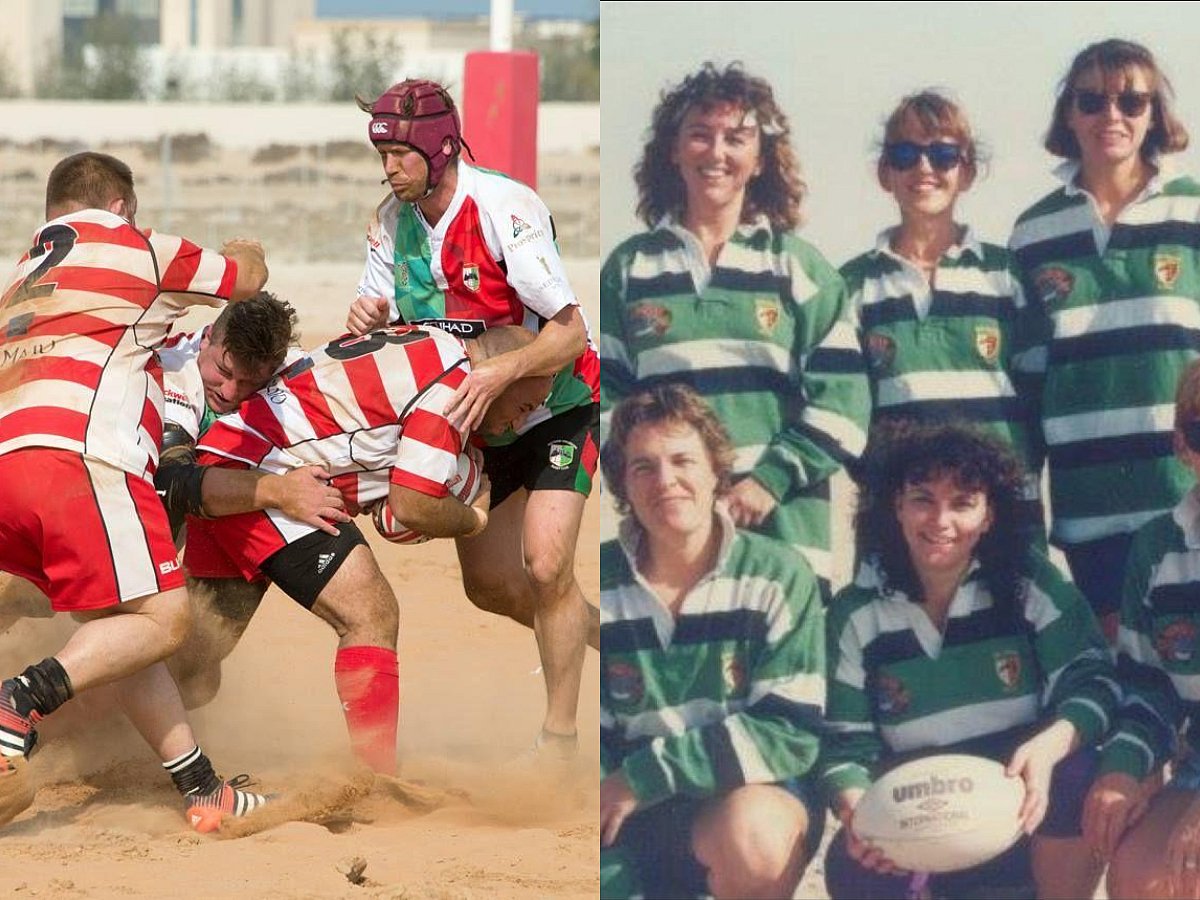
Left: Before pitches, rugby was played on the sand. Right: 1991/2 women’s team
Before they were the Harlequins, they were the Bats.
The history of Abu Dhabi’s oldest rugby club is written in memories, in the minutes of old meetings and in sands that have long since shifted. It began in 1970. There was no formal kickoff, and there has never been a final whistle.
Nick Davies, one of its earliest members, remembers those first days. “We used to play under the lights, and so we called ourselves the Bats,” he says. There were no pitches then, just sand, somewhere near the airport.
As Davies tells it, they were just a group of expats who started playing every day. One thing led to another, and today the club stands tall with more than 600 members and teams for men, women and children as young as six.
Here, rugby is as much about friendship as it is about the game. You make friends as you hit the ground, and learn from them how to get back up. “When you play rugby here, you blend with so many different kinds of people, who are also expats,” says Davies, each bringing their own culture and experiences to the team.
Many arrive looking for a home away from home. They find it on the pitch, and long after the final whistle, at the brunches, parties and award nights that keep the club together off the field.
The early days of rugby in Abu Dhabi, as shared by Andy Cole.
‘The club never had a home ground’
Davies points us to Andy Cole, a veteran who has been part of the club since the early 1990s and once served as its captain.
“My involvement began in 1991,” says Cole, who grew up playing sports in the United Kingdom before moving to the UAE. He fills in a piece of the club’s history: It was founded by an Irish expat, Mike Daly. “When I joined, he provided me with the minutes of the first meeting, back in 1970.”
The 1992, Dubai-7's squad.
Even then, there was no fixed training pitch, and it hardly mattered. They played wherever they could: a car park, a clubhouse, the sands along the Corniche. When a pitch turned up next to the Ritz-Carlton, they played there too. When nothing turned up, they made their own.
The squad was small, but it had already built a reputation against sides from Qatar, Bahrain and Saudi Arabia, and was a force to be reckoned with in the Arabian Gulf Rugby Football Union (AGRFU).
When Cole became captain, he went looking for sponsors to fund the games and rent proper pitches, including one near Al Wahda Stadium. From there, the club expanded. A women’s team was formally established by the mid-1990s, and by 2016 the club counted more than 800 players, four men’s teams and three women’s teams.
Today, the Harlequins call Zayed Sports City home.
Andy Cole, who captained the team in the 1990s.
Cole remembers the first Garland dinners, the end-of-season celebrations where everyone fit into a single room to hand out the trophies. Now, one night isn’t enough. Hosted at hotels and backed by sponsors, there are separate ceremonies for the men, the women, and the coaches, managers and medics.
The city has changed, and so has the club. Yet, what binds its members has remained intact. Both Davies and Cole speak of a camaraderie unique to rugby: You go to war on the pitch, then celebrate with the very people you were tackling. Underpinning it all is respect. “The referee is the last word,” says Cole. “You don’t fight him, and that’s the rule of rugby that everyone follows.”
'The game will beat you down, and you still rise’
That same spirit of belonging is being passed to a new generation. Seven years ago, Mylinda and Eric Recker moved to the UAE with their three daughters. “We were looking for something for our middle daughter, Emilie, to build her confidence,” explains Mylinda, who is the Under 16 manager.
A co-worker pointed them towards the Harlequins, and the couple took Emilie along to training. She was the only girl in the contact sessions, though it wasn’t full tackle.
Eric immersed himself in the sport too, despite barely having played it before. “He picked it up quickly,” Mylinda says, and before long he was coaching the girls’ team. Their other daughters soon followed: the eldest became captain of the ball crew, and the youngest joined the Under 6s. And that's where they all are, five days a week, sometimes six.
It's more than just a game: It's the family you find after the battle on the pitch, in the celebrations and the parties.
Both parents are proud as they describe what rugby has given their girls: perseverance, grit, the determination to get back up even when the game is at its most intimidating. They’ve picked up leadership and teamwork along the way, because on a rugby pitch, everyone has a part to play, as Mylinda notes. Above all, they’re confident in their own bodies now.
In a game like rugby, you need that, Eric adds. “I’ve seen my daughters be unsure of themselves. The game will beat you down. It is extremely competitive, but it’s also about what you do when you’re knocked down. It’s about coming back up.” Watching them put themselves out there, he says, has been a joy.
Eric Recker with the girls team.
This philosophy shapes how he coaches every player. Before a match, there’s a four- to five-minute warm-up, then a pep talk. “We’re not the ones who are going into the arena, they are,” he says. So the players find what works for them, whether that’s talking it through or listening to music, before they head out.
Maddy Recker U18G Emily Recker U16G
Evie Recker U6 mix
The season kicks off as soon as the weather cools, Eric explains, and from then on there are tournaments and festivals at every turn, from Al Ain to the Dubai 7s, alongside standalone fixtures. Some matches run around 40 minutes; the more serious ones stretch to about 80.
Through all the grind of wins and losses, it’s the memories that stay. One of Eric's favourites is the season his Under 14s reached the final, in his first year as head coach. “We lost, but it made me realise how much they’d grown. That’s what this game does. It’s just how much power the game brings.”
A photo shared by Chrissy Ferrara.
‘Rugby will make you utilise every part of your brain’
On the women’s side, the game is in committed hands. Chrissy Ferrara has always been an athlete. She played soccer and softball, then tried rugby at university. “It turns out, I was really good at it,” she says.
After seven years playing in Florida, she moved to the UAE and joined the Harlequins, where she now trains five days a week, fitting it around her full-time job with the Wildlife Rescue Team at the Research and Rescue Center at SeaWorld Yas Island, Abu Dhabi.
“Rugby is my stress buster,” she says candidly. “It makes you utilise every part of your brain and body.” Injuries come with the territory, as in any sport, but they don’t hold her back. You play, you fall, and you get back up, sometimes laughing.
Now, she wants to keep the girls’ teams growing and bring more young players into the sport she loves.
The family you make while tackling
For all the adrenaline, both Chrissy and Mylinda say it’s the friendships that keep them coming back. Spend five days a week with the same people, and the bonds come naturally. “There are so many social activities, including a welcome brunch,” says Chrissy.
A photo supplied by Chrissy Ferrara: The girls rugby team.
The locker rooms fill with music, and sometimes there’s hair being braided as the sisterhood grows. “The friendship that we have all built is so beautiful to watch,” says Mylinda, who manages the girls’ teams, under 16. They’ve been to each other’s weddings, watched each other’s children grow up, celebrated together at the afterparties and, through it all, had each other’s backs.
Chrissy's dog who comes to cheer her on, too.
The floodlit sand is long gone, and the Bats have become the Harlequins. But the game a handful of expats started in 1970 is still being played, by their successors, their children and their friends. Nobody, it seems, is in any hurry to blow the whistle.
Network Links
GN StoreAbout Gulf NewsTerms & ConditionsReach by GNSitemapContact usPrivacy PolicyGN FocusHave your sayWork with usAdvertise with usGulf News epaperPrinting Services
Download our app
© Al Nisr Publishing LLC 2026. All rights reserved.