Abu Dhabi's old Corniche, as residents remember it: The Volcano Fountain, feeding the birds and hot peanuts
'It was the artery of the city, connecting to neighbourhoods', recall residents
The Corniche is sentient.
It takes on a different personality in the memories of Abu Dhabi residents. It was the ‘spot’ where some sat just for a few minutes of silence in the 1980s and 90s. It was the place for picnics, as it was the running ground for training Karate kids.
It was the quiet, and sometimes, it was the noise you chose in the stillness.
It has had plenty of lives to choose from. Before the 1970s, there wasn't a promenade as such, just a beach where dhows and ships dropped anchor to unload their cargo and passengers. Then the city began nudging its way into the sea. Land was reclaimed along the waterfront, and the Corniche has been rearranging itself ever since, like a house where someone keeps moving the furniture.
We hear these stories from the residents themselves. Each conversation begins slowly, with an effort to reach back for times gone by. Then the memories come rushing in, tumbling over one another, as they relive growing up, and growing with the Corniche. They might not have photographs from those days. But their words are enough.
‘People would sell peanuts at traffic lights’
In the late 1980s, the Corniche was still modest, a coastal road slowly learning to become a promenade. The skyline was low and unhurried. Only a decade earlier, most of the city’s buildings rose no higher than five to seven storeys, and the Sheraton, the Hilton and the Al Ain Palace Hotel counted among the tallest along the shore.
A glass-fronted tower from the late 1970s, the first of its kind in the capital, caught the evening light and scattered it across the Gulf. And come National Day, the waterfront filled with music, as people in their finest dress danced the traditional steps to drum and flute.
That, was the Corniche waiting for Benazir Anis when she arrived from the US in 1989. “We have been here for over 30 years, and we grew up in multiple areas,” she says. Their first building had a Dairy Queen downstairs, one that no longer exists. Then they moved to Shining Towers, where the Corniche was there to greet them.
“The water would come so close,” she remembers. Between 2002 and 2004, the city reclaimed more land from the sea and stretched the Corniche outward, and today an eight-lane road and a row of beaches sit between the old waterfront and the water. The sea, it seems, took a few steps back.
Benazir remembers the people walking along the water’s edge, too. “There would be people selling hot peanuts there at the traffic lights, and it would be fairly cheap.”
The Corniche offered space for fishing, walking, picnics and cricket. Malls, she recalls, were still something of a novelty, so this was where social life happened. The memories are still fresh enough that she hopes to pass them on to her daughter by taking her there often. “I try to instill the Corniche in her.”
The days of karate, feeding birds and forgotten footpaths
Her brother, Zaheer Anis, pieces together his memories of the Corniche as he speaks, as if walking it again. “I came here as a child, and I grew up on the Corniche,” he says, without preamble. His family had also lived in a building facing the Clock Tower, one of the oldest and most recognisable structures downtown.
The footpaths were red brick, and a three-pronged path led up to the Corniche, a sight he says is 'burned into' his memory. The Clock Tower is a fond memory now.
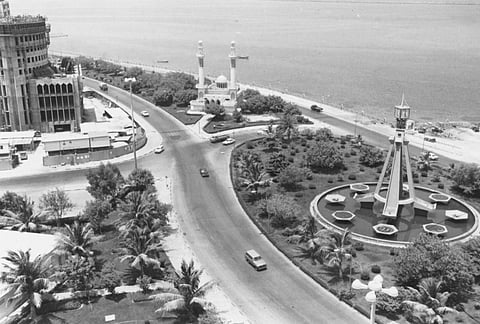
So is the Volcano Fountain. "It was just the meeting point for everyone," recalls Zaheer. It stood where Muroor Road met the Corniche, an 80-foot cone stepped like a circular pyramid, and in the evenings coloured lights turned its cascading water into something close to lava. You could be drenched by the lights, and that's how the residents liked it best.
It was where people came for a breath of sea air: The thrill of racing up the fountain’s steps, then sitting at the top with snacks from the kiosks below.
It might have been demolished in 2004, yet, for anyone who lived here then, it has never quite stopped erupting. It still glows red, somewhere in the back of their minds.
The landscape has changed since, and the buildings stand in tidy, meticulous lines, but Zaheer remembers a time when progress was still raw and unfinished. “You could feed the birds back then,” he says. He could wander the whole stretch, he remembers, with perhaps just a breeze for company.
Small outlets once dotted the 8km stretch, most of them now vanished, including one little eatery at the far end, beside a dhow. And there was the Sheraton, which was nearing completion in 1979 and still stands today, the one landmark everyone holds onto. That, he says, is where most people went to eat.
Then comes the memory he returns to most of all: Karate, and the Corniche had its part in that story too. The club where he trained, Oriental Karate & Kobudo Club, is still very much in business. Thirty years on, when we get in touch, the coaches haven’t forgotten him. “He was one of our first students,” they tell us.
Zaheer remembers the runs along the waterfront that were part of his training, covering the length of a city that was still finding its shape. “The Corniche was really the artery of the city,” he says. “It connected so many different neighbourhoods.”
‘Our everyday spot for barbecues’
Samrah Salman, a Pakistani expat, moved to Abu Dhabi in 2008 to join her husband, who had arrived a few months earlier for work. After working briefly, she chose to be a stay-at-home mother, then a few years ago turned her love of beauty into a career as a hair and makeup artist.
The Corniche Samrah met was a newly made one, freshly landscaped. For her family, it became a cosy, everyday spot for barbecues. She remembers its many seating areas and the sense of community that drew people in. “It was just the hotspot of community, and so popular,” she says.
The waterfront was also a place for shared celebrations, including free festivals with music and dance. With Yas Island still under development, the family explored the city on the “big red bus”. Abu Dhabi felt smaller then, Samrah recalls, with fewer malls.
It was just quieter back then, and less traffic. Parking was free, and the views were so stunning...

Her connection to the area is personal, too. Both her children, now 16 and 11, were born at a hospital near the Corniche. “It was just quieter back then, and less traffic. Parking was free, and the views were so stunning,” she says.
The views remain.
Today the Corniche runs 8km, with separate cycle and pedestrian paths, children’s play areas, cafés and its own beach.
The Corniche may change its mind about what it wants to be. Its people, it seems, keep loving every version.


