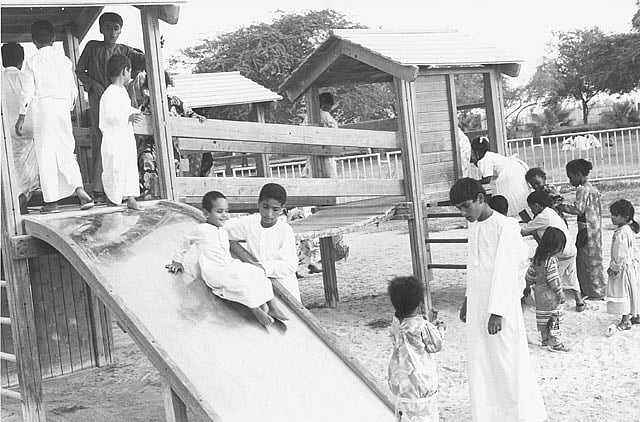
Dubai: Emirati children today are considered among the luckiest children in the world as so much is provided for their entertainment, sports and education.
But if we look back to the 1950s or 1960s, we see a very different picture.
Children grew up without the internet, video games, shopping malls, fast food chains and restaurants.
However a number of Emiratis such as Mouza Ahmad, now 52, Hamda Al Jassemi, now 47, Najat Al Yousef (47) and sisters Fatima (49) and Magida Mohammad (51), all agree that despite the limited resources. the bygone era was unique.
They all agreed that despite the good standard of living today, there was something missing.
The Emirati women are from Dubai and Sharjah. and they said 50 years ago the UAE had a modest education system, but teachers were brought from Egypt, Lebanon, Syria, Palestine and Jordan.
Children of that era would get up early morning to go to school to interact with their friends.
They would sometimes have lunch together and meet again after 4pm to do their homework.
"After revising our lessons we would meet with the rest of our neighbourhood," Najat Al Yousuf said.
"So as students we would exchange the talk about school, exams, teachers, and other students. We also used to go to a nearest grocery (‘Dukkan') to buy candy.
"We also used to spend more time sitting at someone's backyard of our neighbourhood. People used to pass by and sit with us for a little and asked about our families. The elderly would sit with us and talked about their days and how they lived a wonderful life. I remember they would always say to us that their times were much nicer than ours."
However Magida Mohammad said the most unforgettable day was Friday.
"We used to gather with a bunch of our friends and jointly cook a meal that we have called ‘Tabookha'," she said.
"Every one of us would bring something. For example, I would bring the rice, and each of my friends would bring salt, oil, fish, salads, fruits, drinks, and rug to sit on," she said.
"I can't forget that our neighbours would ask us whether we are invited to the feast and would joke with us."
Mouza Ahmad said: "The spirit of togetherness was what we actually cherished most".
Sign up for the Daily Briefing
Get the latest news and updates straight to your inbox
Network Links
GN StoreDownload our app
© Al Nisr Publishing LLC 2026. All rights reserved.