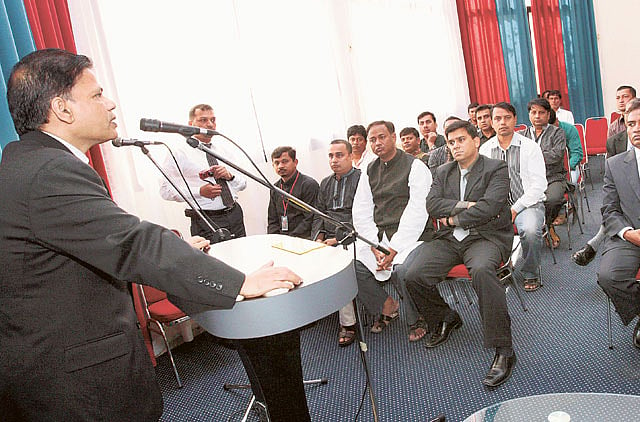
Abu Dhabi Bangladeshi expatriates in the capital Tuesday marked the International Mother Language Day by paying tributes to the martyrs who fought for their mother language.
At a ceremony in the Bangladesh Embassy in Abu Dhabi to observe the occasion — which is also marked as the National Martyr's Day there — they pledged to preserve the spirit of the struggle to protect their mother language.
The day commemorates martyrs of Bangladesh's Bhasha Andolan (language movement), who laid down their lives on February 21, 1952, to establish Bangla (Bengali) as a state language.
In recognition of the sacrifices they made, the day was declared the International Mother Language Day by the United Nations Educational, Scientific and Cultural Organisation (Unesco) on November 17, 1999.
Mohammad Nazmul Quanine, Bangladesh's Ambassador to the UAE, hoisted his country's national flag at half mast to pay respect to the martyrs.
Pledge of commitment
In his address, he highlighted the role of mother languages and called upon his countrymen to uphold the spirit of their language movement. At a meeting, community members pledged their commitment to their mother language and respect for all others. Messages from Bangladesh President Mohammad Zillur Rahman, Prime Minister Shaikh Hasina and Foreign Minister Dr Dipu Moni were also read out.
The Shaikh Khalifa Bangladeshi School in the capital also conducted a separate function to commemorate the day. The Bangladeshi Ambassador, teachers, pupils, parents and members of the school governing body attended the school programme.
The day commemorates events in erstwhile East Pakistan (now Bangladesh) where the people, whose mother tongue is Bengali, protested the Pakistan central government's decision making Urdu the only official language for the entire country. On February 21, 1952, several students were killed in police firing on a peaceful strike. Bangladeshi people have observed this day ever since as Martyrs Day and it inspired their freedom struggle that led to the creation of Bangladesh in 1971.
— With inputs from Nada Al Taher, Staff Reporter
Community: Preserving their heritage
UAE residents shared their concerns on International Mother Language Day about the survival of their mother languages in the wake of domination by foreign language such as English.
Noor Maher Sayadi, 21, a Syrian who studied in Canada, said: "I can theoretically live without my mother language but I would miss out on a huge part of my culture and history. English is an easy language to read, write and pronounce, so I understand why it's so popular. To preserve my language I will keep speaking it and reading it occasionally. As an artist I preserve my language and culture by using the Arabic script or Arabic words in my work sometimes."
Hanan Al No'man, 20, a Yemeni student at American University of Sharjah, said mother language is extremely important because it's part of one's identity. She reads Yemeni literature and poetry to preserve the language and said she reads more Arabic than English but speaks more English than Arabic because people don't understand the Yemeni accent.
— N. A. T.
Sign up for the Daily Briefing
Get the latest news and updates straight to your inbox
Network Links
GN StoreDownload our app
© Al Nisr Publishing LLC 2026. All rights reserved.