What Trump claimed is in the US-Iran 'deal' — and Ghalibaf's warning
Ceasefire extension, Hormuz access at core of Trump’s touted US-Iran settlement
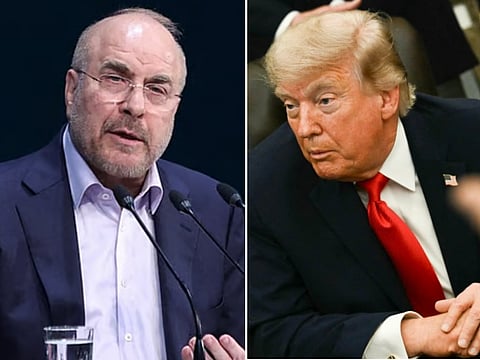
US President Donald Trump has promised a "great" settlement with Iran, including security guarantees for the reopening of the Strait of Hormuz, which may be signed in Europe over the weekend.
Speaking in the Oval Office, Trump said: "We just made a great settlement of the war with Iran, and we're going to be subject to finalisation of documents. We should get done over the next few days. We'll probably have a signing, maybe in Europe. When oil comes down, everything else comes down."
Get updated faster and for FREE: Download the Gulf News app now - simply click here.
Agreement to continue ceasefire
According to Trump and US officials cited in recent reports, the emerging framework would include:
Reopening the Strait of Hormuz to commercial shipping.
Extension of the current ceasefire.
New negotiations on Iran's nuclear program.
Guarantees of unrestricted maritime traffic through the waterway.
Broader regional coordination involving Gulf states and other Middle Eastern leaders.
Trump said he had spoken with leaders from Israel, Qatar, Saudi Arabia, the UAE, Bahrain, Kuwait and Turkey as part of the diplomatic effort.
A realistic near-term outcome could be a continuation of the truce while negotiations continue on broader issues such as Iran’s nuclear programem.
'Unconditional surrender, regime change: Off the table'
Robert Satloff, executive director of the US-based think tank The Washington Institute for Near East Policy, suggested that the “deal” President Donald Trump has repeatedly referenced may not be a sweeping peace agreement but rather a more limited arrangement centered on extending the current ceasefire.
Speaking during a Washington Institute discussion on the US-Iran crisis, Satloff indicated that the most realistic near-term outcome could be a continuation of the truce while negotiations continue on broader issues such as Iran’s nuclear program and the reopening of the Strait of Hormuz.
Satloff said: "'Unconditional surrender', as the president proclaimed, is not on the table. Regime change is not on the table. We're talking about much, much less than what the President said at various points earlier in the conflict... Missiles, unlikely; proxies, unlikely. At most, what we're really talking about is an extension of the ceasefire, to allow for something else to happen, maybe talks about nuclear issues."
Iran has not fully confirmed the 'deal', Ghalibaf warns of 'endless quagmire'
Despite US President Donald Trump's optimism, Iranian officials have publicly pushed back on claims that a final agreement has been "approved".
Sources in Tehran told Axios that key issues remain unresolved and that Iran's leadership has not yet given final authorisation to any memorandum of understanding with Washington.
This means the announcement remains largely a US claim until formally endorsed by Iran.


