Middle East F&B sector in fast forward mode
Food trade in the region is transforming fast, and Gulfood is keeping pace
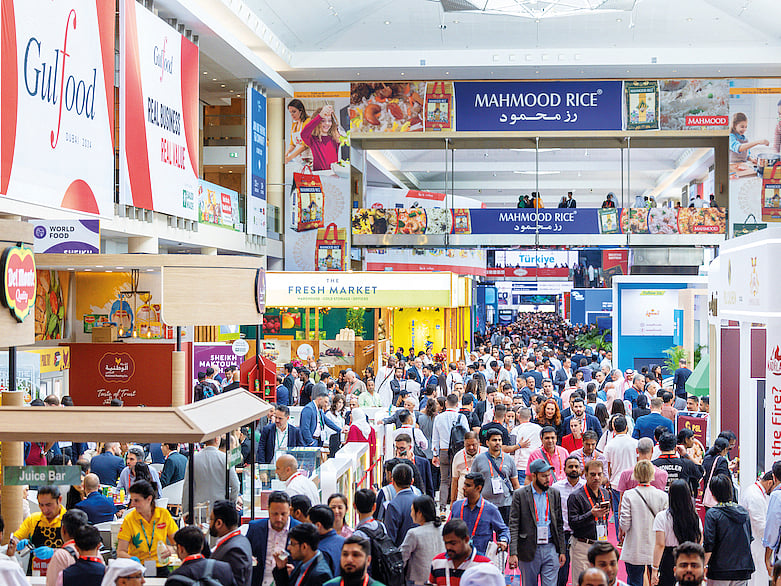
The Middle East food and beverage sector is entering a decisive new chapter. This is no longer a market defined only by scale, appetite, and accelerated retail expansion. Today, it is being reshaped by sharper consumer choices, more demanding buyer expectations, and a growing urgency across the entire food value chain to become smarter, cleaner, more resilient, and more future-ready.
Across the GCC and wider region, the market is evolving at two speeds at once. On one side, buyers remain commercially focused, relentlessly negotiating pricing, logistics, and supply continuity. On the other, the direction of travel is unmistakable. Growth alone is no longer enough. Buyers want proof. Consumers want transparency. Regulators want accountability. And businesses want resilience that protects margins in an unpredictable global environment.
This is exactly where Gulfood’s role becomes more significant than ever. The turnkey event, starting today at the Dubai World Trade Centre and Dubai Exhibition Centre at Expo City, has always been a trade powerhouse, but it is increasingly becoming something more strategic. It reflects what the market needs now, and it reveals what the market is preparing for next.
As Mark Napier, Vice President Exhibitions Department, Dubai World Trade Centre, organisers of Gulfood, notes: “The Middle East F&B sector is entering a new phase of evolution, shaped by changing consumption habits, accelerated innovation and a sharper focus on sustainability and resilience.” That is not just a trend statement. It is a summary of a sector that is rewriting its priorities, and doing it quickly.
Wellness-led consumption rises
The shifts are visible everywhere. In the products being introduced, in the questions buyers ask, and in the way partnerships are being built. And they are visible clearly at Gulfood, which continues to grow in relevance as a platform for the food economy’s next phase.
One defining shift shaping the Middle East F&B market right now is the rapid rise of wellness-led consumption. This is not merely about consumers wanting better products. It is about a fundamental change in how products are evaluated, marketed, and purchased.
Napier captures this movement precisely when he says, “Demand is rising rapidly for products that support health and wellbeing, from functional and fortified foods to plant-based and clean-label offerings.”
Importantly, this health wave is not limited to premium consumers. Wellness is being democratised through affordable functional options, portion-controlled formats, and better-for-you innovation that fits mainstream budgets. Buyers are no longer looking only for niche products. They are looking for scalable winners.
Traceability, an essential
It is not just what’s inside the pack that matters as well. Sharing a critical insight, Napier says, “Transparency and traceability are becoming baseline expectations rather than differentiators.” This signals a major shift in market maturity. Buyers and consumers are no longer impressed by vague claims or generic packaging cues. They want sourcing credibility, ingredient clarity, and production transparency that can be verified.
Agreeing with Napier, Mohammed Alrifai, Group CEO, NRTC, a major participant at Gulfood, says, “The Middle East F&B market is being shaped by three interconnected shifts. Consumers are increasingly value-aware, but value today is defined by consistency, freshness, and trust rather than price alone. There is also a strong pivot towards transparency. Buyers want traceability, clear sourcing credentials, and confidence in food safety. Finally, purchasing behaviour is evolving towards reliability at scale, particularly across fresh categories, as retailers and food service operators prioritise partners who can deliver uninterrupted supply despite global volatility. These shifts are accelerating demand for integrated, resilient food systems.”
This is where Gulfood’s reflection of market change becomes highly visible. The show is no longer only dominated by legacy categories. It is increasingly diverse, with wellness and clean-label innovation commanding a larger share of buyer attention.
Napier explains the show’s response clearly: “Gulfood reflects these shifts by broadening its sector landscape and exhibitor mix to capture both market demand and future-facing innovation.” He adds that Gulfood is bringing forward “wellness-led products, sustainable sourcing models and technology-enabled solutions designed to strengthen efficiency across the value chain.”
Criticality of sourcing integrity
A second defining trend shaping the sector is the rising importance of sustainability, sourcing integrity, and resilience. For years, sustainability in food was often positioned as branding. Today in the Middle East, sustainability is increasingly becoming procurement logic. Kamal Vachani, Deputy CEO Group Director and Partner, Al Maya Group, believes sustainability is no longer an optional initiative but a core business imperative.
“Leading organisations are integrating sustainability into procurement, logistics, and retail operations through responsible sourcing, waste reduction, energy-efficient distribution, and environmentally conscious packaging,” says Vachani. “These efforts are guided by measurable targets and accountability frameworks that balance environmental responsibility with operational efficiency.”
As suppliers and buyers recalibrate strategies, sustainable sourcing and responsible production are gaining traction across categories. Buyers are increasingly evaluating whether suppliers can deliver consistency with accountability, and whether sourcing models can withstand volatility without damaging commercial outcomes.
This shift is reflected on the Gulfood floor. The market is clearly rewarding solutions that strengthen efficiency and reduce operational risk. Gulfood is providing visibility for sustainable sourcing models that are practical and scalable, as well as systems that support responsible production while improving performance.
Napier underscores this evolution through Gulfood’s widened exhibitor mix and value chain orientation: “Alongside established food and beverage categories, the show brings forward wellness-led products, sustainable sourcing models and technology-enabled solutions designed to strengthen efficiency across the value chain.” In practical terms, that means sustainability is no longer treated as a separate track. It is part of the commercial conversation.
Value, reliability and growth
The show also reflects a broader commercial reality. The Middle East remains one of the most strategically attractive food markets in the world, combining consumption growth with strong import activity and fast trade momentum. But global suppliers engaging the region are arriving with sharper priorities than ever.
Napier summarises the supplier mindset clearly: “Global suppliers and brands arrive at Gulfood with a clear set of commercial priorities anchored in value, reliability and long-term growth.” That line matters because it outlines how the buyer-supplier relationship is changing. It is becoming less transactional and more strategic, with a focus on long-term presence and predictable performance.
Rise of partnerships
Another critical shift is the rise of partnerships over one-off transactions. Napier highlights this clearly: “Beyond transactions, partnerships are central to engagement, with many suppliers seeking to build durable distribution networks and regional alliances across the GCC and wider markets.” This reflects how fast the region moves. Speed to shelf depends on strong distribution. Scale depends on alliances. Gulfood is where many of these networks are formed, strengthened, and expanded.
Ultimately, the Middle East’s F&B sector is moving into a sharper, more demanding era. Products must be healthier. Supply must be more resilient. Sustainability must be practical. Efficiency must be proven and partnerships, long-term.
That is why Gulfood is no longer just a calendar event. It is a real-time business barometer for where the region’s food economy is headed.
Napier frames this role powerfully: “For many brands, Gulfood represents a strategic launchpad for market entry and expansion, offering direct access to decision-makers, new trade corridors and scalable growth opportunities.” That statement captures Gulfood’s relevance today. It is where market entry becomes tangible, where trade corridors become opportunity, and where supplier ambition meets buyer intent.
Network Links
GN StoreDownload our app
© Al Nisr Publishing LLC 2026. All rights reserved.