UAE’s waterproofing problem gets a rethink with 20-year warranties
After 1,600+ projects, Roofsealing.ae takes German waterproofing technology beyond the UAE
Rain in the UAE may be episodic, but for a lot of property owners, its consequences are remarkably persistent.
A few hours of heavy rainfall can expose months or years of deterioration hidden beneath roofs, around drainage points, inside shafts and at the junctions where different building systems meet. And when the water finally finds its way indoors, the problem is rarely confined to a wet ceiling.
For Daniel Zacher, chief executive and founder of Roofsealing.ae, that is precisely why waterproofing should be treated less as a maintenance afterthought and more as an investment in the resilience of a building.
“The client is buying an outcome,” says Zacher.
That distinction goes to the heart of the business he has built in the UAE over the past two years.
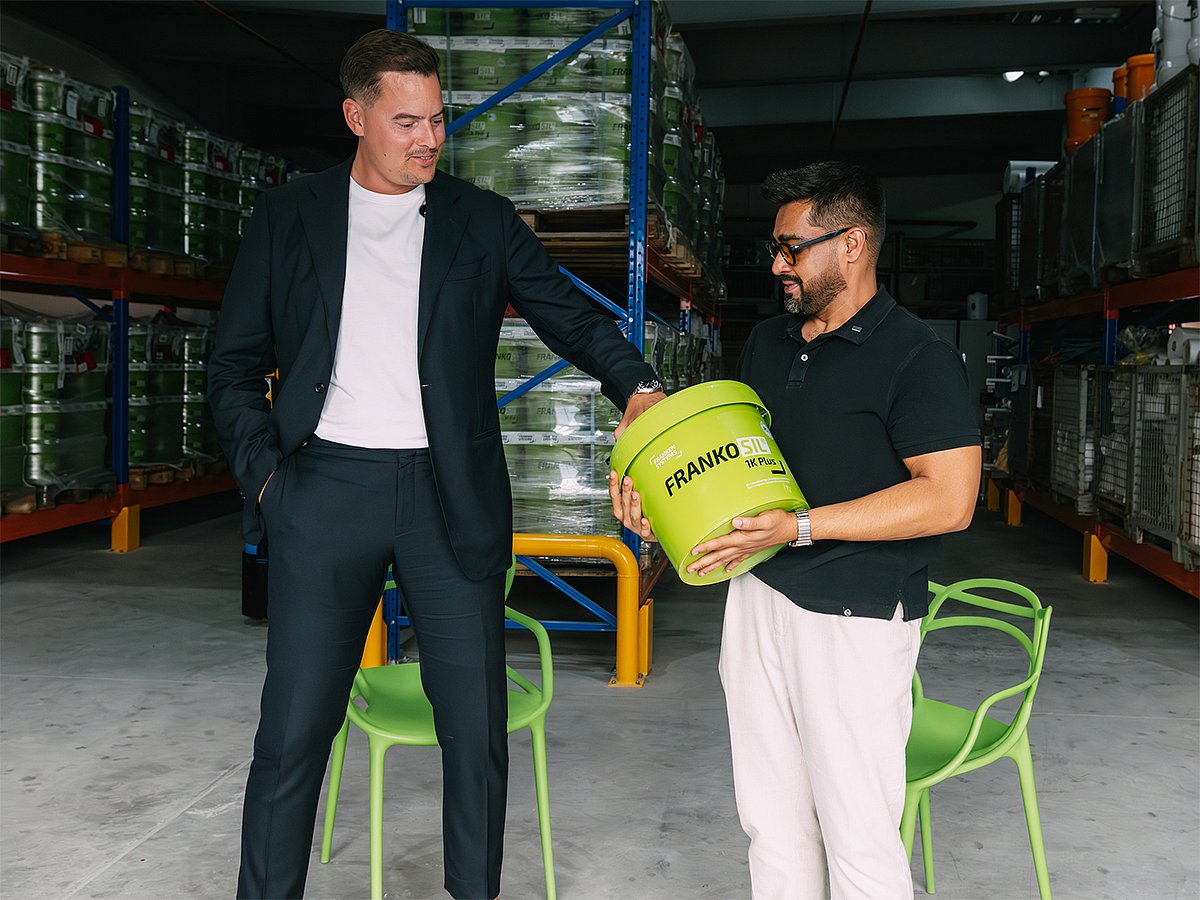
Roofsealing.ae holds an exclusive licence for the German waterproofing material (Frankosil 1K from Franken Systems) across the wider MENA region, with roofs its primary focus. The company offers a 20-year warranty and says its material can bond to a wide range of surfaces, including concrete, sandwich panels and wood. Its work spans townhouses and villas to warehouses, factories and palaces.
The opportunity is rooted in a deceptively simple problem that waterproofing systems here in the Gulf are not designed especially for weather conditions here.
Drawing on more than 5,000 inspections by Roofsealing.ae, the company has noted that rooftop temperatures in the UAE can reach 80–85°C during peak summer, while day-to-night temperature differences can approach 30°C. High UV exposure, coastal humidity and increasingly disruptive rainfall events add further stress to roofing systems.
Zacher points to UV exposure as one of the principal causes of failure. Conventional membranes can lose flexibility under prolonged sunlight, while bitumen-based systems can become vulnerable as temperatures rise.
But he argues that the problem is not simply the waterproofing membrane itself.
“Sometimes what we see on the roof is that the drainage is on the highest point instead of the lowest point,” he says. “Water will never flow up the hill.”
Poor drainage calculations, inadequate detailing around pipes and air-conditioning equipment, and maintenance work that punctures previously sealed surfaces can all create weak points.
The result is that a roof that was technically waterproof when handed over may not remain so.
This is particularly relevant in the UAE, where large villa communities can give the impression that hundreds of homes have been constructed identically. In practice, says Zacher, different teams and workers can produce very different outcomes.
“You think you build 100 times the same house. But you also have, for example, 1,000 workers. They are not trained the same way,” he says. “The difference inside the communities is quite stark sometimes.”
That variability requires repeated repairs in some houses.
Zacher says many homeowners have historically approached leaks by fixing them as cheaply as possible, only to return to the same problem months or years later. Others, particularly newer property owners, are increasingly looking at waterproofing as preventative asset protection.
At Roofsealing.ae, around 30 per cent of projects are preventative, while 70 per cent arise during a property's lifecycle. Those projects can involve anything from ageing roofs to properties experiencing problems only months after handover.
That shift reflects a broader change in attitudes. “There was a time when it was always about prices, prices, prices. Just get it done,” Zacher says. “But now I see a big shift for new homes and also for the renovation sector. They want to have a much better standard.”
Economics are important. A cheap waterproofing solution may appear attractive when measured against the immediate cost per square metre. But repeated repairs, damaged interiors and disruption can make the lifecycle cost substantially higher. An analysis by Roofsealing.ae has found that prioritising low upfront cost can result in significantly higher repair expenditure later.
Roofsealing.ae is positioning itself firmly at the premium end of that equation.
Its proposition is not simply to apply a coating, but to diagnose how water is moving across a building before deciding what intervention is necessary. Inspectors are trained to look beyond visible cracks and ask where water will travel during rainfall, where it could pool and which penetrations or connections could become vulnerable.
An inspection can take between 30 and 60 minutes, according to Zacher. And the company offers both full and partial waterproofing, depending on what the property actually needs.
That distinction is central to the CEO’s philosophy. “It makes no sense to sell the customer the full waterproofing, even though he or she doesn't need it,” he says.
The approach also reflects the company’s attempt to turn a largely invisible service into a trust-based relationship. Waterproofing is unusual as a consumer purchase. Unlike a kitchen renovation or swimming pool, it is difficult to admire when it works. Its success is measured by the absence of an event, which essentially means the absence of the leak.
That makes reputation and warranty particularly important.
Roofsealing.ae has completed more than 1,600 UAE projects since entering the market, ranging from small residential jobs to major commercial and institutional projects. Its portfolio includes Towncentre Mall in Jumeirah, American University of Sharjah, hotels like Marriott Resort Palm Jumeirah. The company has also worked for organisations such as e&, Farnek and Transguard, alongside government projects, palaces, and private properties from Ras Al Khaimah to Abu Dhabi.
The company itself has undergone a similarly rapid transformation.
Zacher describes its beginnings as a “one-man show”. He initially handled the website, marketing and inspections himself. Two years later, the business has grown to about 30 employees, and 100 workers including a subcontractor network for larger projects.
His route into the industry is also rooted in construction. Raised in an engineering family in Germany, Zacher had long standing connections with the UAE before moving here with his wife and son four years ago. He studied wholesale and foreign trade rather than engineering, but remained close to the construction sector through his family's background and business relationships.
The company’s German connection remains fundamental. Most of the engineers are German nationals, while the management staff is from Europe. The waterproofing materials, too, are imported from Germany, arriving by air or sea. The materials are adapted to the UAE conditions, and designed around the country's summer humidity, which affects curing times for moisture-reactive materials.
The company has also built its own testing discipline. In its warehouse, Zacher points to a pool coated with its material in which water has reportedly been standing for six months. It is an intentionally extreme test designed to demonstrate durability.
Sustainability is another part of the proposition. Zacher says the materials are water-based and carry European environmental certifications, while the light-grey finish can reduce heat absorption compared with darker bitumen surfaces.
Yet the bigger ambition extends beyond selling a waterproofing product. Zacher wants Roofsealing.ae to have a role in changing how buildings are designed, constructed and maintained. The company is actively engaging with developers and says it is working with authorities to promote better understanding of roof design, drainage and waterproofing.
The argument is that prevention needs to begin before the first leak. “Water is a really big challenge in general because it will find its way,” notes Zacher. “The tiniest hole can cause a big flood or can cause a big issue.”
That philosophy is perhaps best illustrated by one of the company's projects. A contractor brought Roofsealing.ae to waterproof a large Abu Dhabi mansion as a preventative measure, but initially did not disclose that the property had experienced previous leaks. After rainfall exposed the underlying problem, Zacher says the company chose to complete the additional work without charging the landlord until the issue was resolved.
“We will not leave the landlord alone until it's done,” he says.
For a company that began as a one-person operation, the next phase is potentially much bigger. Zacher sees the UAE as the proof-of-concept market and says the company is now looking towards other countries in the region and beyond.
The underlying bet is that the Gulf's waterproofing market is entering a more mature phase, one where the cheapest square-metre rate is no longer necessarily the most compelling proposition.
For property owners, the calculation may ultimately be less about the price of waterproofing than the price of not doing it properly.
And, as Zacher puts it, the objective is not merely to keep water out.
It is to ensure that when the next storm arrives, homeowners do not find themselves at 3am “searching for buckets”.
That, in the end, may be the most tangible measure of a 20-year warranty. It is not what is visible on the roof, but the peace of mind that comes when nothing happens inside.
Sign up for the Daily Briefing
Get the latest news and updates straight to your inbox
Network Links
GN StoreDownload our app
© Al Nisr Publishing LLC 2026. All rights reserved.