From Los Angeles to Abu Dhabi: How a custom contact lens gave a 28-year-old 20/20 vision after a childhood eye injury
Glasses could not correct an eye scarred at age 10. A rigid lens fitted in Abu Dhabi did
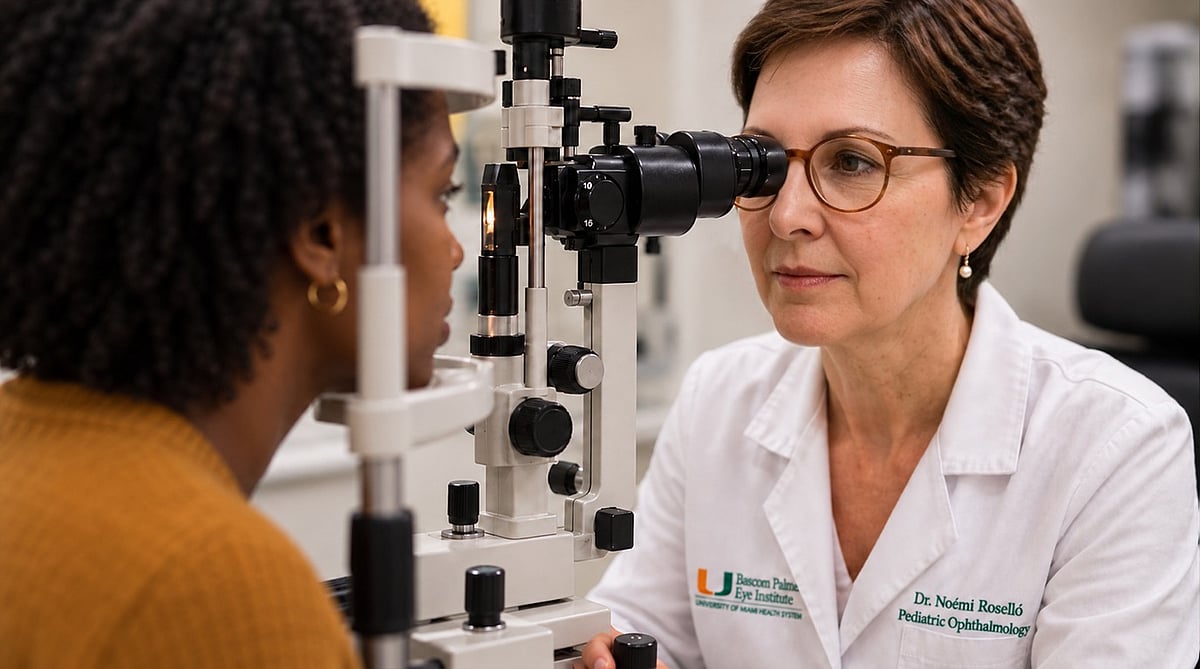
Danna Jordan was 10 years old and playing with her brother when an object pierced her right eye. Surgeons repaired her cornea (the clear front window of the eye) and replaced the damaged natural lens with an implant.
The eye was saved, but a scar remained on the lower cornea. Eighteen years later, the 28-year-old from Los Angeles could see only 20/400 with that eye, even with glasses - roughly the large letter at the top of an eye chart. For eight years, the eye had also been drifting outward, a condition called exotropia.
Danna had long understood that the poor vision was due to amblyopia, or lazy eye (when the brain favors the stronger eye), and was unlikely to improve. She sought specialist advice hoping her eye alignment, at least, could be corrected.
A diagnosis worth reconsidering
When Dr. Noémi Roselló, MD, pediatric ophthalmology and strabismus (eye alignment) consultant at Bascom Palmer Eye Institute Abu Dhabi, examined Danna, the findings suggested the eye might see far better than thought. The injury had occurred at age 10, when visual development was already well established. The scar sat low on the cornea, leaving her central line of sight relatively clear, and the back of the eye showed nothing to explain such poor vision.
"Before considering strabismus surgery, I felt we first needed to understand how much vision this eye was actually capable of," said Dr. Roselló. "The findings did not fully explain a visual acuity of 20/400, and I believed there was reason to look for a better optical correction."
A lens fitted to one eye
The scar had caused irregular astigmatism, an uneven front surface of the eye, which glasses cannot adequately correct. The team recommended a rigid gas permeable (RGP) contact lens, custom-fitted to the eye. A thin layer of tears fills the space between lens and scar, giving light a smooth new surface to pass through.
"Fitting a rigid lens on a scarred cornea takes precise measurement and patience," said Sarah Atallah, optometrist at the institute. "Seeing Danna read the 20/20 line with her right eye was the result we had worked toward."
The result surprised Danna herself: the eye now sees 20/20 (normal sharp vision).
"Discovering that this eye could actually achieve 20/20 vision completely changed the perspective of the case," said Dr. Roselló.
Her eye alignment will be reassessed after visual rehabilitation, before deciding whether the exotropia needs further treatment.
Seeing more of the world
Danna no longer wears glasses. She says she now notices and appreciates the natural world around her more than ever before.
"Danna's case shows that the right first step is not always surgery," said Zain Kenderian MD, MBA, MStJ - CEO, Bascom Palmer Eye Institute Abu Dhabi.
"As part of America's No. 1 eye institute, operating under the oversight of the Department of Health - Abu Dhabi, our role is to bring a full specialist team to each case: surgeons, optometrists and the judgment to choose the least invasive option that works. Anyone with an old eye injury should have it reassessed, as there may be options they are not aware of."
Sign up for the Daily Briefing
Get the latest news and updates straight to your inbox
Network Links
GN StoreDownload our app
© Al Nisr Publishing LLC 2026. All rights reserved.