Bilateral trade soars as Indonesia and UAE strengthen economic ties
Stronger trade ties, export opportunities and economic collaboration between both nations
As bilateral trade accelerates, ITPC Dubai champions stronger commercial ties, new export opportunities and deeper economic collaboration between both nations
When Indonesia and the UAE established diplomatic relations in 1976, their friendship rested on shared faith, culture, and a common outlook on regional stability. Half a century later, commerce has become one of the most dynamic pillars of that partnership — and the past three years have been the most transformative yet.
The turning point came when the Indonesia–UAE Comprehensive Economic Partnership Agreement (IUAE-CEPA) entered into force on September 1, 2023, as Indonesia’s first comprehensive economic partnership with any country in the Middle East and Africa. Signed in July 2022, the agreement removes or reduces tariffs on most goods traded between the two economies, and both governments aim to lift bilateral trade to $10 billion within five years.
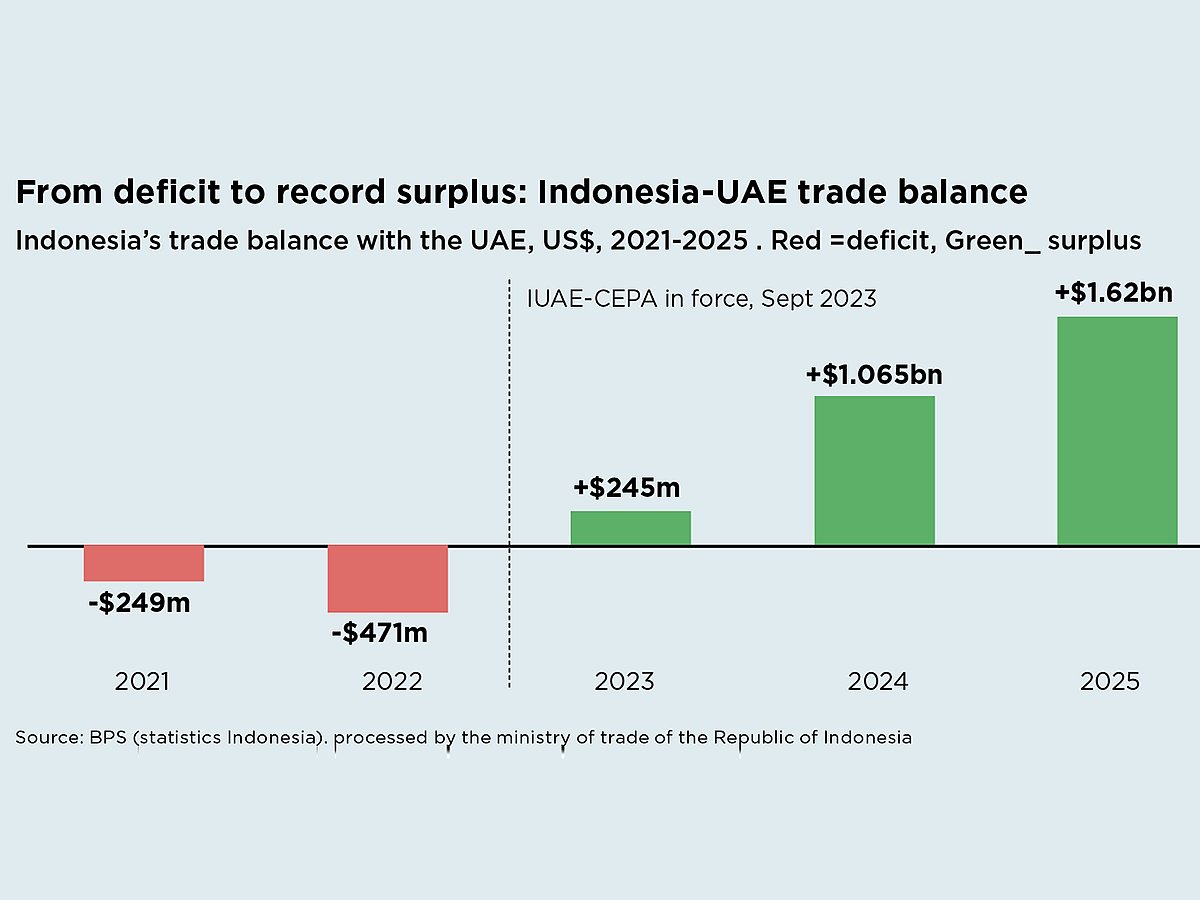
Indonesian exports to the UAE rose from $2.30 billion in 2022 to $4.03 billion in 2025, up 75 per cent in three years. Growth of 31.4 per cent in 2025 alone was the fastest annual pace in recent years, and total two-way trade reached about $6.4 billion. Over the same period, Indonesia’s trade balance with the UAE swung from a $471 million deficit to a record $1.62 billion surplus.
Beyond commodities
CEPA is also changing what Indonesia sells. Jewellery remains the anchor: Indonesia shipped $1.02 billion of it to the UAE in 2025, about 5 per cent of the UAE’s $19.7 billion jewellery imports, and it still made up 27 per cent of Indonesian exports to the UAE in January–July 2026. Palm oil follows at 12 per cent, worth $244 million in the first seven months of 2026, up 7 per cent on a year earlier.
The mix keeps broadening. Semi-finished steel, absent before 2025, reached $202 million that year and has held steady in 2026, while aluminium oxide climbed to $145 million in 2025. In January–July 2026, shipments of smartphones doubled to $138 million, electrical control panels jumped from almost nothing to $92 million, and footwear and seamless steel pipes grew by 20–24 per cent — evidence that tariff preferences are opening doors for Indonesian manufacturing, not just raw materials.
The headroom remains large: Indonesia supplies only about 1 per cent of the UAE’s $378 billion import market, even though it was the fastest-growing of the UAE’s top 25 suppliers in 2025.
Four decades of opening doors
Behind these numbers stands the Indonesian Trade Promotion Center (ITPC) Dubai, the export promotion office of Indonesia’s Ministry of Trade in the UAE. Established in 1985, it has accompanied the relationship for more than 40 of its 50 years, growing alongside Dubai itself as the city became the region’s trading gateway. Operating under the Directorate General of National Export Development and alongside the Indonesian Embassy in Abu Dhabi and the Consulate General in Dubai, ITPC Dubai is often the first point of contact for UAE companies looking to source from Indonesia, and for Indonesian exporters entering the Gulf.
ITPC Dubai is a network of trade promotion offices that supports Indonesian businesses in entering and developing foreign markets. As an extension of the Ministry of Trade and its network of trade representatives, the ITPC provides market information, product promotion, market intelligence, business matching, and exhibition facilitation services. Its role has evolved with the partnership. National pavilions at Gulfood, ISM Middle East, Beautyworld Middle East, Index, Automechanika and other Dubai trade shows remain the entry point, but the office now judges itself on what happens after the handshake, through three pillars.
Market penetration. ITPC Dubai publishes regular market intelligence on demand trends, prices, competitors and UAE regulatory requirements so that Indonesian suppliers arrive export-ready. It encourages UAE importers to source directly from Indonesian producers rather than through third-country traders, and helps exporters make full use of CEPA preferences and certificates of origin. Priority goes to categories where UAE demand is large but Indonesia’s share is still small, such as furniture, cosmetics and fragrances, footwear, seafood and motorcycles.
Buyer conversion. Instead of counting contacts, the office concentrates on turning introductions into orders. Business-matching sessions, online and in person, are arranged only when a genuine fit between a buyer’s needs and a supplier’s capability has been identified. Buyers are screened in advance, and ITPC follows up after each meeting through samples, contracts and repeat orders.
Each year it also leads a UAE buyer delegation to Trade Expo Indonesia; more than 150 UAE buyers registered for the 2026 edition, held on October 14–18, where Indonesia–UAE MoU agreements are scheduled to be signed.
Market diversification. Using the UAE as a regional hub, ITPC Dubai helps Indonesian products reach re-export markets in the wider GCC, Africa and South Asia, while broadening the export base into processed food, home living, beauty and wellness, and industrial goods. It also guides Indonesian firms setting up companies or distribution points in the UAE, and offers facilitation when commercial disputes arise.
For UAE businesses, the office offers a government-backed gateway to Indonesian supply: sourcing inquiries are matched with verified Indonesian producers, samples and product information can be arranged, and buyers can reach Indonesian exporters directly through the Ministry of Trade’s export platform, inaexport.id.
As the partnership enters its next 50 years, the ambition is clear: to make Indonesia not just a supplier the UAE buys from, but a production partner it builds with, from food security to manufacturing and the green economy.
Indonesia–UAE trade at a glance
ITPC Dubai: established 1985, Ministry of Trade of the Republic of Indonesia
IUAE-CEPA: signed July 1, 2022; in force September 1, 2023
Indonesian exports to UAE: $2.30bn (2022) → $4.03bn (2025), +75 per cent
Trade balance (Indonesia): –$471m (2022) → +$1.62bn (2025)
Total two-way trade, 2025: ~$6.4bn; exports up 31.4 per cent on 2024
Leading exports, Jan–Jul 2026: jewellery (27 per cent), palm oil (12%), motor vehicles (7 per cent), smartphones (7 per cent)
Indonesia’s share of UAE imports: ~1.1% (rank 22), fastest-growing of top 25 suppliers in 2025
Sources: BPS (Statistics Indonesia), processed by the Ministry of Trade of the Republic of Indonesia (data to July 2026); ITC Trade Map.
Sign up for the Daily Briefing
Get the latest news and updates straight to your inbox
Network Links
GN StoreDownload our app
© Al Nisr Publishing LLC 2026. All rights reserved.