Vice-like grip of a deadly habit
Peer pressure and easy availability have led to growing drug addiction in the Middle East
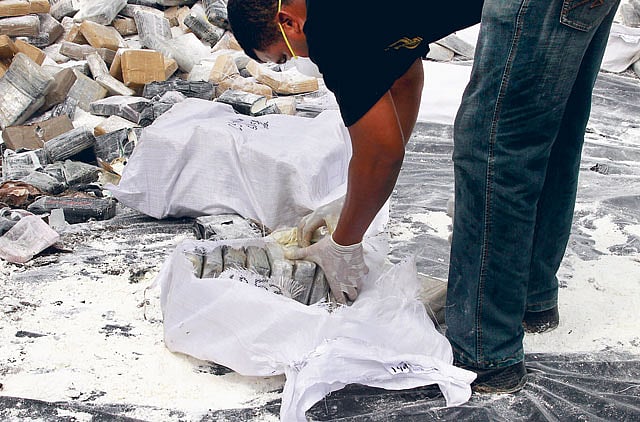
Actually, reality is not as it appears in many television dramas, including the Arabic ones.
Addiction never starts with drug abuse when a person is in grief. It is simply initiated by a desire to feel good, out of curiosity or as a result of friends' influence.
"No, no, no. It is not like the films [show]," prominent Arab psychiatrist Walid Sarhan said, referring to TV series and films which show that people start taking prescribed and illicit drugs, including sedatives, tranquillisers or even heroin and marijuana, to overcome suffering and sadness. Later, they become hooked on drugs.
In reality, Sarhan said "young people try it [first] to feel good".
But a more serious and complicated problem starts to surface at a later stage. Then, it becomes more difficult for drug addicts to retreat.
Just for fun
"Ninety-nine per cent of the addicts take drugs because they want to maximise enjoyment and happiness. This is why people start taking drugs," said Sarhan, who has been treating drug addicts in Jordan since the early 1980s.
Contrary to the commonly held opinion in many Arab societies, many narcotics abusers and drug addicts have never travelled to the West. They picked up the habit locally.
Middle Eastern countries are considered the "corridor" for the transfer of drugs from producers and consumers.
These countries are also witnessing an increase in drug addicts and drug dealers.
According to a recent report on Al Jazeera English television, a Jordanian rehabilitation centre treats nearly 400 addicts a year. There are several rehabilitation centres for drug addicts in Jordan. One of them is run by the Public Security Department's (PSD) anti-narcotics section.
Besides the desire to get a high, other factors such as friends' influence and peer pressure can't be ignored. Some "want to show they're having fun like their drug-taking friends. So they [also] abuse drugs," an observer said. At the same time, some drug abusers want to have more "clients", such as 27-year-old Jordanian B.Z., who encouraged his friends to follow.
He was quoted as saying: "I unfortunately had a role in getting several of my male and female friends to start abusing drugs and get addicted.
"I was trying to get closer to my drug dealer by bringing him new clients."
B.Z. is now under treatment at the Addiction Treatment Centre in Amman, which is run by the Anti-Narcotics Department, for heroin abuse over the past five years.
The centre has treated 2,670 addiction cases so far, its director, Major Mazen Qublan, said. Heroin addicts constitute the majority of patients admitted to the centre. There are 1,255 such cases while there are 451 hashish-addiction cases. Others include 12 cocaine cases, 781 drug and prescription-drug users and 170 cases of other drug and substance abuse.
According to Qublan, 50 per cent of the addicts who receive treatment return to the habit after they leave the centre and 65.6 per cent of them return to drugs under the influence of their friends.
B.Z. has repeatedly returned to drugs after several periods of treatment in Jordan and overseas because drugs are easy to get, he said in a story posted on the Ammon News website run from the Jordanian capital.
"They [drugs] are readily available in the region and among my friends, and this leads to widespread abuse and addiction."
Experts believe that there are many reasons why people who start the habit get stuck on drugs and don't know how to pull out. Ignorance is one of them. Another reason, an expert said, is the fear of "facing withdrawal symptoms", especially among those who lost the pleasure from taking drugs but continued with the habit.
However, experts acknowledge difficulties in collecting reliable data on drug addicts in the Middle East. Talking about drugs in public is still a taboo. But not so in private, Sarhan said.
"Such a problem exists and is on the rise. … If you open the subject with any ordinary citizen, you will get an answer. Citizens know. They see and they hear."
Other challenges for combating drug abuse in the Middle East and North Africa region is "to understand that this region is not an isolated island", according to Matt Nice, an expert on amphetamine-type-stimulant at the United Nations Office on Drugs and Crime (UNODC) in Vienna.
"It is not [only] a Middle Eastern problem. But in fact, a lot of times, the drugs can come from neighbours or from within. [Some drugs] can be made anywhere," Nice said.
Captagon, for instance, is widely circulated in the Middle East, unlike amphetamine, which is not only in circulation in the region but also in South East Asia, North America, Europe and parts of Africa.
Hence, having an open exchange of information about different experiences among different regions would lead to "a more effective response" to the problem.
The need for integration
And for any response to be effective, it needs to be an integrated one, experts stress. "It doesn't help if one country reduces production or another country reduces consumption. It is just fine for that country but it doesn't help on the global level," said Thomas Peitschmann, from the Policy Analysis and Research Branch at UNODC.
If the United States, for instance, reduces cocaine consumption within its borders, this would be a positive development for the US "but it has not really helped the global problem because we end up with more cocaine consumption" in other parts of the world, Peitschmann added.
Information related to drug-demand data is equally important, Nice said.
"To understand the complexities of clandestine drug markets, we need to understand not just the supply — for example, seizures, drug purities and trafficking routes — but also drug demand, including treatment data," he added.
"More drug use in a community leads to increased ‘problematic drug use', which typically results in increased arrests by law enforcement, more admissions into treatment centres, greater hospitalisation and health problems such as increased incidence of blood-borne infections or in the most unfortunate of circumstances, more deaths."
This explains, he stresses, the importance of drug-demand data.
Insufficient treatment for addicts
The World Drug Report 2010 exposes a serious lack of drug-treatment facilities around the world. "While rich people in rich countries can afford treatment, poor people and/or poor countries are facing the greatest health consequences," said UNODC executive director Antonio Maria Costa.
The report estimates that, in 2008, only about a fifth of problem drug users worldwide had received treatment in the past year, which means about 20 million drug-dependent people did not receive treatment. "It is time for universal access to drug treatment," Costa said.
He called for health to be the centrepiece of drug control. "Drug addiction is a treatable health condition, not a life sentence. Drug addicts should be sent to treatment, not to jail. And drug treatment should be part of mainstream health care."
Source: UN report
Sign up for the Daily Briefing
Get the latest news and updates straight to your inbox
Network Links
GN StoreDownload our app
© Al Nisr Publishing LLC 2026. All rights reserved.