Beauty of a people without borders
Hazem Mahdi’s ‘One, Wahed, Yi, Eins, Alpha’ builds on the essence of all humanity to present a compelling argument for unity
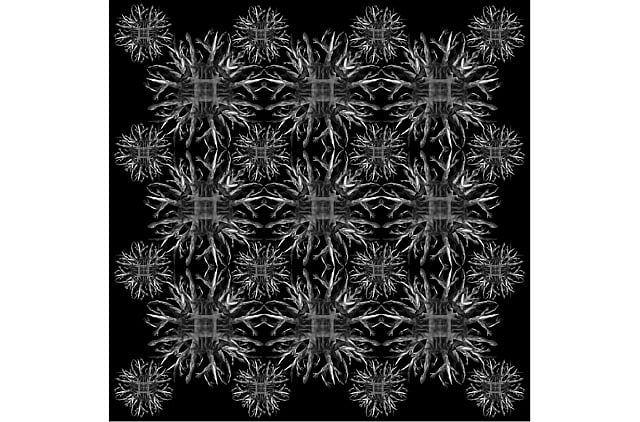
Dubai-based Egyptian artist Hazem Mahdi’s photographic artworks look like beautiful arrangements of snowflakes or grids, composed of repetitive geometric patterns and inspired by traditional Islamic art. But a closer look reveals that the lines and curves in these structures are actually formed by images of the artist’s own body. The work is therefore very personal at its core. But the patterns created by linking the hands in the repeated motifs convey the idea that everybody in the universe is connected and we are all one. In the title of his first solo exhibition, “One, Wahed, Yi, Eins, Alpha”, the artist has brought together different words for “one” to express this idea of oneness.
Mahdi was born and raised in Dubai. His earlier work has been about his struggle to find his identity as an Egyptian who has never lived in his country. But his latest work reflects a shift from personal anxieties to a more universal approach. “This work has been done during a phase in my life when I turned to spirituality to overcome a difficult situation. Prayer and meditation helped me calm down and focus my thoughts. And as I got deeper into it, I felt more and more connected with humanity. One day while I was meditating I saw in my mind the roots of a tree made out of human arms and hands. And they were holding on to other similar roots to form a massive grid of interconnected hands,” he says.
The experience inspired him to try and create a visual representation of that mental picture. In his earlier work Mahdi had used images of himself with typical Egyptian patterns projected on his body. Once again he decided to use photographs of his body to create roots made up of hands. He then played digitally with this unique motif to create different repetitive patterns. He developed the concept further by studying quantum mechanics, traditional Islamic art and also fractal arts, which look at how trees and plants grow in perfect symmetry. He took thousands of photographs of himself to create different motifs made up of his arms, legs and torso. These were then digitally mirrored, repeated, reduced and linked to form a variety of interesting patterns. The artworks are all in black and white, with the play of light intensity adding to the beauty of the patterns.
On the micro level these artworks are all self-portraits. But on the macro level the artist’s body is barely discernible as it merges into the grids. The repetitive patterns have a meditative quality. You can see new shapes in the grids every time you look at time, and you can find different layers of meaning in the forms and their inter-relationships. “The main essence of life is a carbon atom, which grows outwards to create the different forms and shapes around us. So I tried to create almost a carbon form out of my own body and build on it to create a complex pattern. Ultimately, these structures are about unity. Just as all the elements in the grids are interconnected, so also are the souls of all human beings, regardless of the differences in our culture, religion or beliefs. These days people seem to be looking for reasons to break apart rather than stay united. But I want to convey a positive message through my work. The interconnected hands in these artworks are a symbol for reaching out and supporting others and connecting with the universe,” Mahdi says.
“One, Wahed, Yi, Eins, Alpha” will run at Carbon 12 gallery until January 10, 2013.
Box:
The many facets of a woman
Canadian-Iranian artist Nic Nejad ’s first solo exhibition titled “Versions of Her” features a series of large oil and acrylic paintings of feminine faces seen from different angles. The beautiful and serene faces are covered with several lines that emphasise the contours, while at the same time breaking up the images. The main theme of Dubai-based Nejad’s work is the perception of femininity in our society. And he has used the lines to deconstruct and analyse our concept of femininity and the role gender plays in our society.
“In a male-dominated society, a woman’s idea of feminine beauty and her sense of self are often shaped and conditioned by a male perspective rather than her own inner feelings. But our society is changing. In this age of technology, we are all so interconnected that we are losing our individuality and the connection with our intuitive side. As we move towards becoming cyborgs, there will be a change in the role that gender plays in our society and in our perception of femininity. So this show is about looking at femininity as it has been seen in the past, as it is seen today and how it may be perceived in the future,” the artist says.
The series begins with colourful paintings that have strong, dominant lines on the faces, but gradually moves towards a black-and-white palette with the lines becoming fainter and almost disappearing in some of the canvases. “The lines refer to a deep-rooted tribal-culture element in our society and the colours signify emotions and the innate instinctive side of a person’s personality. They direct the eye on a journey along the face, inviting viewers to deconstruct and analyse the way we see an image and define it as beautiful or feminine. The changing colours and intensity of the line takes us from the past to the present and into the future when humans will be less driven by emotion and intuition and will be more like cyborgs,” Nejad says.
The artist also has on display two videos that question the influence of a male perspective in the hyper-feminine sensual images of the fashion world, and the more masculine look adopted by women in positions of power.
“Versions of Her” will run at 8th Street Studios, Al Quoz, until December 25.
Sign up for the Daily Briefing
Get the latest news and updates straight to your inbox
Network Links
GN StoreDownload our app
© Al Nisr Publishing LLC 2026. All rights reserved.