Artificial Intelligence will transform our planet
It is likely to pose fundamental questions to officials and experts in future studies
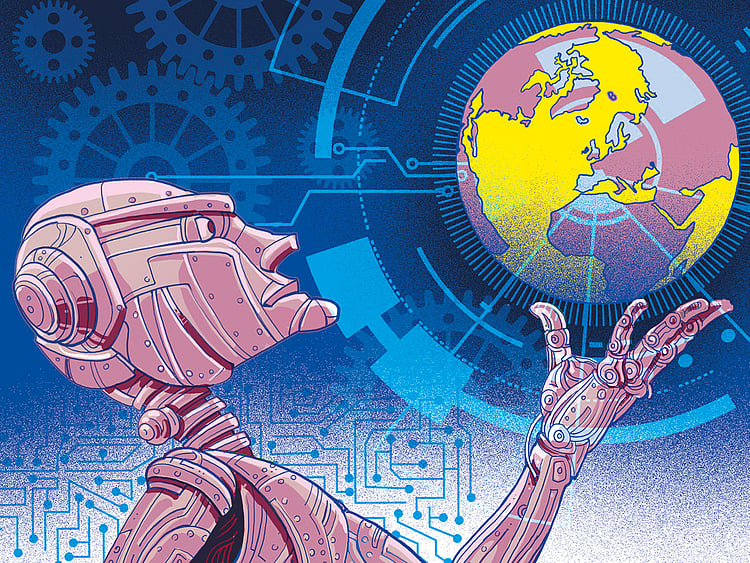
It is agreed that Artificial Intelligence (AI) is the hurricane or tsunami that would transform our planet, impacting all fields and questioning the decades-long commonly accepted facts. In this regard, the political sphere is not exempt from the impacts of AI in terms of interstate relations in terms of balance and interaction of international relations, the level of domestic policies, the mechanisms to make and implement policies, and the active players in them.
The impact AI has on domestic policies has positive and negative aspects. Explaining them requires large-scale and in-depth studies; however, I will try to briefly outline them.
1. AI technology allows ordinary citizens to play a greater role to impact public policy, as it provides them with big data and permits them to oversee the government action more effectively, unveiling all forms of corruption or wrongdoing. Moreover, this allows for further pressure on governments through what we may call Cyber Mobilisation, due to the considerable potentials of cyber platforms that have increasingly become, because of technological advances in communications, more difficult for governments to ban or control. This means that the role of institutions that traditionally echo and defend people’s interests and concerns, such as political parties, parliaments, and civil societies, would gradually diminish, as citizens have acquired, thanks to modern technology and primarily AI, new tools and mechanisms to express their ideas and defend their own interests.
In the same context, AI consolidates the concept of Open Government, which means increasing the dissemination of information and enhancing the principles of transparency, which allows people to learn more about government action and to contribute to drawing plans and strategies by taking into account their thoughts, suggestions, and opinions before the adoption of these plans and strategies. The open government concept, adopted by the International Monetary Fund (IMF) and the Organisation for Economic Co-operation and Development (OECD) among others, has gained remarkable international attention, mainly in the context of efforts to fight corruption and ensure financial transparency. The Global Open Data Index, annually issued by the non-profit UK-based Open Knowledge International, ranks countries in terms of public access to different government data. The substantial technological advances, mainly in AI, permit individuals’ access to greater amounts of information, some of which are credible while some others are baseless, allowing them to exert more pressure on governments in light of the information at hand. Therefore, governments are required to be more open to people and share information with them, at least to counter disinformation obtained from other sources.
2. AI may provide significant support to decision-makers. First, it allows them to thoroughly and precisely examine any amount of information within a short time frame, thus understand them more deeply and comprehensively.
Second, AI allows decision-makers to learn more about people’s thoughts and tendencies analyse them, and predict their future trends by examining people’s activities in social media platforms and online search engines, or even through their hobbies, lifestyles, readings, or the music they listen to. Therefore, decision-makers can reach quick and precise results, allowing them to make decisions based on accurate knowledge of people’s orientations.
Third, AI significantly allows decision-makers to expect the future course of events nationally, regionally, and internationally, by utilising specialised programmes; therefore, helping them to make the right decision in terms of domestic and foreign policies.
Fourth, studies indicate that robots can autonomously make decisions in light of the information they receive, which gives decision-makers a wide range of options to address any emerging issue or crisis. China has actually begun to benefit from AI in decision-making, relying on the major advances reached by AI in strategic games, such as the game of chess in which robots outperform humans.
Fifth, AI helps decision-makers to easily and effectively deliver their message to the public regarding any issue, by resorting to techniques that would rapidly deliver the message taking into account the target’s educational level, social status, and field of work. This resolves the issue of communication between leadership and the public, which still persists in certain countries and societies.
3. AI technology facilitates the tasks of leaders and officials, because it provides them with programmes and techniques that would allow for following-up and monitoring work process, as well as spotting defects, in order to accurately and rapidly address them, which is not possible with traditional mechanisms including periodical meetings and field visits. This technology permits governments to save considerable time, effort, and money.
4. AI technology actually serves decision-makers and facilitates government action; however, it paves the way for new competitors and entities capable of impacting the policy-making processes, primarily technology firms that possess AI techniques. Such firms, local or foreign, would have significant influence on economic, political, and security arenas, and would intervene in public affairs. Certainly the influence of foreign companies would be more dangerous, since sovereignty and national interests would be threatened. The situation would be riskier if those companies are exploited by the countries to which they belong in order to leverage greater impact on policies and decisions, compared to that exerted by multinational companies.
5. Nevertheless, AI leads to the emergence of sources of threats and tension that would jeopardise internal stability, and thus exert further pressure on governments. Jobs’ automation has increased due to AI, abandoning human workers, in variant degrees, for the sake of machines, which would cause unemployment and consequently lead to serious security and social tensions. AI creates new job opportunities, yet they require human resources with highly advanced competencies, which is not possible in many societies, mainly those in the developing and poor countries. Moreover, this entails huge funds to upgrade the current human resources and qualify them to meet the new requirements. AI also contributes to the increasing threat of breaching national security. Communications revolution has led to the intrusion on countries’ sovereignty, in its traditional sense; however, AI, in light of the huge possibilities it offers to conduct spying and influence activities in various ways, is exacerbating that intrusion, especially against countries that lack such techniques.
Further, there are three aspects of AI’s impact on international policy to shed light on. First is the impact on the balance of global powers, including features and characteristics of these powers. Possessing AI along with its sophisticated techniques, countries gain substantial power and ability to impact the world and dominate it at all political, economic, military, and security levels. The Russian president, Vladimir Putin, points out that, “The one who becomes the leader in this sphere [that of AI] will be the ruler of the world.” This probably would establish a new power balance in the world, especially as several world powers, primarily China, Russia, and the USA, invest heavily in this area. Therefore, experts believe that the world, in the upcoming period, will be ruled by those who own AI technology, rather than those who possess nuclear weapons. In light of this, it is no surprise that the huge funds allocated for AI worldwide exceed the expenditures on oil explorations, as indicated in the UAE Ministry of Economy’s 2018 report on Artificial Intelligence in the UAE.
Second, world conflicts would be more probable, since rivalry between major world powers over AI would seriously intensify conflicts among them. The French Institute for International and Strategic Affairs (IRIS) warned in November 2017 that global rivalry over AI would lead to a Third World war. This can be noticed clearly in terms of the competition between the USA and China, as the latter plans to top the ranks of AI worldwide in a few years. In this regard, China announced, on January 1, 2018, its intention to invest more than $2 billion (Dh7.34 billion) to build a huge compound to host around 400 companies specialised in AI, which raises concerns of the USA and threatens its leadership of the world. This also would trigger conflict between the two countries, mainly as Washington has launched numerous AI programmes focusing on the military field.
Third, AI technology would deepen global imbalance among advanced countries and the rest of the world, because it provides the advanced world with greater potentials to penetrate developing or poor countries, undermine their sovereignty, and impose foreign hegemony on them, through AI programs that offer wider access to information and espionage capabilities, thus influencing people’s thoughts and orientations. Furthermore, this would substantially widen the existing gap between advanced countries and the rest of the world, which would create tension between countries and people and undermine peace in the world.
Regardless of the magnitude, course, and nature of the impact of AI technology on domestic and foreign policies in the upcoming period, it is certain this technology poses many fundamental questions to political officials, experts, strategic thinkers, and those specialised in futures studies, national security, and political science, in general:
1. How does AI impact the concept of national security? Are the methods, approaches, and notions that have shaped our understanding of this concept over years still relevant in the age of AI, despite the changes in the nature of threats and risks, as well as their sources and the ways to tackle them?
2. How can sovereignty be defined in light of AI? Can this concept maintain its current significance and meaning? How far can it undergo changes? How can it be addressed without undermining the best interests of the country?
3. How can AI impact diplomacy? Will diplomatic action be conducted in the same traditional way, without altering its mechanisms and tasks, or will AI impose new mechanisms, tools, notions, and tasks that require different skills, and provide new trainings for diplomats to reshape the diplomatic action’s nature and tasks?
4. In order to stay abreast with the huge advances triggered by AI technology, will colleges, institutes, and academies concerned with political science and national security change their curricula and instructional tools?
5. Will parliaments, political parties, and civil societies keep current methods to ensure their functioning and target-setting, or has it become necessary for them to comprehensively reconsider their working mechanisms and philosophy, so that they can continuously play their role in promoting and defending people’s interests, as AI technology has provided individuals with alternative mechanisms to express their interests?
The UAE is one of the pioneering countries in the Arab region and the Middle East in terms of emphasis on AI, as manifested in the adoption of UAE Strategy for Artificial Intelligence and the creation of Ministry of State for Artificial Intelligence. Nevertheless, it is crucial to address this issue, domestically, as a national security issue, because it is linked to the UAE’s future, position in the world, and ability to safeguard its own security and interests. This implies diligent implementation of pertinent programmes, primarily UAE Strategy for Artificial Intelligence, and effective utilisation of Ministry of State for Artificial Intelligence. It is also equally important to continuously and thoroughly examine various aspects for AI development. This would enable setting plans to tackle consequences resulting from such development, harness positive effects, and monitor its various impacts on the international balance of power.
Dr Jamal Sanad Al Suwaidi is a UAE Author and Director-General of the Emirates Centre for Strategic Studies and Research.
Sign up for the Daily Briefing
Get the latest news and updates straight to your inbox
Network Links
GN StoreDownload our app
© Al Nisr Publishing LLC 2026. All rights reserved.