How a sign language can improve your speaking skills
Did you know that some of the popular public signs like Stop, No Smoking and wheelchair access for handicapped drivers are taken from a sign language called Makaton? Roxanne Kavarana Vakharia meets the language’s only UAE-based regional tutor to find out how it can support the development of spoken language in children and adults
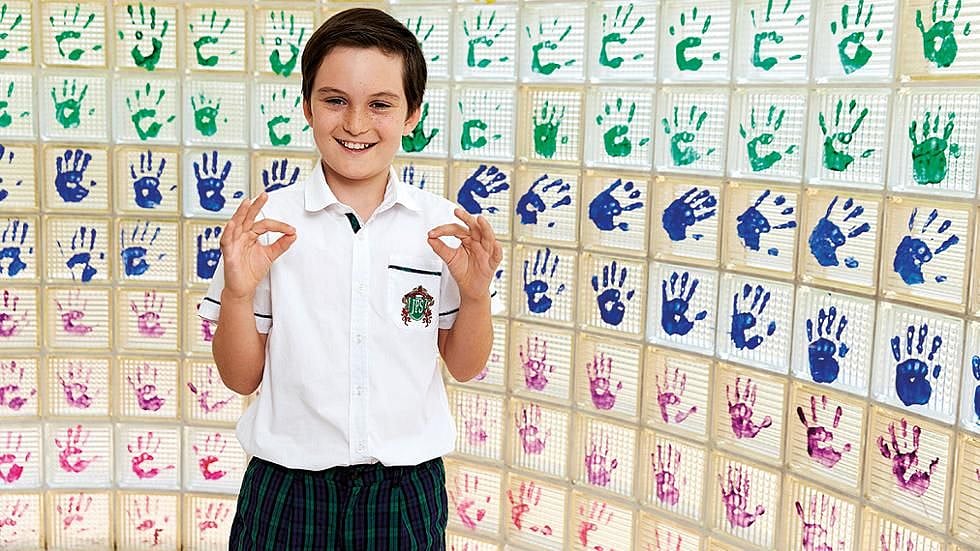
The setting is a Foundation Stage 2 class in a primary school in Dubai. A teacher and a group of children are sitting together. The teacher holds up a book, Mrs Honey’s Hat, makes a peekaboo gesture with her hands and says, “I want you to remember what happened on Monday.” When she comes to the word ‘Monday’, she simultaneously makes a sign with her hands. The kids respond heartily with their peekaboos and reply that on Monday Mrs Honey saw her grandson Peter and they bought bubble gum. The next time the group meets they take up what happens on Tuesday and so on as Mrs Honey does something new with her hat every day.
The location is GEMS Jumeirah Primary School (JPS), the teacher is Malla Medford and the hand sign she uses every time to indicate ‘day’ is from Makaton, a unique sign language system. Malla is Makaton’s only UAE-based regional tutor and JPS is the country’s first and only Makaton-friendly school. Having seen the benefits they have reaped in the school in a short time, the school authorities are now eager to help spread its practice in other schools here.
The language uses signs (gestures) and/or symbols (pictures), along with speech. It is unique because unlike all other sign languages, a vital component of Makaton is the concurrent usage of speech – it is nothing without the spoken language. And although it employs signs and symbols to help communication, it actually aims to support the development of the spoken language in both children and adults.
Interestingly, many of the public signs that one comes across around town like ‘Stop’, ‘No Smoking’, wheelchair access and parking slots for handicapped drivers have been taken from Makaton. As also the hand gesture one makes to indicate a phone call while telling a friend you will be in touch, and the thumbs up emoji one uses so often to convey ‘good’ or ‘like’ on social media. ‘We are already using Makaton in our daily lives without realising it,’ says Malla. ‘We all use gestures in our daily lives. Research shows that a large percentage of our work is done non-verbally, so that means we are already doing something that is linked to an action. Makaton just formalised and standardised it by giving us a structure.’
Largely utilised by people with learning or communication difficulties, Makaton’s signs are so universal, iconic – and empowering – that its application in an inclusive way with everybody is now increasingly being promoted and encouraged.
‘The idea is to take Makaton forward to all schools and get everyone to use it, not only children of determination. We must make it an inclusive part of our community and society because only when everybody learns it will the people with issues be able to use it, interact with the rest of the world and thereby improve themselves and feel a sense of purpose. We need to condition the environment, not condition a few individuals,’ says Malla, a teaching assistant in the school’s enrichment department, stressing that Makaton is not just for the differently abled.
Devised in the UK in the 1970s, it remains popular there and is extensively prevalent in pre-schools for baby signing groups, in primary schools and the community.
The UK-based Makaton Charity is responsible for developing and sharing the language programme globally; the signs of British Makaton are based on the British Sign Language (BSL), the language of the deaf community. Now with presence in over 40 countries, in the Arab world Makaton is most firmly rooted in Kuwait where it took off more than a quarter century ago. In the UAE - where British Makaton is the norm – it is largely concentrated among people of determination with most people outside the educational field never having any knowledge of it.
A trained mental health nurse-turned-educationist, Malla’s interest in the language was spurred a decade ago in her home town of Northampton, England, where a pre-school child with learning difficulties could successfully communicate thanks to Makaton. When Malla’s family relocated to Dubai eight years ago, she set about getting her Makaton qualifications, which include eight rigorous stages. That accomplished, she was keen to spread her knowledge with the help of the JPS team.
Rachel Higgins, principal and CEO of JPS, observes: ‘After being the first school in Dubai to be awarded the prestigious Makaton Friendly School status in September 2016, we have constantly been striving to ensure the whole school community comes together in learning and using Makaton at JPS. British Makaton is used by some of our children to aid in their communication skills and understanding of their world around them. It helps in promoting good communication, language acquisition and independence.’
Malla explains how she conducts the speaking and listening sessions with the Foundation Stage 2 students with the help of Mrs Honey’s Hat. ‘The aim of the group is speaking and listening; but they are telling a story and I want them to use full sentences. Given their young age, I will only use one Makaton sign, i.e. day, and their objective is to speak and listen to each other.
‘When you use signs, they are very happy to say what Mrs Honey is doing, thus encouraging them to talk. At the FS level, they can’t do much writing but they can express themselves verbally. So if you feel a child may not be able to speak in full sentences, you put a small group together to start generating more vocabulary.’
Malla makes it clear that there is no ambiguity here. ‘People may start to drop the signs or symbols naturally as their speech develops. It was thought earlier that signing would stop people from speaking but research has proved the opposite,’ she says.
The school’s music department is also using Makaton successfully to improve singing skills in children. Last December, Year 1 students of JPS reached out to the special needs pupils of Rashid Centre for The Determined Ones to collaborate on a popular Christmas carol called Christmas Pudding using Makaton signs. The Makaton Charity released one song online every day from different parts of the world for 24 days during Advent. ‘We had to bid for this song…they liked it and we got our chance on the 19th day. It was an acknowledgement of our Makaton success and our larger goal of linking up with society,’ beams Malla.
The school has noticed that Makaton’s magic works in aiding writing too. ‘In pre-reading and writing skills, if the children can read the symbols (picture), they can make a sentence. So if they lack motor skills to write, Makaton can help them do the job.’
She cites an example: ’One of our Learning Support Assistants found that the boy she was assisting wasn’t able to write a particular word. She tried several methods but in vain. So we gave her the Makaton symbol and sign…and now he is writing the word!’
The principal Rachel, agrees. ‘Makaton can be used in so many different platforms. The children in FS2 have been learning to tell stories whilst the whole school enjoyed taking part in the Peace One celebration, which was singing and signing at the same time on World Peace Day. It is a fun and practical tool to engage children and adults in learning and a great way to develop a more tolerant and integrated society – a vision for JPS.’
The word ‘Makaton’ originates from the first letters of the names of three UK speech and language therapists - Margaret Walker, Katharine Johnston and Tony Cornforth – who conceived the language programme. It draws its basics from the recognised sign language of that country, so in the UK it uses the BSL, in the US it is the American Sign Language and so on.
Makaton has a core vocabulary of 450 words and concepts, with the total extending to no less than 11,500 words. How do you master that many? ‘It is not as daunting as it seems. It depends on what you need, so you learn as you go along depending on the subject matter. So I will learn about it and I will teach only the relevant bits to the students or teachers. If you need to say ‘I want my mum’ or ‘I want to go home’, the signs ‘want’, ‘mum’, ‘go’ and ‘home’ can be taught by using the symbols on a choice board or chart.’
A major difference between the various sign languages and Makaton is the syntax, especially the word order. Makaton always uses signs and symbol s in the natural word order of a sentence. Medford simplifies it for us: ‘Let’s take the sentence ‘I am going to work’. In BSL, they will use signs to state ‘Work I go’. In Makaton, I will speak ‘I am going to work’ and simultaneously sign the words in the same order. The signs/symbols are the clues. Isn’t that easier for everyone and also more inclusive?’
She emphasises that the multi-modal approach of Makaton makes it a far simpler channel of interaction than a pure sign language. ‘It accesses everyone when you speak because if I just sit here and sign to you, it would be of no use to you. People with autism probably might not have so much understanding of speech and they might not be able to read but they would have a visual image of things, so they may be able to pull out the symbols and make sense. That’s the beauty of Makaton – it is useful for everyone.’
As the sole regional tutor based in the country, Malla is keen that more people are taught the language so that more schools and society in general can be helped. From her experience she knows that acquiring formal Makaton qualifications is not easy on the pocket. ‘So if you are going to be trained in it, it has to be a community effort with as little cost to the people who are going to help build that structure.’
Towards this end, JPS has now extended the learning to other schools, running training sessions for teachers in GEMS Wellington, GEMS Metropole, JESS, DESS and Victory Heights, as well as working with training centres across Dubai such as Kids First and Sensation Station. ‘These can only help to build stronger relationships and encourage positive learning across our community,’ feels Rachel.
Malla is also keeping an eye on the upcoming unveiling of the first Emirati sign language dictionary, and dreams of adopting His Highness Shaikh Mohammad Bin Rashid Al Maktoum, Prime Minister and Vice President of the UAE and Ruler of Dubai’s three-finger salute as a Makaton sign. ‘That would be fantastic,’ she smiles. The hand gesture portrays a W for Win, a V for Victory and an L for Love.
Sign up for the Daily Briefing
Get the latest news and updates straight to your inbox
Network Links
GN StoreDownload our app
© Al Nisr Publishing LLC 2026. All rights reserved.