At walking speed with Andrew Zimmern
The chef and television host on food, curiosity, and storytelling beyond speed
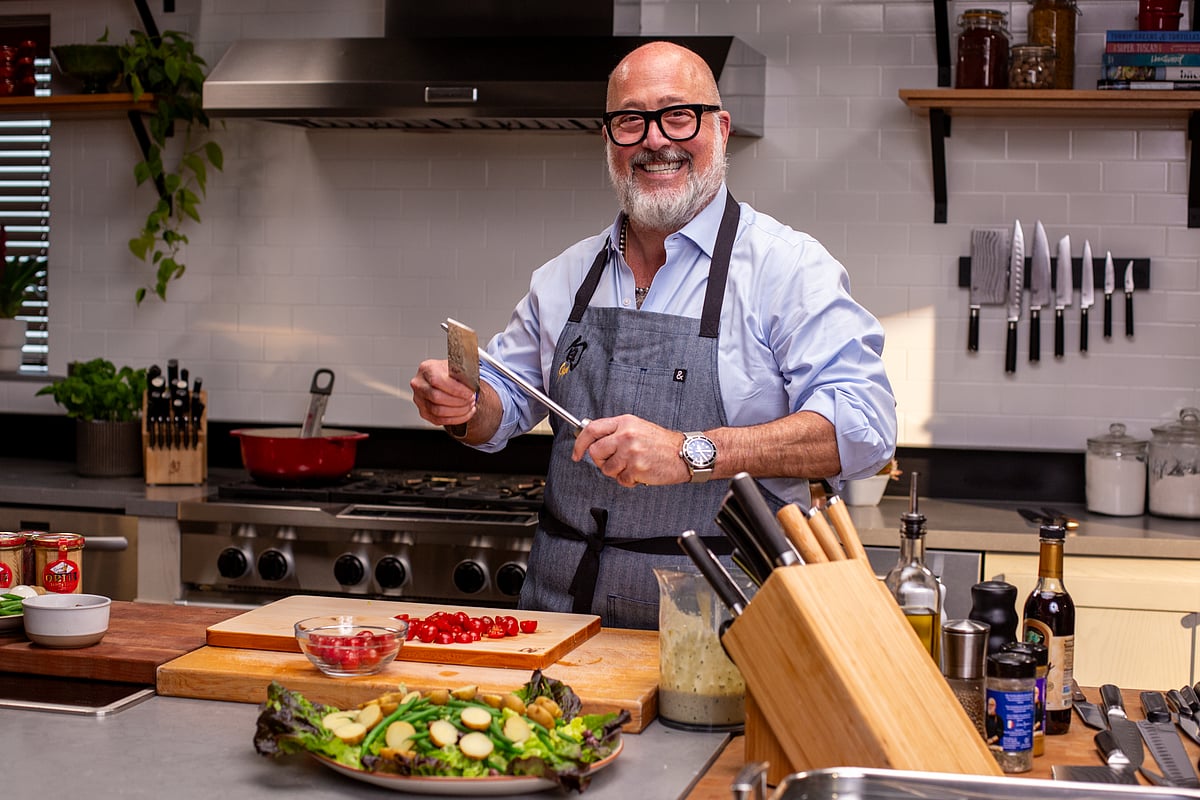
For much of the last three decades, Andrew Zimmern has been framed as television’s great culinary adventurer, the man willing to eat what others would not and travel where most viewers would never go. That reputation, shaped early by Bizarre Foods, has obscured the quieter throughline of his work: a persistent belief that food is one of the last remaining spaces where curiosity, responsibility, and human dignity intersect, provided it is approached with care rather than spectacle.
Curiosity, Zimmern insists, is not a performance. It is not something that can be switched on for a camera or flattened into a personality trait. In the current media ecosystem, he believes it has been hollowed out by speed and certainty. “Curiosity dies when it becomes just a costume, or wallpaper,” he says. What replaces it is confidence without understanding, a condition he sees reinforced by algorithms that reward outrage and certainty because they travel quickly. Curiosity, by contrast, “moves at walking speed”, requiring time, humility, and the willingness to risk being wrong.
Zimmern maintains that posture deliberately. He puts himself, by design, in rooms where he is not the expert. He listens longer than feels comfortable. He asks questions that expose his own ignorance. “I don’t know XYZ, can you explain it to me?” he says, describing a phrase he repeats many times a day. Curiosity, he believes, behaves like a muscle. Without use, it atrophies. Audiences, he adds, are more perceptive than media often gives them credit for. “You cannot fake it for the camera for very long,” he says. “The audience knows when you were collecting experiences versus collecting proof of virtue.”
That distinction matters to Zimmern because he believes food media has reached a point of moral fatigue. The volume is higher than ever. The attention span is shorter. What has been lost, he argues, is meaning. “Speed flattens meaning,” he says, a process he links directly to disinformation and the quiet perpetuation of falsehoods. When stories are engineered for the scroll, context evaporates. People become interchangeable props. “Recipes lose their history. Cooks lose their agency. Places lose their dignity,” he says.
What still justifies slowing down, in his view, is responsibility. Zimmern frames it as a series of questions that rarely survive the pressure to publish quickly: Who benefits from this story. Who is harmed by it. Who gets paid. Slowing down, he believes, creates the conditions necessary for truth to emerge, and truth, unlike virality, does not expire overnight. “The truth has a longer shelf life than virality,” he says.
Zimmern’s conviction that food carries ethical weight has only deepened with time. Having seen it used as both bridge and weapon, he believes its greatest power lies in places where formal systems fail. “Food has the most power where politics fails,” he says. At the table, he argues, people arrive as humans before identities. He points to shared meals in schools, community kitchens, refugee camps, church basements, and fishing docks, spaces where eating becomes an act of mutual dependence rather than performance. “You actually break bread with someone, and you recognize their dignity,” he says. That recognition, he adds, travels further than slogans or policy statements. He is careful not to sentimentalise the idea. When asked where food can heal cultural divides right now, his answer is pointed rather than poetic. It works, he says, “in the places that need it the most.” Food heals because it must. It does so precisely where politics has failed to deliver dignity or stability.
That realism becomes sharper when Zimmern turns to sustainability, a subject he believes has drifted dangerously toward abstraction. The language of ethical eating, he notes, often ignores the conditions under which people actually live. “The uncomfortable truth is that ethical eating without access is simply a luxury conversation,” he says.
Discussions about regenerative systems and carbon footprints ring hollow, he argues, when millions are worried about their next meal. “The moral failure is not people choosing cheap calories,” he says. “The failure is that we have created systems that make good food scarce and expensive.”
Eating well, in his view, has become a class issue. Sustainability narratives that bypass hunger amount to branding, not ethics. “Feeding people is a prerequisite to every other value,” he says.
This recognition underpins Hope in the Water, a project that marks a clear shift in Zimmern’s approach to storytelling. For years, exposure felt sufficient. Show the problem. Trust awareness to spark change. That assumption no longer holds. “We are past the awareness phase,” he says. “People are exhausted and hungry for direction.” What feels urgent now is demonstrating what works and highlighting those already doing effective work without fanfare. Solutions, he believes, create agency. Agency creates hope. Hope alters behaviour.
Zimmern’s evolving perspective has required unlearning as much as learning. Early in his career, he believed authenticity resided in preservation, that food cultures were fragile artifacts to be protected from change. Experience dismantled that belief. “Food cultures survive through adaptation,” he says, listing migration, improvisation, and necessity as forces of continuity rather than erosion. Change, he argues, is not cultural theft. It is how traditions stay alive. The deeper error, he reflects, was assuming the authority to define authenticity for others. “The arrogance was thinking I could define what was real for someone else,” he says.
That humility informs his advocacy for independent restaurants, many of which remain under severe strain. Zimmern dismisses temporary relief and sentiment as inadequate. Structural change matters more. Healthcare and labour stability, he says, are foundational. Independent restaurants are small businesses that carry culture, and they require different support than chains. Tax incentives and financial benefits, particularly in neighbourhoods targeted for investment, can help stabilise them.
He is equally focused on the people these restaurants employ. Independent restaurants, he notes, are often the primary employers of first-time job seekers, last-time job seekers, immigrants, single parents, and returning citizens. These realities, he argues, must be reflected in policy. He supports healthcare tied to individuals rather than jobs, portable benefits, and fair access to credit. “Restaurants fail from structural pressure, not lack of passion,” he says. Removing existential fear allows talent to flourish. He adds a reminder for diners tempted by nostalgia. “Romance does not pay the rent.”
For the next generation of food storytellers, Zimmern sees a bigger burden than his generation. Platforms are larger. Accountability is unavoidable. “The next generation inherits a louder megaphone and a shorter fuse,” he says. Accuracy, attribution, and impact matter more than ever.
Sign up for the Daily Briefing
Get the latest news and updates straight to your inbox
Network Links
GN StoreDownload our app
© Al Nisr Publishing LLC 2026. All rights reserved.