Police and security personnel detain All India Students' Association (AISA) President Neha Bora during a protest against the country's Chief Election Commissioner Gyanesh Kumar in New Delhi on October 3, 2026, to demand his resignation over alleged irregularities in the Special Intensive Revision (SIR) of electoral rolls.
Who is Neha Bora? Meet the 29-year-old Gen Z activist and theatre actress rattling India's political establishment
From theatre to protests: How Neha Bora became a voice for India's restless youth
Last updated:
5 MIN READ
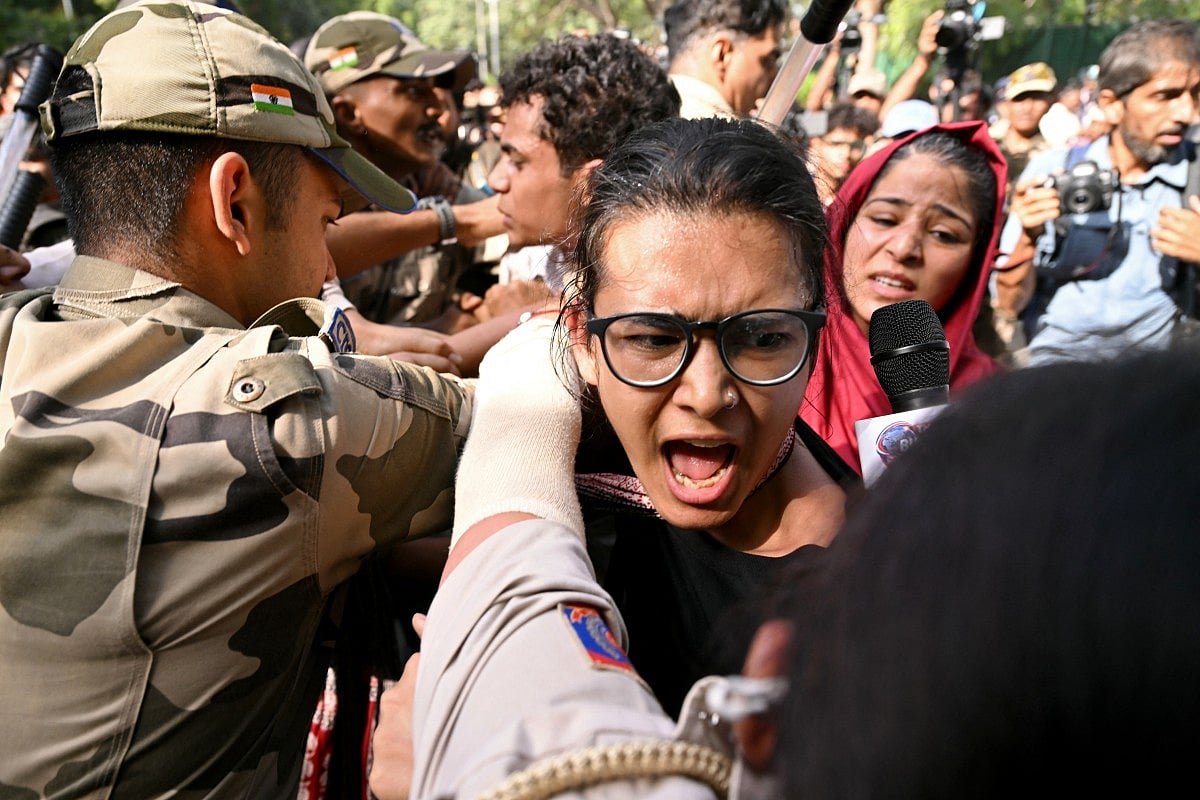
Police and security personnel detain All India Students' Association (AISA) President Neha Bora (C) during a protest against the country's Chief Election Commissioner Gyanesh Kumar in New Delhi on October 3, 2026, to demand his resignation over alleged irregularities in the Special Intensive Revision (SIR) of electoral rolls.
AFP-ARUN SANKAR
She is 29, pursuing a doctorate, and isn't afraid of being bundled into a police van. Meet Neha Bora, the unlikely new face of India's growing youth unrest, who has gone from performing on theatre stages to taking on the country's political establishment.
And she's proving to be a difficult voice to silence. The national president of the left-wing All India Students' Association (AISA) has become one of the most visible faces of a protest movement challenging Prime Minister Narendra Modi's government over everything from unemployment and examination paper leaks to allegations of electoral malpractice.
But here's what makes her story interesting. Bora wasn't always a firebrand student leader. Her political awakening began in theatre, where she learnt to step into other people's shoes, including those she fundamentally disagreed with.
Today, that empathy has evolved into a more confrontational form of activism. Her speeches are fiery, her criticism of the establishment is pointed, and even repeated police detentions haven't kept her away from the streets.
According to Reuters, Bora was among several activists detained in New Delhi on Saturday, October 10, during demonstrations organised by the youth-led Cockroach Janta Party movement.
But even from detention, she had a message for her supporters.
"I am in detention. The movement is not," she declared in a video circulated online.
It's the kind of line that could easily become a rallying cry for a generation increasingly frustrated with the political status quo.
When police blocked the protest, she changed the venue
Saturday's demonstration was supposed to take place at Jantar Mantar, New Delhi's familiar address for public protests.
But when police prevented demonstrators from reaching the venue, Bora simply suggested another meeting point.
"Dilli Haat becomes Jantar Mantar today," she wrote on X, referring to the popular crafts market about 10 kilometres away.
She then set off towards the location, chanting slogans with fellow protesters, before police detained her.
She was released later that day.
The protesters are demanding the resignation of Chief Election Commissioner Gyanesh Kumar, alleging serious irregularities in electoral rolls.
Organisers claim that 130 million voter names have been deleted, an allegation that has intensified their calls for electoral accountability.
The Election Commission has denied favouring any political party, while Modi's Bharatiya Janata Party has accused opposition groups of undermining democratic institutions by casting doubt on legitimate electoral processes.
The claims remain contested, but for Bora and her fellow activists, the protests are about something bigger than electoral lists.
They are also about jobs, opportunities, education and a growing feeling among young Indians that their grievances aren't being heard.
Before the slogans, there was theatre
Interestingly, Bora's journey into activism didn't begin with political rallies or fiery speeches.
It began with acting. Born and raised in the Himalayan state of Uttarakhand, she moved frequently during her childhood because her father served in the Indian Army.
She later studied at Delhi University, where she joined a theatre group as an undergraduate.
And that experience, she told Reuters in an interview this month, changed how she looked at the world.
All India Students' Association (AISA) President Neha Bora (C) shouts slogans next to lawyer and civil rights activist Prashant Bhushan (2R) and politician and advocate Kapil Sibal (R) during a protest against the country's Chief Election Commissioner Gyanesh Kumar in New Delhi on October 3, 2026, to demand his resignation over alleged irregularities in the Special Intensive Revision (SIR) of electoral rolls.
"There might be a character that if you meet in your real life, you will disagree with, you will not like. But to do theatre is to understand where that person comes from."
It's a revealing insight into the young activist. Long before she began questioning the government, she was learning to understand people whose lives and beliefs were vastly different from her own.
Bora is currently pursuing her doctorate at Jawaharlal Nehru University's School of Arts and Aesthetics.
But somewhere between theatre rehearsals, university classrooms and student demonstrations, she found herself drawn into politics.
The moment that turned a student into an activist
The turning point came during the protests against India's controversial citizenship law in 2019 and 2020.
The legislation, which critics argue discriminates against Muslims, triggered widespread demonstrations across university campuses.
For Bora, watching students walk out of classrooms and organise protests was a revelation.
Political debates that she had previously encountered through books, films and documentaries were suddenly unfolding in front of her.
And she wanted to be part of them.
Her involvement in student activism deepened over the following years, eventually taking her to the national leadership of AISA.
By July 2026, Bora was attracting wider attention during demonstrations over alleged examination paper leaks, with protesters demanding the resignation of India's education minister.
Her speeches at Jantar Mantar, where she criticised the government and police handling of demonstrations, began circulating widely online.
Unlike some political leaders who rely on carefully crafted speeches, Bora's appeal appears rooted in her ability to connect everyday student frustrations with larger questions about democracy, inequality and constitutional rights.
She speaks in both Hindi and English, and while she may be soft-spoken in conversation, she's considerably more forceful when addressing a crowd.
Why India's Gen Z is angry
There's a reason why Bora's message is finding an audience.
For many young Indians, the anxieties are painfully familiar: the struggle to find meaningful employment, uncertainty surrounding competitive examinations and questions about whether institutions are accountable to ordinary citizens.
Bora has consistently linked these issues rather than treating them as isolated controversies.
Her activism has also brought her into repeated confrontations with the authorities.
During protests seeking the chief election commissioner's resignation, she was detained several times. Each time, she returned to demonstrations after her release, according to Reuters.
But she doesn't believe anger alone can sustain a movement.
She believes hope is just as contagious.
"Fear is infectious, of course. But hope is also infectious," Bora told Reuters. "People have courage now because they think that they can have courage."
It's perhaps the most telling statement from a young woman who has become a prominent face of India's student protests.
Rather than presenting the movement purely as an expression of outrage, she sees it as a sign that young people are beginning to believe they can make themselves heard.
'People remember'
Bora is also clear that the current protests haven't erupted out of nowhere.
Years of frustration, she argues, have been simmering beneath the surface.
"People remember," she told Reuters. "People carry that discontent, people carry that betrayal, people carry that disappointment."
Whether this wave of youth activism will translate into lasting political change remains to be seen.
But Bora's rise is significant in a country where the political conversation is often dominated by established leaders and familiar faces.
She's young, outspoken and unafraid of confrontation. And her growing visibility suggests that India's student politics is producing a new generation of voices willing to challenge those in power.
For now, the doctoral scholar who once explored human conflict through theatre is finding herself at the centre of a very real political drama.
Only this time, there are no rehearsals, no retakes and certainly no guarantee of a happy ending.
With inputs from Reuters.
Network Links
GN StoreAbout Gulf NewsTerms & ConditionsReach by GNSitemapContact usPrivacy PolicyGN FocusHave your sayWork with usAdvertise with usGulf News epaperPrinting Services
Download our app
© Al Nisr Publishing LLC 2026. All rights reserved.