Michael Jackson exhibit looks back at an icon
The works of 48 artists across numerous media are brought together at the National Portrait Gallery in London
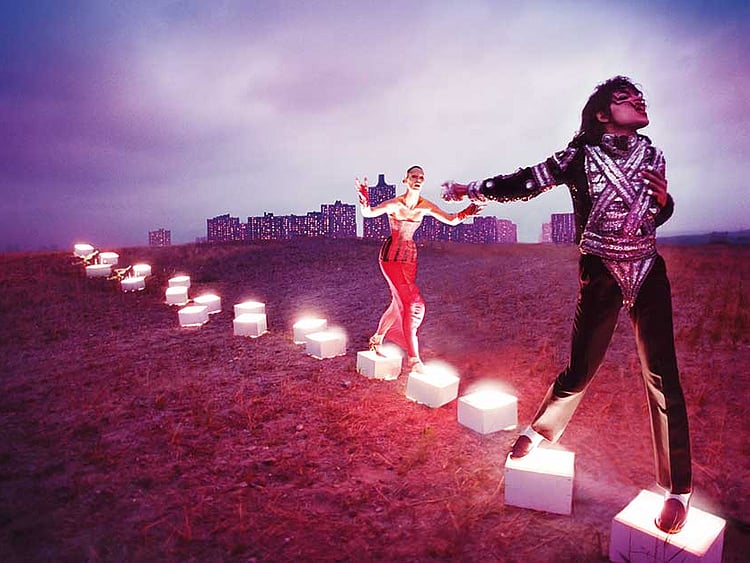
When the world learned of Michael Jackson’s death, from an accidental overdose in 2009, the news had a whiff of unreality about it.
This was in no small part because, for so long, it had been hard to remember that he was actually a person. A child prodigy who in adulthood became a genuine Peter Pan — fantastically refusing to grow old — Jackson was always more an idea than a human being in the flesh. Nearly a decade later, the shape-shifting body frozen in memory, his extraordinary image endures as if he never left.
Now, an ambitious and thought-provoking new exhibition at the National Portrait Gallery in London, running through October 21, seeks to measure the impact and reach of Jackson as muse and cultural artefact.
Michael Jackson: On the Wall, curated by Nicholas Cullinan, sprawls without feeling bloated, occupying 14 rooms and bringing together the work of 48 artists across numerous media, from Andy Warhol’s instantly recognisable silk-screen prints and grainy black-and-white snapshots, to a vast oil painting by Kehinde Wiley. (Jeff Koons’ famous porcelain sculpture Michael Jackson and Bubbles is notably absent, although it is reinterpreted in several other pieces.)
First the obvious: No artwork, however clever or pretty, that has been inspired by a talent the size of Jackson’s can compete with its source material. To get the most out of what this show has to offer it is best to acknowledge this at the entrance and move on, as the most successful pieces do, eschewing strictly aesthetic concerns and exploring instead Jackson’s conceptual possibilities.
Consider for example one of the simplest works in the show, David Hammons’ 2001 installation, Which Mike Do You Want to Be Like... ? The piece — full of wondrous pride even as it conjures a sense of depressing limitation — consists of three abnormally tall microphones and its title recalls the Holy Trinity of late-20th-century black American entertainment icons as set out by the rapper The Notorious B.I.G.: “I excel like Mike, anyone: Tyson, Jordan, Jackson.” (B.I.G.’s own guest feature on Jackson’s 1995 History album marked a crowning achievement in his career.) More than 20 years later, rappers still clamour for a Jackson co-sign.
On Scorpion, his latest chart-topping release, Drake flexed the ultimate status symbol, having purchased the rights to unreleased vocals and scoring a posthumous feature with the King of Pop.
Jackson, more than Tyson or even Jordan, so epitomised black excellence that Ebony magazine could unselfconsciously run an airbrushed image of him on the cover in 2007, his creamy skin and silky cascading hair framing a razor-sharp jawline, beside a headline reading “Inside: The Africa You Don’t Know.”
A year after the singer’s death, Lyle Ashton Harris recreated that image on Ghanaian funerary fabric. It’s jarring to compare the real late-life M.J. with another imaginary iteration that Hank Willis Thomas appropriates in one of the show’s more shocking offerings, Time Can Be a Villain or a Friend (1984/2009).
In this, we see an uncannily convincing, and wholesomely handsome, rendition of Jackson with his natural skin tone, a pencil-thin moustache on his lip and an ever-so-lightly relaxed puff of hair on his head.
Thomas explains in the catalogue that it is simply an artist’s rendering from a 1984 issue of Ebony, a glimpse of what the magazine imagined Jackson would look like in the year 2000. Without any alteration, it is by far On the Wall’s most critical work — the image originally so full of pride and hope is now an indictment and haunts the show like a scathing rebuke.
The man who wrote We Are the World and Liberian Girl, and proudly recreated Egyptian splendour in Remember the Time, had an idealistic and expansive view of our common humanity. His androgyny, too, helped shatter restrictive notions of black masculinity.
___
Michael Jackson: On the Wall is on through October 21 at the National Portrait Gallery, London.
Sign up for the Daily Briefing
Get the latest news and updates straight to your inbox
Network Links
GN StoreDownload our app
© Al Nisr Publishing LLC 2026. All rights reserved.