Michael Schumacher's wife Corinna tells 1994 F1 title story in Netflix film: 'My heart is with him when he wins, and when he loses'
Corinna is the recurring narrator, offering anecdotes and personal insight into Michael
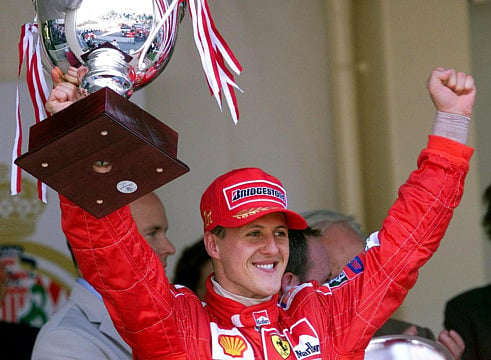
Most portraits of Michael Schumacher try to cover the whole sweep: the seven titles, the Ferrari years, the records. Netflix's new film goes the other way, narrowing in on a single year. Rather than retelling his entire career, it concentrates on the twelve months that took a 25-year-old and made him a Formula 1 world champion.
Who made it, and who speaks
The German-language feature was directed by Christin Freitag and produced by LEONINE Documentaries. Schumacher's longtime manager Sabine Kehm and Netflix co-producer Janek Romero have said the project was made with the full support of the Schumacher family.
At its centre is Corinna Schumacher. She acts as a recurring narrator, offering anecdotes and personal insight into Michael both as a driver and as a man. She also speaks about how her relationship with Michael began. Around her are figures who were inside that season: former Benetton team principal Flavio Briatore, former F1 chief executive Bernie Ecclestone, former manager Willi Weber, ex-driver David Coulthard, and German broadcasters Kai Ebel and Heiko Waßer. The film also promises footage that has never been shown before.
Netflix has billed it as a granular, in-depth look at the year that changed everything in the sport. Kehm's own summary is simpler: for her, it is ultimately a story with a happy ending.
The season itself
The 1994 championship ran over sixteen races, from 27 March to 13 November. Schumacher, driving for Benetton, opened the year with wins in Brazil and at the Pacific Grand Prix in Aida, Japan.
Then came Imola. Rubens Barrichello survived a heavy crash on the Friday. Roland Ratzenberger was killed in qualifying the next day. Ayrton Senna died in the race on May 1, a race Schumacher went on to win. In the film, his former manager Willi Weber recalls that the weekend left Schumacher saying he no longer wanted to race.
From mid-season, the year was dominated by stewards and courtrooms. At Silverstone, Schumacher passed Damon Hill on the formation lap and was given a five-second stop-go penalty. He then did not respond to the black flag, which was shown on three consecutive laps. He later said he had not seen it. He was disqualified from second place, and the World Motor Sport Council later raised the punishment to a $500,000 fine for Benetton and a two-race ban for Schumacher. He appealed, which allowed him to race at home in Germany. His engine failed there while he was running second.
At Spa he crossed the line first but was disqualified anyway: scrutineers found the wooden plank under his Benetton had worn too thin. With Schumacher banned from Italy and Portugal, Hill won both races and closed to within a point for the first time. Over all of this hung suspicion about the car: Benetton faced allegations of running illegal traction control, a thread the film is expected to address.
Adelaide
The title came down to the final race. Schumacher arrived in Adelaide on 92 points to Hill's 91. On lap 35 Schumacher went off at East Terrace and hit the wall. Hill dived inside him at the next corner, and the two cars made contact as Schumacher turned in. Hill got back to the pits, but his front suspension was too badly damaged to continue, so Schumacher won the title by a single point. Many in the paddock blamed Schumacher for the collision.
Why it matters now
The film also follows how Schumacher coped with media attention and pressure as his success made him famous worldwide. It is a familiar theme from a new angle. It follows Netflix's 2021 documentary Schumacher, but with a much tighter focus. Schumacher himself has not been seen in public since his skiing accident in the French Alps in late 2013. That makes this, in large part, his family telling the story of the year it all started.
Sign up for the Daily Briefing
Get the latest news and updates straight to your inbox
Network Links
GN StoreDownload our app
© Al Nisr Publishing LLC 2026. All rights reserved.